

Breaking News
If you haven’t heard, there is sad news and a brewing crisis in the HamClock realm.
The crisis is an end-of-life notice for HamClock. My guess is the software “phones home” to do things like DX spotting and that system (translation: that server) is going to go dark. But that is a guess on my part. You might find more information in an active Reddit conversation by the time this issue publishes.
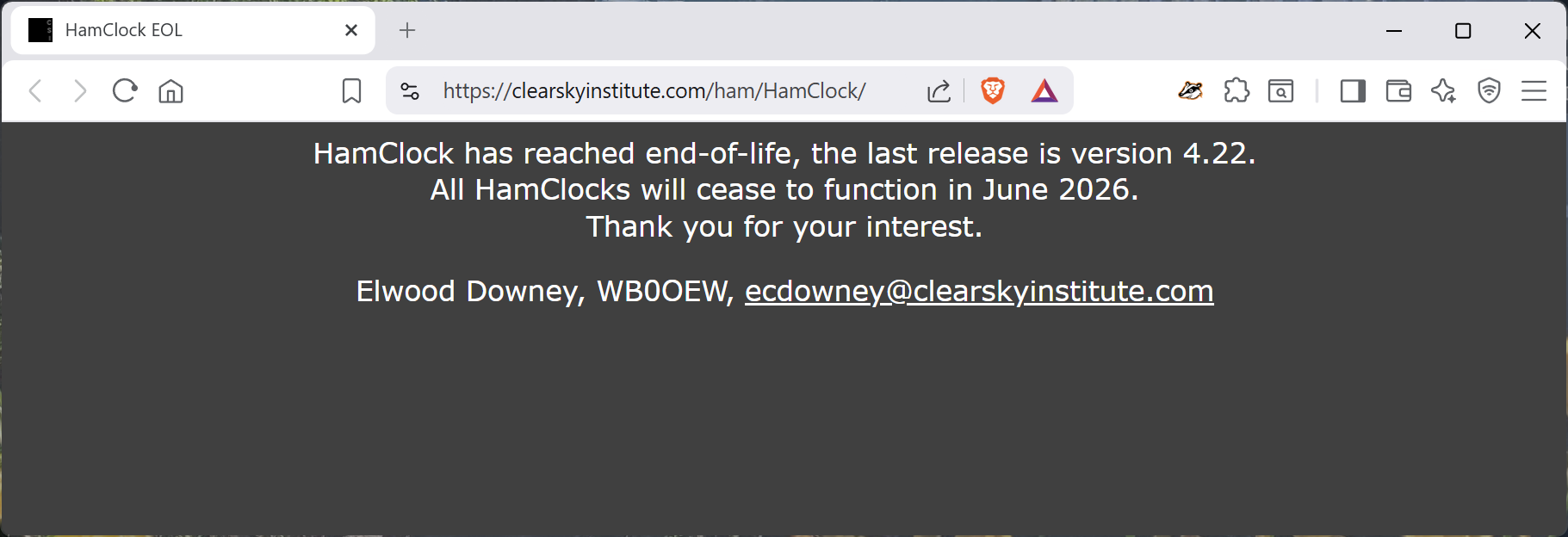
The sad news is — and I don’t have independent confirmation, but from all I hear, this is true — Elwood Downey WB0OEW has become a silent key. At this point, I just don’t know what to make of this.
HamClock availability and alternatives
As I write this, I see that the HamClock bundle is still shown for sale on the N0LSR store. This is, of course, the hardware layer. It’s worth watching that space.
Meanwhile, you might be interested in evaluating the Gray Line HamClock available through the Gray Line HamClock Users Group on Facebook. This has a 21-day free trial before payment is required. For those interested in a possible alternative to the HamClock software package, you may wish to follow this interesting GitHub project: https://github.com/Aaediwen/AaediHAM. Simon’s World Map is also a contender for a HamClock that runs on Windows 7, 8, 10, and 11: https://www.sdr-radio.com/world-map.
You might also want to take a look at Ham Dashboard. The demo site is at https://va3hdl.github.io/hamdash/
I’m sure there are many other projects underway or soon to be starting to find a solid replace for HamClock. Of course, there is always the venerable GeoChron!
Elwood Downey will be missed
The followed was pulled from multiple sources. I hope it is accurate. I have not found an obituary yet. Even where it may not be accurate, it is clear that Downey was a remarkable contributor to engineering, science, and amateur radio.
Elwood Downey WB0OEW is remembered for his generous contributions to open-source scientific software. He was a distinguished engineering alumnus of Purdue University.
HamClock was created via his ClearSky Institute, becoming a staple for amateur radio operators around the world.
Downey developed XEphem, a legendary ephemeris and planetarium program for Unix-like systems, which also served as the foundation for the PyEphem Python library.
He specialized in telescope control systems and astronomical instrumentation, working with various major observatories and the University of Arizona’s Steward Observatory.

Topics in issue 167
Correction
M17 Poll
Ampersand-ASL: Installed and Working
New PoC Radio
Droidstar and DVSwitch Mobile: Thoughts
What Is Really Happening in Belarus?
DVStick 30 and DVMega Cast
DVMega Cast DG-ID
Video with V30 microSD Card
NVMe Drive Cloned and Replaced
Short Stack
Reflections and Appreciation
Correction
In my note last week about Ronald Barlow KJ7T(SK), I carried some information from his obituary into the Random Wire without cross-checking it. Reader Chuck (thank you!) offered the following helpful correction:
BellSouth didn’t become Qwest (with a “w”). BellSouth, one of the seven Baby Bells formed in the 1980s, was eventually merged back into AT&T. Another Baby Bell was US West, which renamed itself Qwest and eventually became part of CenturyLink which renamed itself Lumen.
You might think: well, does this really matter? I think it does. The Bell family of companies was huge. I have several peers who worked for a Bell organization and I’ll bet many Random Wire subscribers worked for, or knew someone who worked for, one of the Bells. Out of respect, I’m pleased to publish the correction because it amplifies a bit of history that many of us share, either directly or by association with friends or family.
M17 Poll
Last week, I asked folks to weigh in on the M17 protocol. As of Wednesday of this week, I found 74 responses:
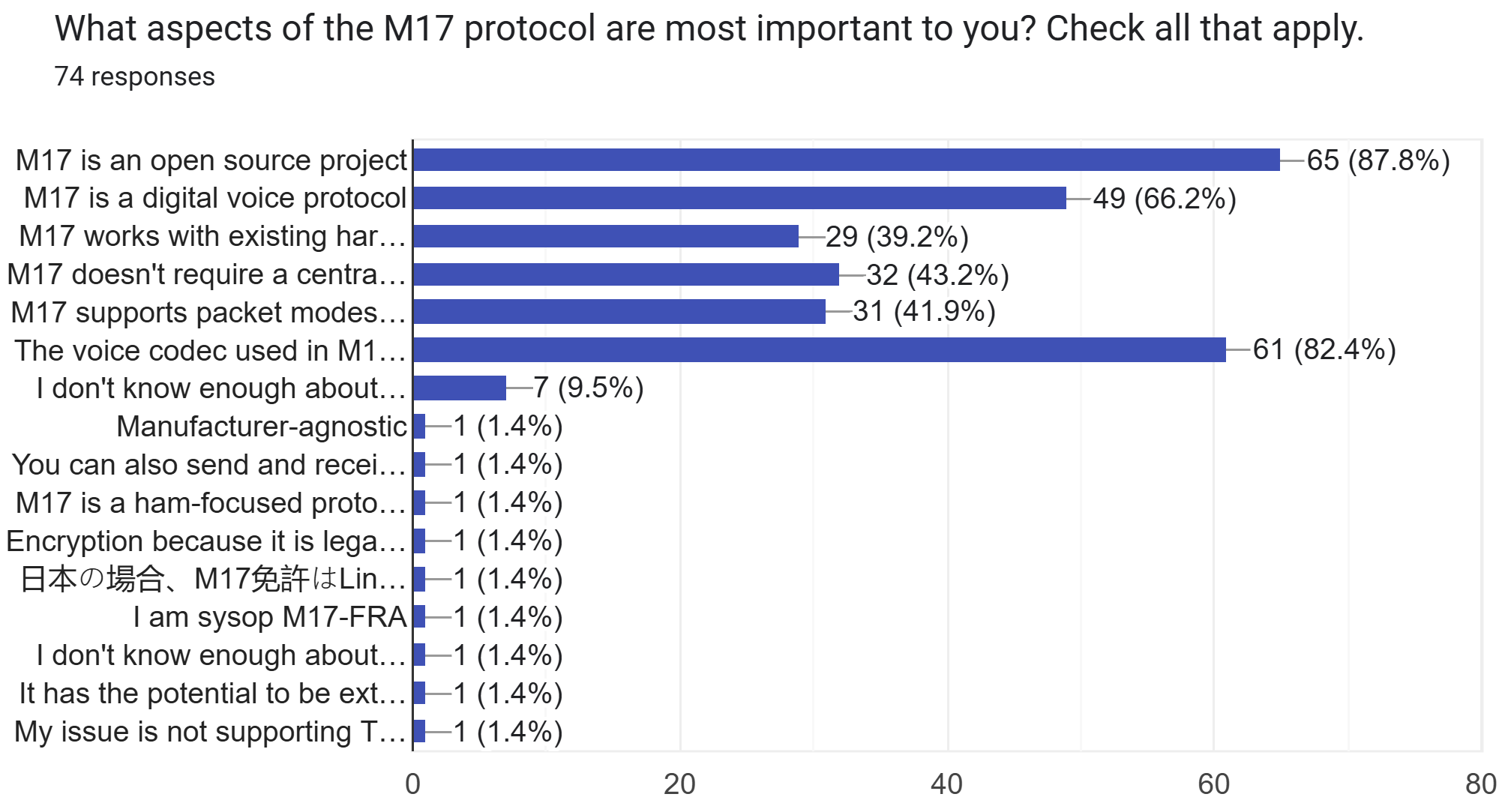
The questions and submissions are not completely visible in the survey summary so I’m listing all of those below. The items included in the survey are:
M17 is an open source project
M17 is a digital voice protocol
M17 works with existing hardware
M17 doesn't require a centralized user database
M17 supports packet modes like APRS and AX.25
The voice codec used in M17 is open source, unlike other digital modes
I don’t know enough about M17 to have an opinion
User-submitted items include:
Manufacturer agnostic
You can also send and receive digital data with it
M17 is a ham-focused protocol, not a repurposed commercial one
Encryption because it is legal in Canada and Amateur Radio is a hobby of experimenters
日本の場合、M17免許はLinHT etcが必要。価格がUS$100 to $200で入手希望。 (Google translates this for me to: In Japan, the M17 license requires LinHT etc. I would like to purchase it for US$100 to $200.)
I am sysop M17-FRA
I don’t know enough about M17 to have an opinion about the other choices
It has the potential to be extended such as the experiment of adding cryptographic signatures for authenticating transmissions
My issue is not supporting TDMA, it would be great to have a TDMA replacement for DMR
I found these responses very interesting. The three most popular responses were:
M17 is an open source project (87.8% of respondents selected this)
The voice codec used in M17 is open source, unlike other digital modes (82.4% of respondents)
M17 is a digital voice protocol (66.2% of respondents)
Thank you to all who have participated. The survey will remain open for one more week at: https://docs.google.com/forms/d/e/1FAIpQLSe5DJ3l4DOdKA9Z2teZB7WNAGi8K-R-LySG-odWwXVh6b0B5g/viewform?usp=header
If you have observations or thoughts about M17, please leave a comment.
Ampersand-ASL: Installed and Working
TL;DR — Ampersand-ASL is a lightweight system for AllStarLink that does not use Asterisk. It also supports high-quality 16Kbps audio. While this is a young project, it holds a lot of promise for compact, high-fidelity ASL nodes. I installed it on a Dell 3040 thin client computer and it works!
I was curious about a fairly new AllStar project that doesn’t use Asterisk. (Both AllStarLink and HamVOIP use Asterisk.) The new project is called Ampersand-ASL by Bruce MacKinnon KC1FSZ. Find it on GitHub at https://github.com/Ampersand-ASL/amp-server/tree/main
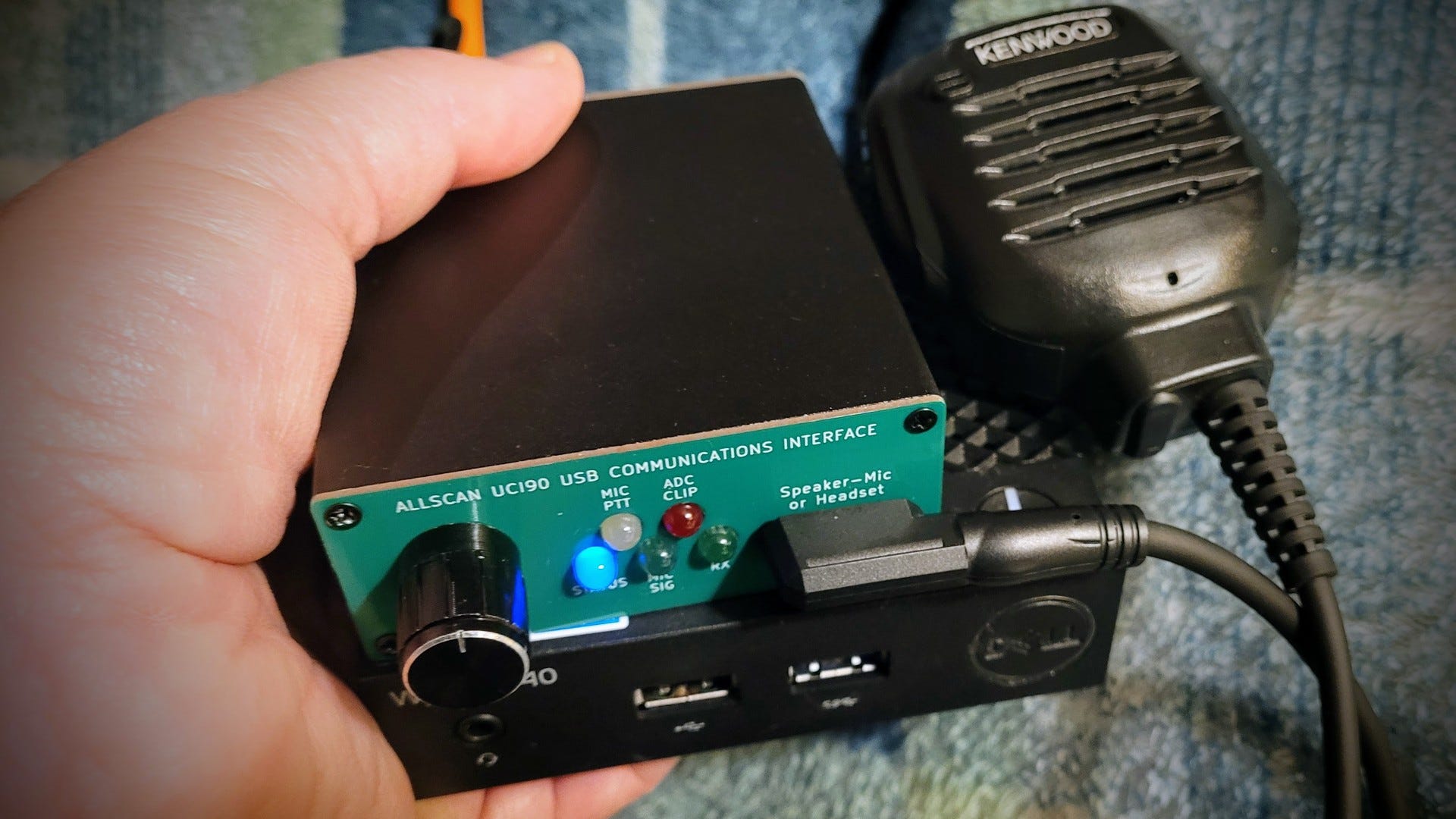
To do this, you need an AllStarLink node number. I chose to extend one of my nodes with an NNX number, creating node number 578499. I set my router to forward the UDP port I chose for the Amp-ASL Server to a Dell Wyse 3040 thin client running Debian 13. The audio interface is an AllScan UCI90 and a Kenwood KMC-45D K-1 speaker-mic.
This is a very promising project. I’m looking forward to following it as it evolves.
Read more on EtherHam in Ampersand-ASL: Installed and Working
New PoC Radio
This arrived the same day issue 166 was published:
Uniwa F400 Network Radio 4G LTE Rugged Phone Android 15 PTT Walkie Talkie Unlocked PoC Radio 4.0 inch Touch Screen Support Zello and Real PTT (affiliate link)
I’m sure when you look at the pictures at that Amazon link, you’ll say: that’s not a radio, that’s a phone! It sure looks like a phone. It takes a SIM card for cellular access and also connects through WiFi. Running Android 15 with a reasonably large 4-inch IPS touch screen, it could easily be mistaken for a cell phone. And you know why? Because it is a phone. It’s a phone with a big PTT button on the side.
The first thing I noted when I opened the box was the power adapter has a type C plug (“Europlug”). That won’t work. Fortunately, the adapter outputs through a USB-C port, so a US-style USB-C adapter was all I needed.
Next, the phone wasn’t charging. Probably some plastic over the battery terminals, I thought. Sure enough, some tape covered the battery contacts. Once I removed the tape and plugged the phone into a PD (power delivery) USB-C charger, the screen showed a charging battery and a red LED lit up on top of the device.
It also has a camera, making the comparison to a cell phone even more evident.
I pulled my Google Fi data-only SIM card from an old iPhone and slipped it into the F400. That did not work. The F400 is a 4G phone and the data SIM works with 5G. When I contacted Google Fi support, I was told it wasn’t backward compatible with 4G networks. Well darn it.
I’m still trying to figure out how to get the large, left-side PTT button to work with Droidstar and with DVSwitch Mobile. Until I can get the PTT working right, this is really nothing more than a cheap cell phone on which I’ve installed Droidstar and DVSwitch. You could do that with your real cell phone (and I do have those apps on my Samsung Galaxy phone).
That being said, it is nice to not have to use my real cell phone for digital voice. Now if I could only get the PTT button mapped to the Tx button in the apps…
Droidstar and DVSwitch Mobile: Thoughts
Speaking of Droidstar and DVSwitch, I poked at both of these apps a bit this week. I’m liking one more than the other and I describe these thoughts on the EtherHam site in Droidstar and DVSwitch Mobile: Thoughts
What Is Really Happening in Belarus?
The bit I shared last week about the alleged persecution of amateur radio operators in Belarus stirred up a bit of a hornet’s nest. I got comments (sent directly to me) about there being only one source of this information, making it suspect. A Google search with this phrase — are amateur radio operators being arrested in Belarus? — yielded multiple stories. I can’t tell if all of those publications are basing their content on a single source or on multiple sources.
I heard from one respected amateur who appears to have valid confirmation of this information. I’ve also heard the ARRL believes the story has significant inaccuracies and will be publishing something about that.
Bottom line: who knows what to believe? I don’t think I’ve believed a single source since I listened to Walter Cronkite on television.
Interestingly, I lost more subscribers this week than in any other week since I started publishing the Random Wire. Was that because I included something that sounded political? I don’t know. A few days later, I saw that I also gained more subscribers than any other week. I don’t know what to make of that. I appreciate my community of subscribers and always welcome your feedback.
DVStick 30 and DVMega Cast
I’m going to try a DVStick 30 AMBE USB stick in two ways: installed in my DVMega Cast and attached to a USB port on my PC. We’ll see how this goes. My DVMega Cast receive audio is fine but my transmit audio is often not great. Maybe using the AMBE stick will help.
Resources:
DVStick 30: https://www.dvmega.nl/dvstick30/
DVStick 30 at GigaParts: https://www.gigaparts.com/dvmega-dvstick-30.html
BlueDV software: https://software.pa7lim.nl/
DVMega Cast Upgrade Manual: https://www.dvmega.nl/wp-content/uploads/2019/03/Manual-Cast-Radio-Upgrade-v1.pdf
DVMega Cast: https://www.dvmega.nl/dvmega/
I’ll update you once I receive the AMBE stick (it’s back ordered) and get it installed.
DVMega Cast DG-ID
Speaking of the DVMeta Cast, here’s a quick note for amateurs with a DVMega Cast device. How do you set the DG-ID for a particular reflector? It is not obvious. It’s not in the software. Here’s how: touch the DG-ID numbers on the DVMega Cast screen. Then backspace to remove the two-digit number and use the keypad on the screen to enter the two-digit DG-ID.
I found this doesn’t actually “take” until I key the microphone once.
I hope this helps someone.
Video with V30 microSD Card
I tried a V30 microSD card in my Potensic ATOM 2 drone to see if the video it captured was smooth. Yes! The video linked below begins by looking straight down at me, standing on the front deck, controlling the drone. The height above ground is about 85 meters. Then I rotate the camera up, and in the resulting view of the lake, you are looking southward, toward the inlet to the lake. As I pan left to right, the Olympic Mountains to the west dominate the skyline. The video ends looking northward toward the outlet of the lake.
Here’s the video: https://www.flickr.com/photos/204104041@N02/55059095183/
Is the V30 microSD card any better than a “normal” card? I don’t know. What I do know is it performed well. I’ll keep testing.
NVMe Drive Cloned and Replaced
I spent about five hours on this project. The NVMe drive in my Dell OptiPlex 7050 SFF work computer was not doing well. I ordered a replacement and decided to clone the still-working-but-ailing drive to the new one. Thea actual cloning process with the two 1 TB drives took about three hours. During that time, there wasn’t much I could do so I listened to a few nets with Droidstar on my cell phone.
Read the story and view the images: NVMe Drive Cloned and Replaced.
Short Stack
My source for many of the items in the Short Stack is my “mega feed” at https://etherham.com/feeds/. I track more than 50 information sources, bringing their RSS feeds into a big, date-sorted collection of feeds. I’m happy to add more, so if you know of a great source of radio or technology information, please let me know.
I wanted to buy more NVMe storage in 2026, but I’m doing this instead. This article was published on January 28th and I had to chuckle because I bought a couple of large-capacity hard drives on January 27th. (Great minds and all that!) One hard drive is going into my work computer to hold backups and the other is going into an external enclosure with a USB-C connection. I’ll let you know how the external enclosure works. I’m hoping the USB-C connection makes it relatively speedy.
This Highly Rated Wi-Fi 6E Mesh System Is $150 Off Right Now. This is the same mesh system I installed at my sister’s vacation home. It is working very well.
Stop buying full-size desktops: Why I’m finally switching to a Mini PC. Mini PCs are becoming more popular. I’ve even heard the Ham Radio Workbench crew talk about using them instead of Raspberry Pi single-board computers. For the dollars spent, you get more of everything, compared to an RPi. I love my RPi’s, but I also use mini PC’s for some applications.
This one free app solved all my Windows 11 lag and stutter. This is clever. I’ve actually bought new computers simply because my video and audio did not work as smoothly as I wanted on an existing computer. If you have that problem, this might save you from the expense of buying a new PC.
I ditched my favorite to-do app for a Linux terminal—here’s what surprised me. I’m trying it. This lightweight terminal app works and the learning curve is not steep. This might be a keeper.
Reflections and Appreciation
Music on my Android phone
During a recent drive, I got tired of listening to audio books so I switched to some music. I’m enjoying the Poweramp app on my Android phone because when I change songs, it fades from one piece to the next. Some other players make an abrupt change which can be jarring. Poweramp is, well, more graceful in how it handles the audio. I also think my music sounds better played through this app.
I was listening to an old Chicago album and really noticing the superb drumming of Danny Seraphine. I could pick up some big band influences and heard some great jazz licks. Seraphine did a great job with his fills, something lesser drummers don’t do well. I thought I picked up some hints of one of my favorite drummers, Steve Gadd. When I looked at Seraphine’s Wikipedia page, I noted that Gadd is listed as one of the drummers who influenced his development. Seraphine‘s fills resembled Gadd’s, except Gadd tends to use more cymbals.
Testifying
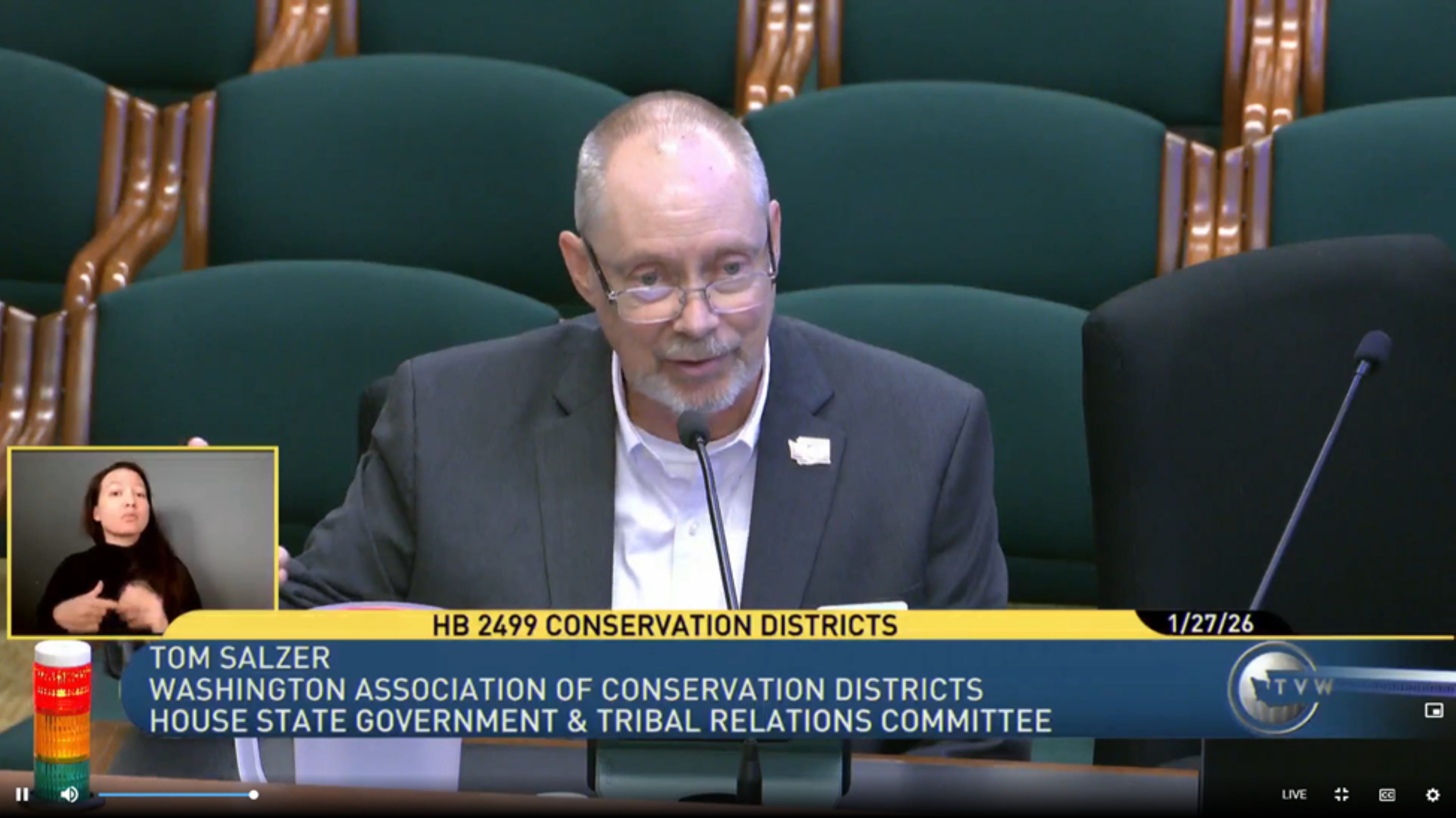
This was another week where I testified at a Washington State legislative hearing. Being a bit of an introvert, these are not experiences I look forward to. However, I owe it to my Association members to deliver the very best performance possible, so I prepare my comments (and prepare for questions) and do my best. One never knows how much time a committee chair will grant for testimony, so I usually prepare testimony for a five-minute chunk of time, three minutes, two minutes, and one minute. The last few years, most committee chairs have limited speakers to two or three minutes. This time, I got one minute. That’s not much time to make key points and back them up with data. I’m always in awe of my associates who can sit at the microphone with no notes and extemporize for just the right amount of time, sounding relaxed and natural. That is an amazing skill.
What a great time to be a ham
And finally: what a great time to be an amateur radio operator! We are in the midst of an intersection of sets: “classic” radio and new technologies. Of course, we’ve been here before. I say that thinking about the transition from tubes to transistors. I’m certain quite a few Random Wire subscribers lived through that time and remember the back-and-forth among the amateur radio community. I asked an AI engine about it:
The transition from tubes ("boat anchors") to transistors (solid-state) in the amateur radio community during the 1960s and 1970s was a mixed, multi-year evolution characterized by skepticism regarding performance, appreciation for new portability, and a reliance on "hybrid" technology before fully embracing solid-state. While transistors offered lower power consumption, smaller size, and instant-on capability, early models were criticized for poor heat handling and limited power output compared to vacuum tubes.
We’re in a similar boat now with analog vs. digital radio modes and platforms. Firmware upgrades are shifting from downloading and installing a package to simply tapping an upgrade button on a connected device. Radio hardware is shifting from hardwired circuits to circuits defined and controlled in software. Wired headsets vs. Bluetooth devices. Radios connected to WiFi and the internet. Digital data transfer instead of analog modulation and demodulation. Terminal node controllers that operate in software instead of as a separate hardware device. Virtual sound cards. Even the AIOC — the All In One Cable — that let’s you use an analog HT radio for digital data and AllStar.
I don’t know where our hobby is going but it is clear that it is evolving rapidly. If you want to build and use a tube-powered transceiver, you can still do that. If you want to experiment with cutting edge technology, you can do that. Pick something in the hobby that interests you and you can likely spend a lifetime learning and enjoying. This is simply a great time to be a ham.
73 to all, and remember to touch a radio (with or without tubes) every day!

Got Amp-ASL working on a Pi Zero 2W. I have horrible cgnat issues with my internet connection so parrots only but it worked.
I have a couple of Android phones/PoCs that I run Droidstar and DVSwich Mobile on. The trick with getting PTT to work with DVSwitch is to make sure you have the correct keycode for the PTT button in Config, and the code isn't standard between devices. On my Samsung XCover6 Pro, for instance, the PTT keycode is 1015, while on my Sonim XP8 it's 228.
To use PTT with Droidstar, I've had to kludge up a workaround with button manager like ButtonMapper, and make the app think that pressing the PTT button is the same as pressing the on-screen soft PTT. Last I'd heard the developer wasn't keen on adding PTT button functionality, but that info may be out of date.
73!