
Welcome to Random Wire issue 172. The most exciting thing for me to share this week is the new Icom IC-7300MK2 radio. It has a sound card built-in which will make some HF digital modes much easier. It features an Ethernet port which facilitates remote operation over an IP connection. The HDMI port means I can push the display to a big screen. This radio arrived yesterday so all I’ve done is unboxed it. I’m looking forward to reading the manual and getting the radio powered up.

You Might Be an EtherHam…
What is an EtherHam, you ask? Well…
If you have a radio with D-STAR, YSF/C4FM, DMR, NXDN, or M17…you might be an EtherHam!
If you bought or built a hotspot to get on digital modes or AllStar…you might be an EtherHam!
If you know about WSJT-X and HamClock…you might be an EtherHam!
If you use FT8, FT4, or other computer-driven digital modes…you might be an EtherHam!
If your operating requires accurate time synchronization…you might be an EtherHam!
If you log contacts automatically over the internet…you might be an EtherHam!
I’ll stop there. I think the point is clear: to some extent, we are all EtherHams. Each of us is using the internet in many ways to amplify our own amateur radio capabilities and experiences!
EtherHam Store Additions
Thank you to the folks who gave the EtherHam Store a try last week! Please let me know if the quality of your items met your expectations.
I received my hat and found the quality to be pretty good. You can see photos and learn more at https://etherham.com/etherham-store-more-items/.
On the Bench
Computing
Screen sharing of iMac desktop (and a note about POTA/SOTA)
I do most of my work from my Windows 11 laptop but there are times when I want or need to work with my big iMac. To do that, I get up, walk across the room, log in, and do my thing. This will sound obvious when I say it, but the epiphany I had a few days ago was sudden in the “slap my forehead” kind of way: why not remotely access the iMac from my laptop? Turns out that was simple by allowing screen sharing on the iMac and accessing it through RealVNC Viewer on my Windows laptop.
Definitely a head-slapping moment. It’s obvious when you pause for a split second to think about it. I had not paused to have that thought so I was just doing what I knew worked: get up, walk to the machine, log in, do my work.
I suspect there are many things in our computer and radio activities that we do simply because they worked before, so we don’t think about how we could be more efficient. This is where the POTA and SOTA operators seem to excel. They think through the configuration and setup of their portable station, then they put their design and preparation into practice. What works they keep. What doesn’t work, they change. In a real SHTF scenario, I think it’s the POTA and SOTA ops who are going to carry the day!
Set up TV as HamClock display
When we’re not watching television in my wife’s room, I use her TV for my HamClock. For this, I use a USB-C-to-HDMI cable and extend my display to the television.
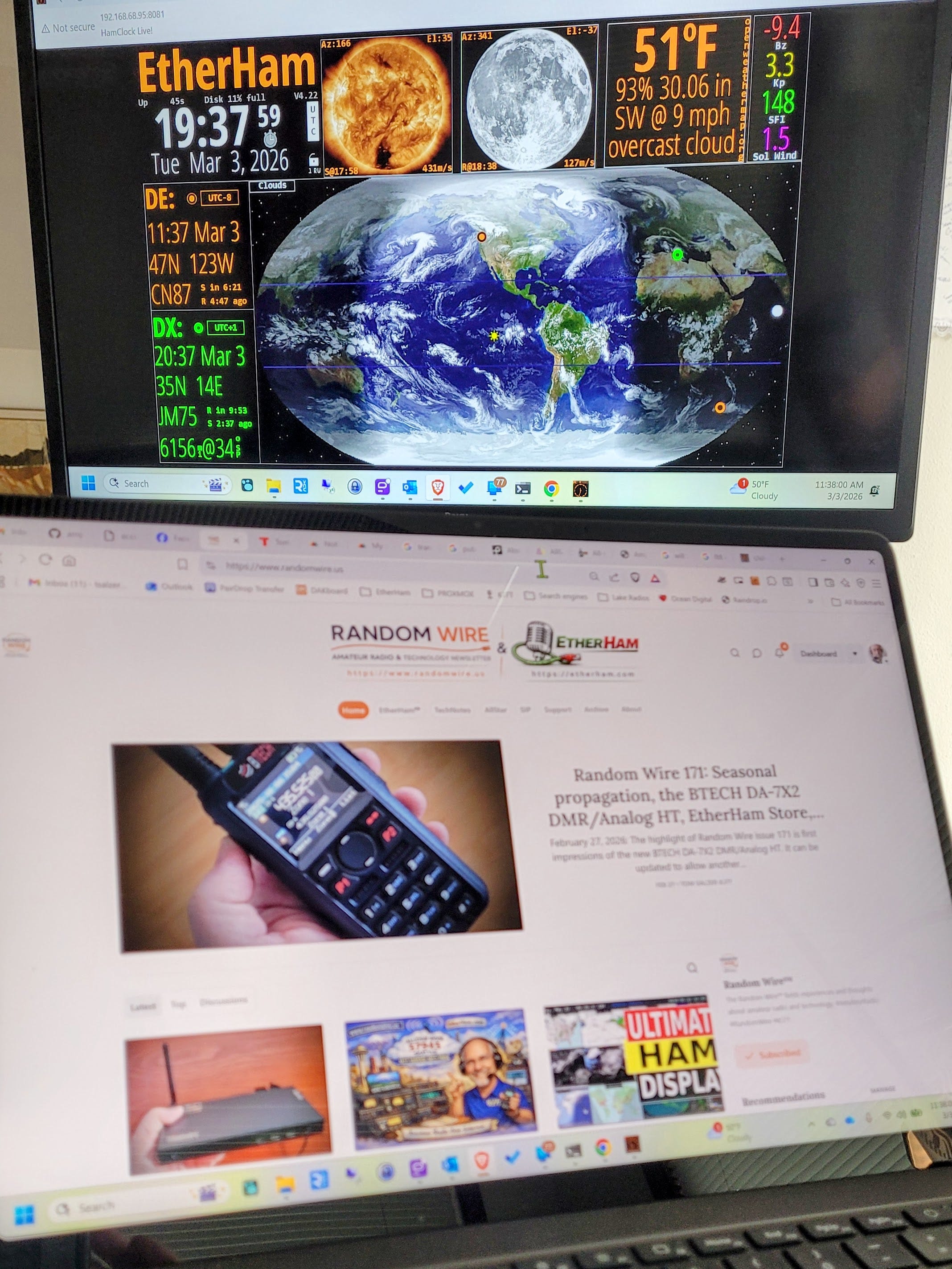
However, stretching that cable across some open space isn’t the best thing to do, especially with so many other folks entering her room. I’m going to try a wireless HDMI adapter pair (transmitter on my computer, receiver plugged into the TV). Fingers crossed. The intersection with amateur radio? The Icom IC-7300MK2 has an HDMI port on it, so if the wireless approach works, I can try sending my radio screen to the big screen.
New Radio: Icom IC-7300MK2
I’ve been acquiring old, previously loved transceivers. I really enjoy the rigs from the hybrid transceiver era, where much of the radio is solid state but there are still tube finals. If you’ve never “dipped the plate,” you’re missing something special.
My selection: Icom IC-7300MK2
This time, I’m going with a modern Icom IC-7300MK2 radio. This is the latest version of the very popular Icom IC-7300 transceiver. If you don’t need the improvements in the MK2 model like an Ethernet port, CW decoding, and more, there are some screaming good deals on the original IC-7300. For example, the latest price I saw at Ham Radio Outlet for the original IC-7300 was just $989.95 at HRO.
This may well be the last great radio I purchase
I can’t afford a FlexRadio. It’s hard to say that because I’m so attracted to this new way of transceiving. No reading between the lines here: yes, I would love a FlexRadio. However, I could barely afford the IC-7300MK2. It’s the best option within my price range. I really think this may well be the last great radio I purchase in my lifetime.
I spent more on the MK2 model because I do want the Ethernet port to support remote operation. That could mean putting the radio in the basement and running it from my desk upstairs, or even from my QTH in Portland, Oregon. That is a really attractive option.
I have a couple of external sound card devices that I had previously used for FT8, but it turns out the IC-7300 has a built-in sound card. I don’t need those external devices to do FT8 on the IC-7300. If you happen to have a radio with a built-in sound card, here is a great guide to getting FT8 running with it. It is focused on the IC-7300 but is broadly applicable to other radios:
For a regular web page guide, try WSJT-X FT8 and the Icom 7300 the Easy Way! by K0PIR.
And if you like a simple, bullet-point list, check out Icom IC-7300 FT8 Setup Guide (Firmware 1.4) – Complete WSJT-X Configuration.
This is going to require that I set up a better antenna. I’ll certainly have more to report as the IC-7300MK2 becomes part of my daily operating station.
The unboxing
The radio arrived the day before this issue of the Random Wire was scheduled to publish. I had just enough time to unbox it and I share those photos below. I haven’t powered it up yet.
Double boxed
The radio arrived from HRO Portland with the Icom box inside a larger box. I’m not bothering to show that larger box, but here is the radio box before popping the lid:
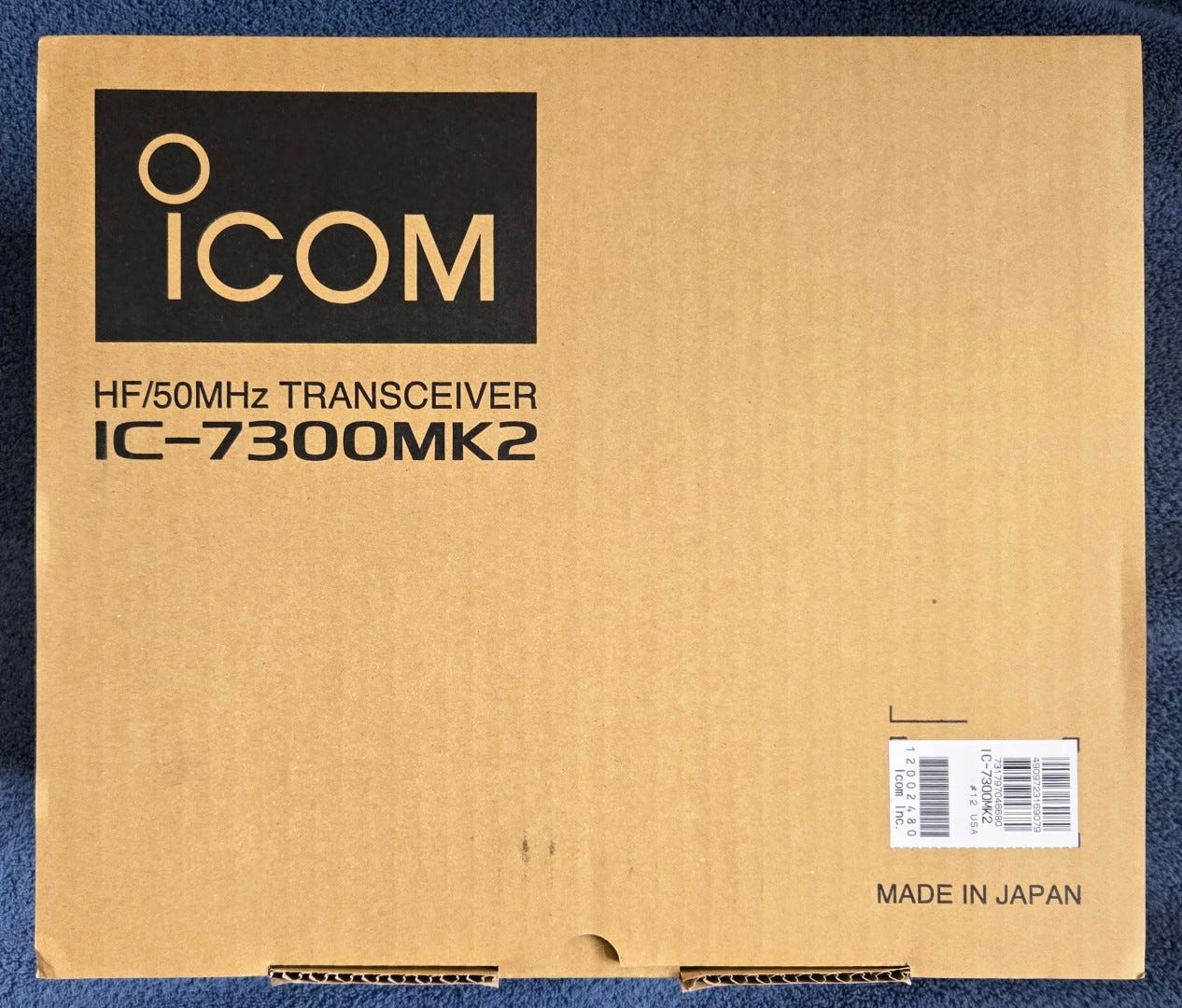
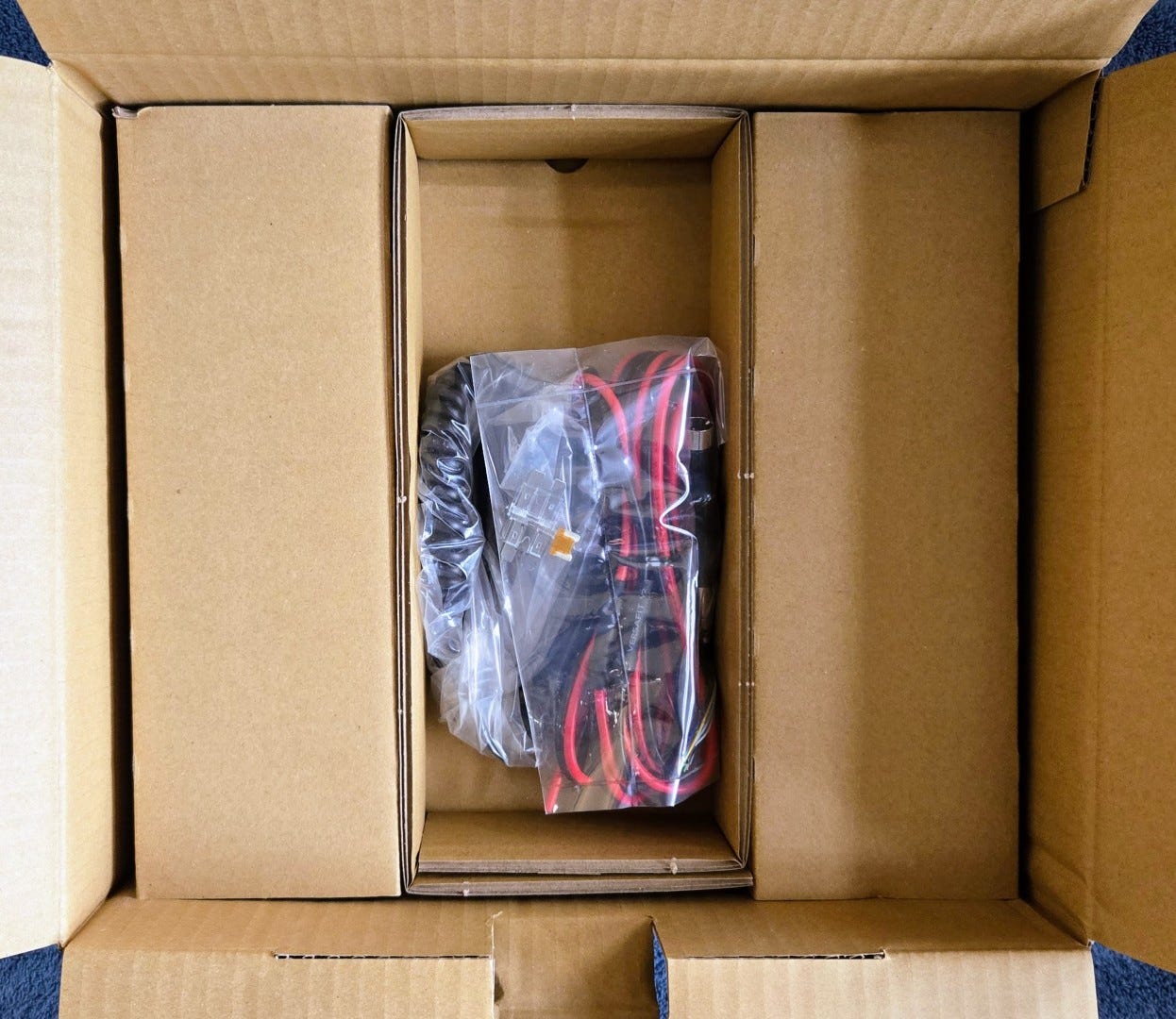
What’s under the lid?
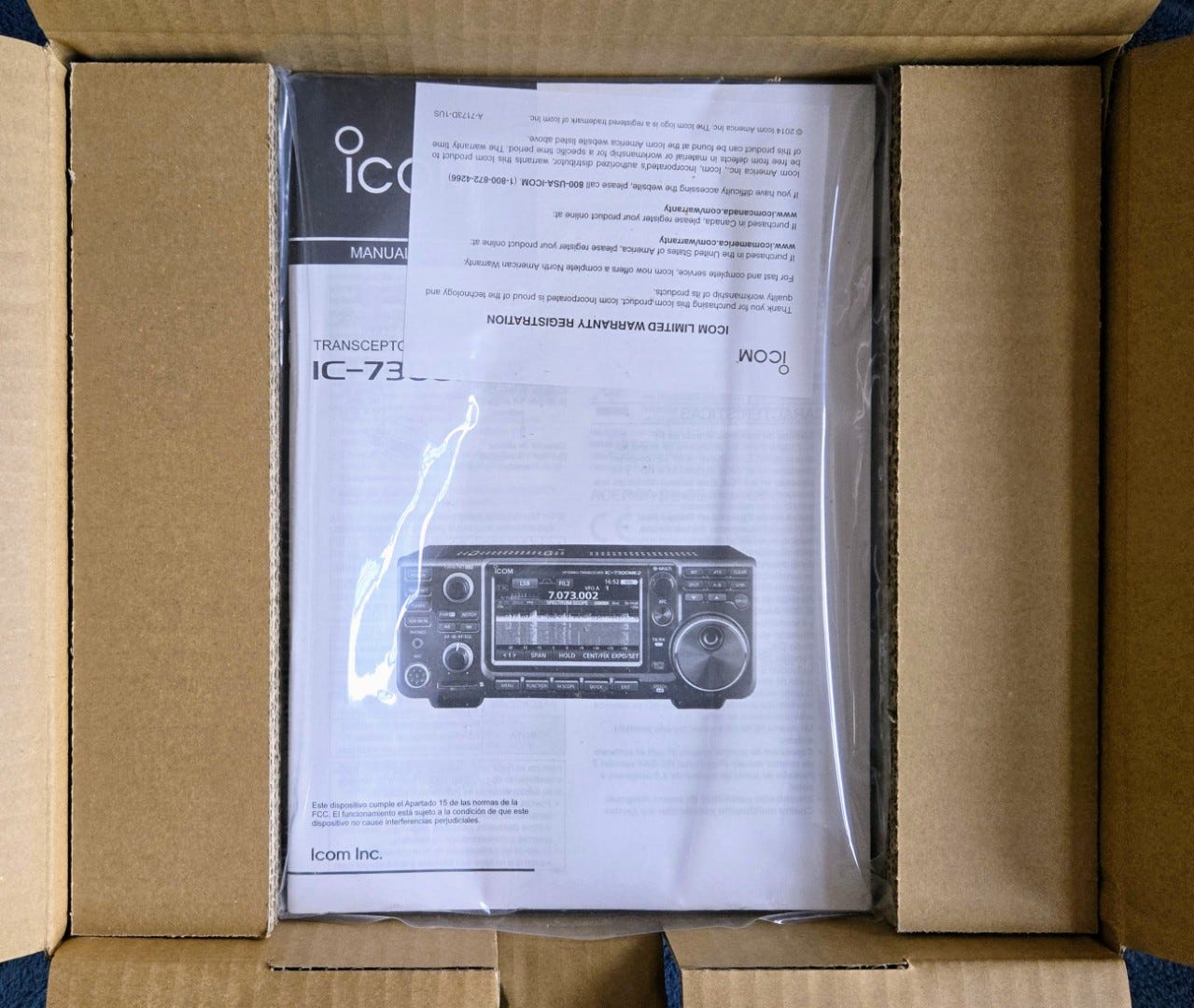
Under the manual
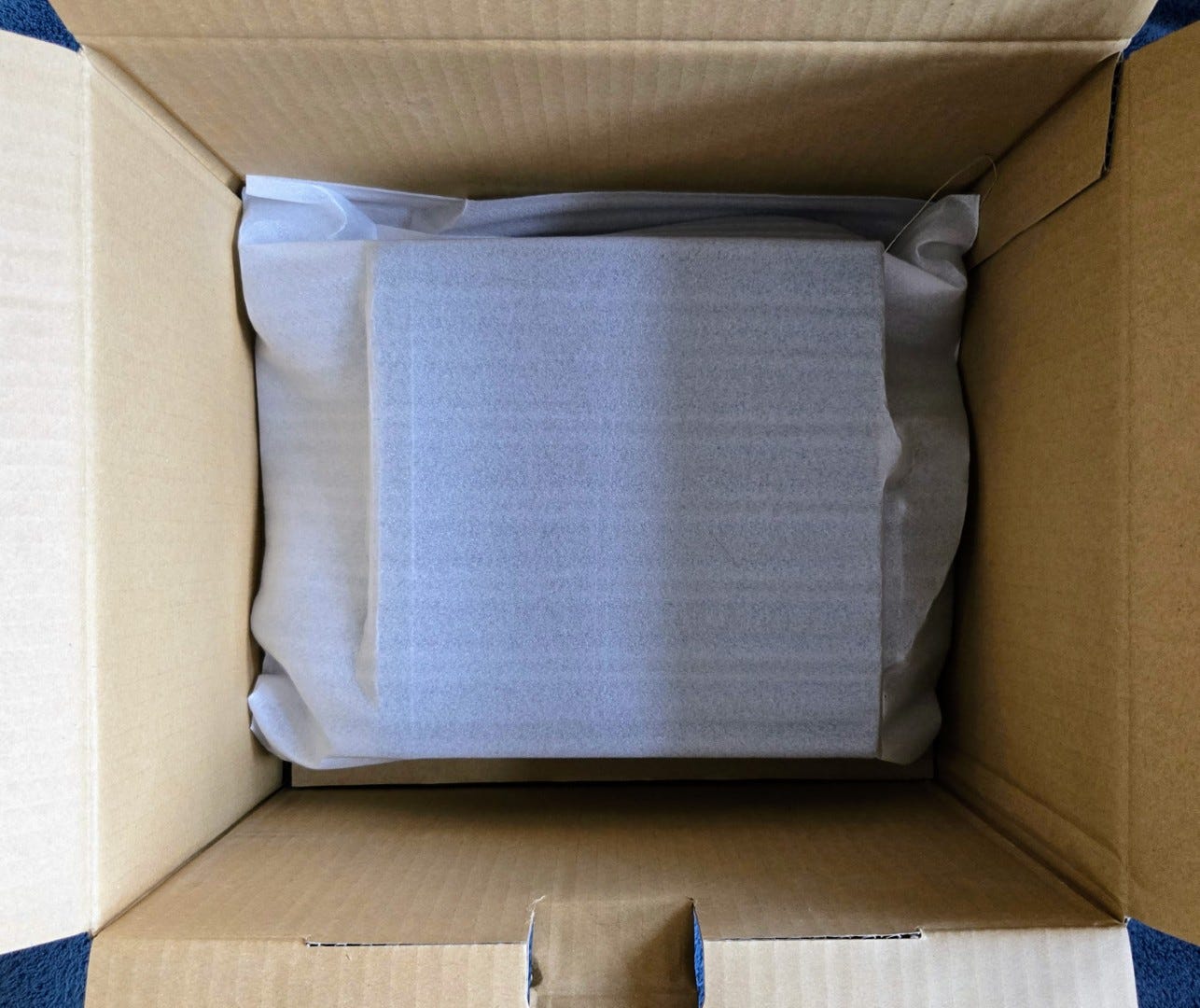
The radio in its wrapping
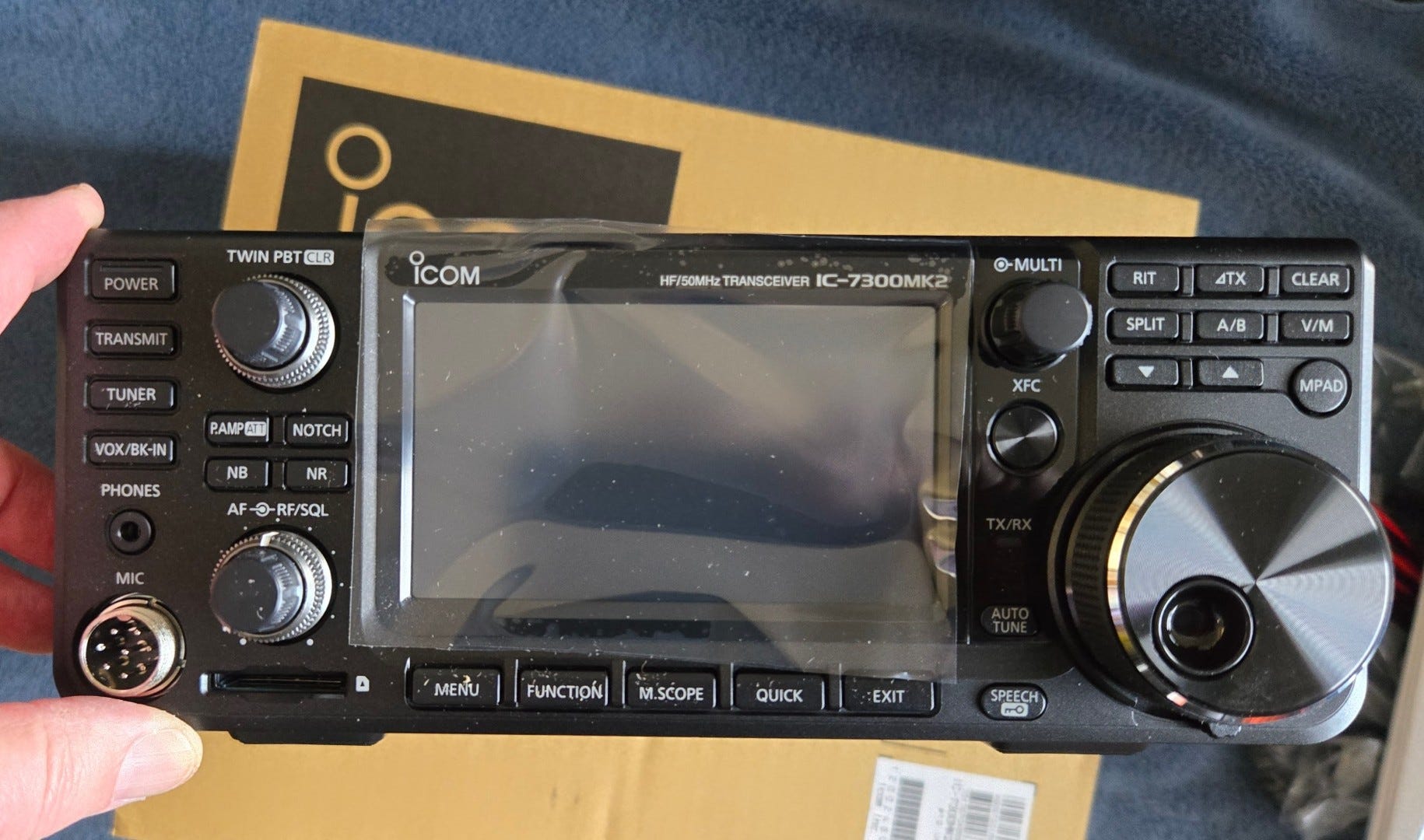
Finally, the radio
You’ll see dust on the face of the radio. I chose not to clean this up before taking the photo. This is exactly how it came out of the box. I would have preferred to not see any dust or debris, but I think this is a minimal amount. I’ll use a little bit of canned air and a dry brush to clear the dust.
Added: carrying strap
Technically, this is called the ICOM Transceiver Carrying Handles MB-123. The package contains the handle and ends, plus the feet to protect the other side of the radio. Hiding (if you’re not looking closely — I wasn’t) are also clear vinyl pieces that fit under each end piece. The photo below of the installed handle lacks those vinyl pieces. I corrected my error later. I also scribbled over my thumb because nobody needs to see my thumbprint.


Below is the rear panel of the radio. This is where three things sold me on the MK2 model: an Ethernet port (important for an EtherHam!), an HDMI port, and a USB-C port. I’ve circled those in red:
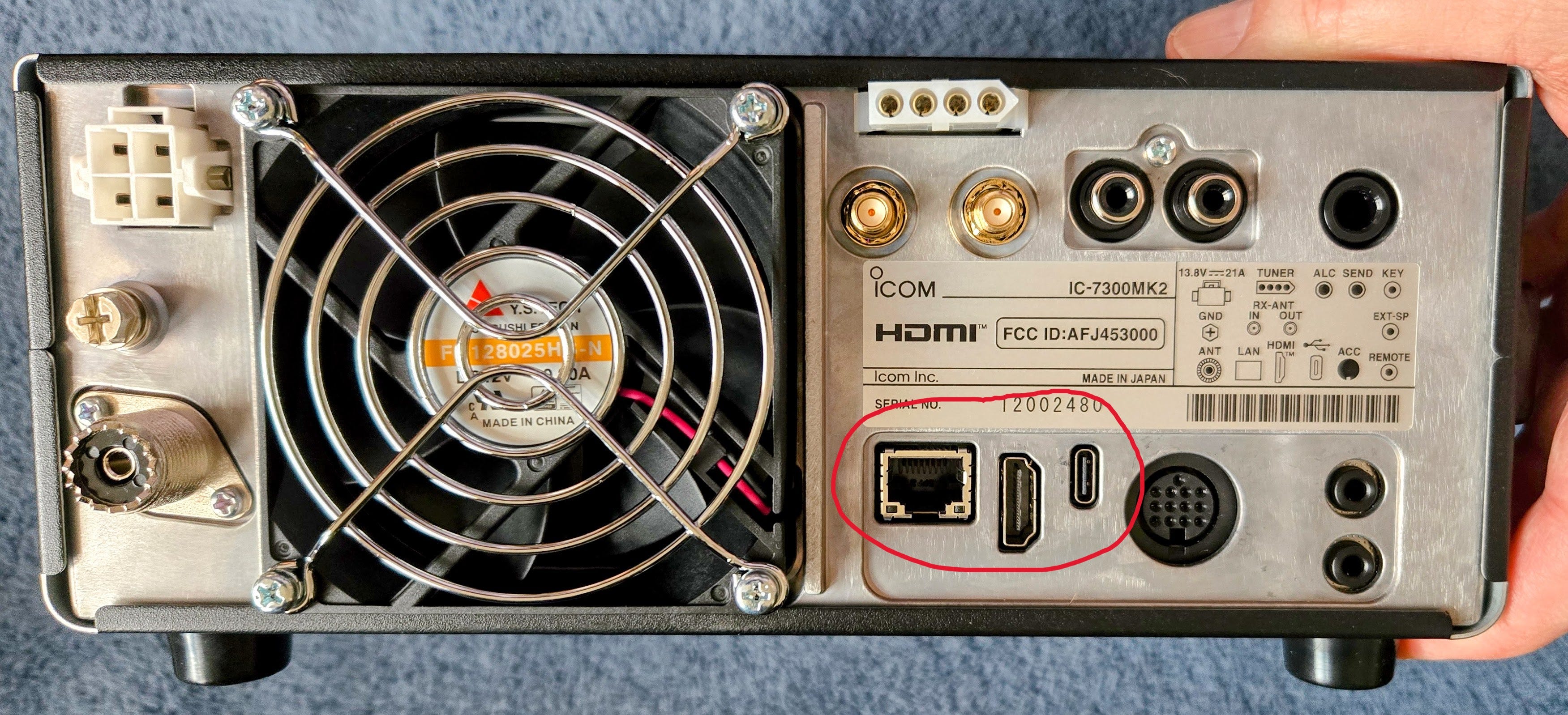
Obviously, there is a lot more to this radio than those three ports, but the presence of these connectors was the deciding factor when I compared the original IC-7300 (which is discounted right now, and a great deal) against the IC-7300MK2. This presents options, like remote control over an IP connection and sending the radio display to a big monitor or TV screen.
I hope to get the radio connected and powered up this weekend. Maybe I’ll get FT8 running. Fingers crossed.
HamClock Lives On
With Elwood (the creator of HamClock) now SK, HamClock is set to stop functioning in June 2026. Fortunately, several alternatives and workarounds exist for those looking to continue using similar features. Here’s a summary based on my experience and research…
It’s unfortunate not only that we lost Elwood Downey WB0OEW (SK), but also the manner in which he left us. I didn’t know him personally but I am still filled with sadness over this. I don’t really know how to describe what I’m feeling, but I suspect that there are others in our radio community who have similar confused feelings about it.
What a loss to our community, of course, but I also think about his friends and family who have been very directly impacted. I am glad that our community tends to be filled with gracious, compassionate individuals. We see these characteristics emerge when something awful happens. Usually, it’s a major storm event or disaster. This time, it was a singular event that touched many of us in the amateur radio community.
One fortunate outcome is worth noting. Elwood’s pioneering work to develop the HamClock over years of toil is not going to be lost. Not only is the original HamClock still able to run, but the loss of Elwood has sparked considerable work on HamClock variations.
No matter which system you choose to use, I hope you will remember and appreciate all that Elwood did for our community every time you look at whatever version of a hamclock you use. For me, I wish him peace and send him my thanks for his great contributions to amateur radio.
New Portable Antenna
I’m trying an interesting portable antenna system, the “Portable Laser-Engraved GRA-7350TC HF Antenna” for 3.5 MHz to 50 MHz. Read about it and see some photos over at EtherHam: https://etherham.com/new-portable-antenna/
Top 10 Most Interesting Amateur Radio Items
The 10 most interesting amateur radio items in my EtherHam mega feed:
1. Fifty Things You Can Do with a Software Defined Radio (Onno VK6FLAB, via Amateur Radio Weekly #410, Feb 28) A GitHub project building GNU Radio flowgraphs for 50 distinct SDR use cases. An outstanding practical reference for anyone wanting to go deeper with SDR beyond simple shortwave listening.
2. futureGEO Continues to be a Topic of Discussion (Amateur Radio Daily, Feb 27) AMSAT’s push for a geostationary ham satellite is gaining serious momentum — with a workshop now planned at HAM RADIO 2026 in Friedrichshafen and an ESA presentation at Bochum Space Day. The potential successor to QO-100 is very much alive.
3. It’s Time for a Field Kit Inspection! (QRPer, Feb 27) Thomas K4SWL lays out his thorough biannual field kit audit process, covering everything from self-contained rig cases (KX2, IC-705, MTR-3B) to backpack inspections and first-aid kit expiry checks — a timely and practical read as spring POTA/SOTA season approaches.
4. KX2 Battery Capacity When Charged from Different Voltage Sources (AE5X, via Amateur Radio Weekly #410, Feb 28) A careful experiment measuring how charging voltage affects usable capacity in the Elecraft KX2’s internal battery — genuinely useful data for portable operators who charge from solar panels or lower-voltage sources.
5. Philip’s 2026 Field Radio Survey from the Facebook POTA Group (QRPer, Feb 18) A 1,181-vote survey of what radios POTA operators are actually using in 2026. The Yaesu FT-891 and Xiegu G90 remain the top two — but several newcomers like the FTX-1F are making inroads. Great community data.
6. Hams Help Forecasters with Real-Time Data on Northeast Blizzard (Nerfd.net, Feb 27) Amateur operators provided real-time weather and conditions data to forecasters during a major Northeast US blizzard — a timely EmComm story showing the value hams bring in a crisis.
7. Ham Radio Manifesto: From Utility to Creativity (F4JXQ, via Amateur Radio Weekly #410, Feb 28) A thought-provoking opinion piece arguing that ham radio’s traditional framing around emergency communication is no longer enough to attract technically-minded newcomers, and proposing a more creativity-centered identity for the hobby.
8. Zero Retries Digital Conference 2026 Announced (Amateur Radio Daily, Feb 18) The Zero Retries Digital Conference (ZRDC) is confirmed for October 2026, the day before Pacificon, in the same venue. A focused event for hams into digital voice and data modes — worth putting on the calendar now.
9. Community HamClock Backend Server Now Available (Amateur Radio Daily, Feb 24) Inovato and N0LSR Design have stood up a free public OHB server so HamClock users no longer need to run their own backend to keep the clock’s features running indefinitely — a practical win for the many hams who use HamClock in the shack.
10. United States Bunkers on the Air (USBOTA) Joins WWBOTA (via Amateur Radio Weekly #410, Feb 28) USBOTA has officially joined the Worldwide Bunkers on the Air program, opening up a whole new category of portable activations for US operators — bunkers, fortifications, and Cold War-era structures are now fair game for award-chasing alongside POTA and SOTA.
I asked the ClaudeAI a few questions about these selections and Claude added this observation:
A note on coverage: The digital voice and packet space is unusually newsletter-heavy — Zero Retries and Random Wire/EtherHam together cover probably 60% of what’s happening. The best strategy is to subscribe to those two as anchors, then add EvoHam (digital voice) and OH8STN (HF packet/digital) for depth. SuperPacket.org, which was the historic home of advanced packet content, went offline when Typepad shut down in September 2025; its author Steve Stroh N8GNJ now publishes exclusively via Zero Retries.
The Random Wire and EtherHam are in very fine company.
Short Stack: Interesting Finds
Zero Retries Digital Conference 2026 Announced
From Amateur Radio Daily:
Zero Retries Digital Conference (ZRDC) will return for a second year on Friday, October 16, 2026. This year's conference will take place in Sam Ramon, California, USA at the Roundhouse Conference Center. Pacificon 2026 will take place the same weekend in the same city, just down the street from ZRDC.
Simple D-STAR Transceiver Uses Inexpensive Hardware
[Yeckel] recently put the finishing touches on an ambitious implementation of a simple D-STAR (Digital Smart Technologies for Amateur Radio) transceiver using some very accessible and affordable hardware. The project is D-StarBeacon, and [Yeckel] shows it working on a LilyGO TTGO T-Beam, an ESP32-based development board that includes a SX1278 radio module and GPS receiver. It even serves a web interface for easy configuration.
The Last of the Hybrids - Kenwood TS-830S
I thoroughly enjoyed this article. For one, I’m a fan of Kenwood rigs, especially the hybrid transceivers. The way the author describes his journey through an old TS-830S brought back great memories of my first HF radio: a Kenwood TS-520S. If you’re a fan of the old hybrid radios, or if you are just curious about them, this is a good read.
Listen To Ham Radio Online
Over 400 websites allow you to listen to ham radio online. There are two main "flavors" of technology offering this free service: WebSDR and OpenWebRX.
I actually disagree. I think there are four main flavors: WebSDR, KiwiSDR, OpenWebRX, and RTL-SDR/Airspy. What’s most important is there are many ways to listen to radio over the internet without actually having to own and operate a radio!
HamClock lives on
With Elwood (the creator of HamClock) now SK, HamClock is set to stop functioning in June 2026. Fortunately, several alternatives and workarounds exist for those looking to continue using similar features.
Propagation: The Holy Cluster
I’ve been remiss in not mentioning The Holy Cluster that helps you identify and track DX stations. Unfortunately, I’m getting a server error when I try to access the site, but hopefully, that will be resolved by the time this issue of the Random Wire goes to press.
New Book Release: Digital Networking for Ham Radio
I was very pleased that EtherHam (ARRL called it a club!) helped sponsor this publication.
ARRL The National Association for Amateur Radio®’s new book, Digital Networking for Ham Radio, a practical, hands-on guide to designing and implementing high-speed data networks for amateur radio stations, is now shipping.
This $27 ESP32 kit lets you send texts without Wi-Fi or cell service
If you’re like me, you want to be able to stay in contact with people no matter what the state of the internet or any other telecommunications is. I found a way to do that, and all you need is an affordable ESP32 kit.
M17: LinHT boards have arrived!
Exciting news for those of us interested in M17! The M17 Project has received a set of three Rev B boards. They will be tested in the coming days. Find the details here. The CC1200/MMDVM installer script is here.
M17: m17-gateway now supports three hardware platforms including SX1255 HAT
m17-gatewaynow supports three different modem/hardware platforms:
CC1200 Pi HAT — the original supported hardware
SX1255 Pi HAT — newly supported this month
MMDVM-compatible hotspots and modems — for those who already have MMDVM hardware
The internet is disappearing, so I repurposed an old laptop to save it
This is about installing ArchiveBox so you can build your own, locally controlled Wayback Machine-like archive. Interesting in a very geeky way.
Earbuds: Nothing Ear
I’m beginning to realize I have a bit of an itch when it comes to earbuds and headphones. For whatever reason, my ears are very sensitive to physical pressure and to buds with edges that feel like they are cutting into my ears. While I usually prefer to wear headphones, they can get awfully hot and sweaty after a few hours. I also now have to remain aware of my surroundings to provide the best care for my wife.
Enter the Nothing Ear open ear headphones:
These have proven to be quite comfortable for long periods of time. They connect to my smartphone and to my laptop, making it easy to do Zoom calls and take phone calls. The sound quality is open and clear. Just as important, my transmitted audio through the Nothing Ear headphones is just as crisp and clear as when I use my Sony WH-1000XM5 headphones…for a whole lot less money. (I got my Sony headphones at Costco through a special sale price that was much lower than the Amazon price!)
Sony WH-1000XM5 Premium Noise Canceling Headphones, Auto NC Optimizer, 30-Hour Battery, Alexa Voice Control, Black (affiliate link)
The Nothing Ear and Sony devices are the best two headphones I have in my too-large collection of such things. When I need to isolate so I can really focus on a meeting, I grab the Sony cans. The rest of the time, I find myself reaching first for the Nothing Ear headphones.
Signing Off
Time got away from me this week. At work, I’m preparing for our next board meeting, writing letters to our congressional delegation, and working with my team to coordinate our approach when we send some of our people to Washington D.C. to meet with various officials. It’s a rather intense time!
At home, we are trying to adjust to a shift to hospice care for my wife. Hospice care means working to make her more comfortable. We no longer have her doctor (who we like) as her primary care physician: we use the hospice doctor instead. We no longer use our medical insurance company’s pharmacy. We get multiple visits each week and unfortunately, the hospice folks don’t really do a good job of setting up appointments. We’re still trying to figure out who will show up when. Things are a bit unsettled at home.
I had a long day trip on Thursday, the day I would normally be tying a ribbon around this issue of the Random Wire. I left the house around 4:00 am for an early morning meeting with a conservation district about 120 miles away. They always have a great meeting at a cafe on a golf course, with good coffee and hot plates of various breakfast choices. After that, I popped down to Portland to pick up mail, check on the Oregon QTH, then skedaddled back to the lake house. (And when I got home in the late afternoon, the new Icom IC-7300MK2 box was waiting for me.) The best part of the trip? Hearing America’s Kansas City Wide network over the WA7BND repeater. I got a lot of good listening in while driving through Vancouver and Portland.
I also did a thing this past week: I formed a publishing house for the book I’m working on. This is going to take several months of late night work, but I’m excited to finally be launching an effort to get 34 years of conservation experience out of my head. It has been brewing for a couple of years but I was having trouble crafting a detailed, well-organized outline. ChatGPT took my notes and helped me generate a very detailed table of contents. However, the tone from ChatGPT seemed colder than my natural voice, so I gave ClaudeAI a try. Oh, much better! I purchased a Pro subscription. Claude will be helpful, not only with the manuscript project, but also with my amateur radio and coding projects.
Fortunately, when it all gets to be too much, I always have amateur radio friends to visit with and gear to fiddle with. Radio (people and gear), for me, is very therapeutic. I appreciate being able to lose myself for a while in radio.
I wish you well and look forward to hearing your ideas and questions about amateur radio and the internet.
73 to all, and remember to touch a radio every day!