


Welcome
What a week. I took a left turn from hardware and focused on software and firmware, including diving headfirst into Python scripting on some of my AllStarLink nodes. I was surprised that the scripts ran pretty well on a Raspberry Pi Zero 2 W device. My node 578495 sports several new additions, including:
Announces the time each hour, from 9 am to 8 pm.
Amateur Radio Newsline is imported once a week and plays when I send *6 over DTMF to the node, or when I key up the microphone 4 times in less than 2.5 seconds.
Local weather is available on demand with *7 DTMF.
I can initiate a clean shutdown of the node with 5 microphone key-ups. This was probably the most useful modification I made.
But it wasn’t just scripting — I also added an uninterruptible power supply hat to node 578495. In short, it was a fun week of early morning and late evening work with Python and AllStarLink. I learned a lot.
So fair warning: if you don’t want to take a dive down the Python rabbit hole, don’t click the links about Amateur Radio on Your ASL3 Node in the next section!
It’s not all Python in this issue of the Random Wire. There is new content to enjoy, beginning in this issue. I did some antenna design work with an AI and also used an AI to help me un-brick a radio.
There’s a catch-up article section for those who have not followed M17 changes from about a year ago. I also added an uninterruptible power supply to a Raspberry Pi Zero 2 W-powered AllStar node.
And of course, I close with the Short Stack of interesting internet finds. I hope you enjoy issue 176!

Python on My AllStarLink Nodes
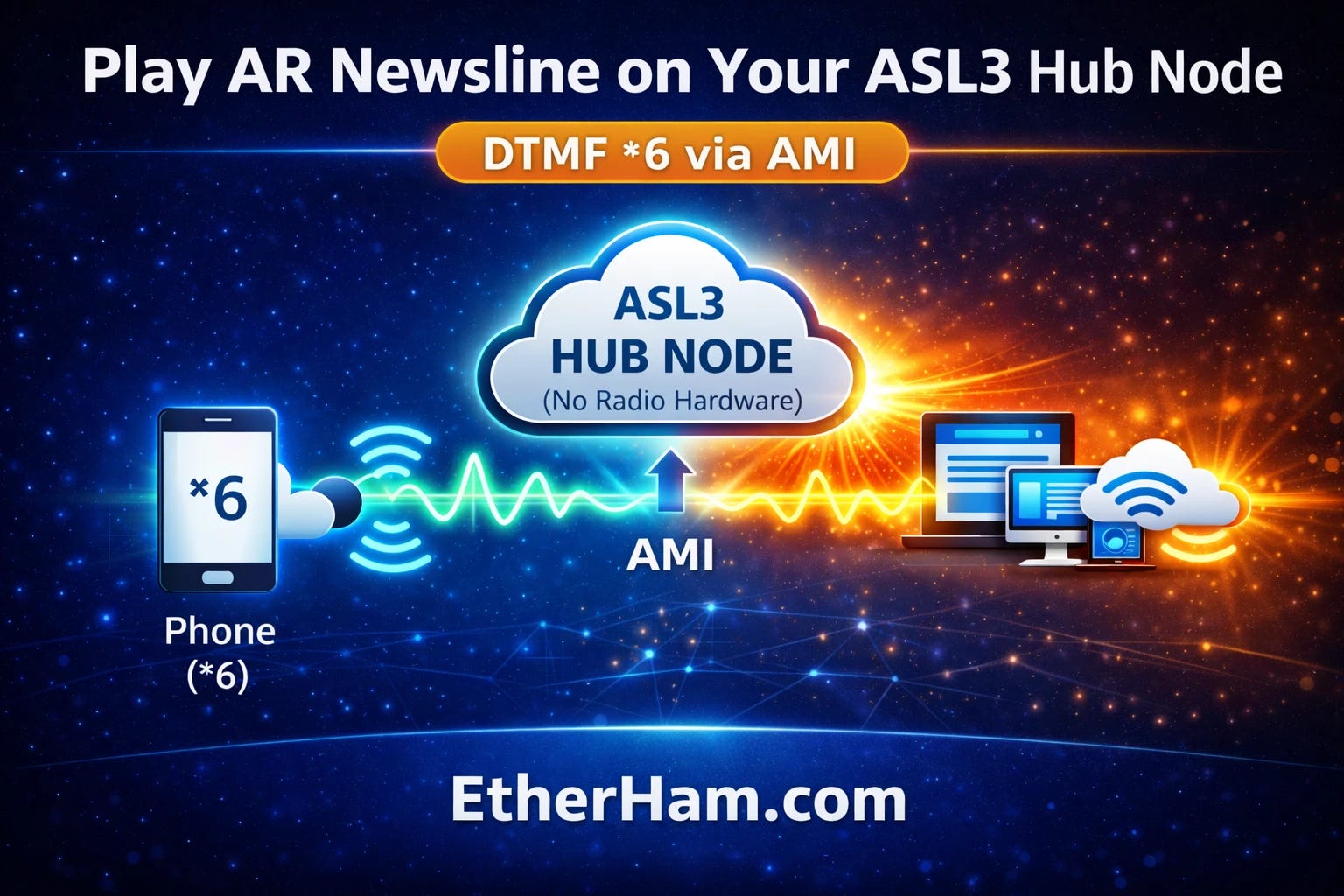
I’ve been having too much fun with Python on my AllStarLink nodes. See these two very recent articles on EtherHam.com which go into a lot of detail about what I’ve been doing with Amateur Radio Newsline on a couple of my ASL nodes.
Doing something like this isn’t really new, but using Python and the Asterisk Management Interface was, for me, a new way to do it.
Of interest to those of you who play with Python and Asterisk is this: I used the Asterisk Management Interface (AMI) to intercept commands sent to the nodes. In one case, I use microphone key-ups to trigger an action. In the other, I send a DTMF code but the AMI catches it. This was a lot of fun to figure out.
New Content in the Random Wire
Beginning in this issue, I’m also using my cloud node as a server platform to process some additional content for this newsletter. You’ll find this new content toward the bottom titled as:
Radio Propagation Digest
This Week in Radio History
After testing the Radio Propagation Digest for a few weeks, I’m finding it useful. I don’t want to wade through lots of content to try to figure out how propagation conditions are trending. I want a digest, so I’m sharing this product with you.
I’m pretty involved in the digital side of our hobby, but at the same time, I appreciate reminders of the great work that came before me. Thus, This Week in Radio History is designed to be a quick look into amateur radio’s past. I hope you find it as interesting as I do. This content is being generated by AI, and as with all such things, information should be verified if you are going to do something significant with it.
As an example of not just accepting what an AI does, I asked ChatGPT to help create some graphics for me. The first couple of images were okay — they had the required elements — but they lacked the style elements I had specified. When I asked ChatGPT to revise them to match the style I had included in the requirements, I started getting weird images about crypto, bookstores, and radio contesting. The output was so far outside the parameters I had set that I found it rather disturbing. I had to rein in the AI three times before I got an image I could use. It wasn’t exactly what I wanted, but I certainly did not want to keep trying to get the AI to follow my instructions for creating an image!
Painter Pole Antenna, Part 3
The painter pole adapter and VersaTee™ arrived from Buddipole. They fit and should work well as I play with a painter pole antenna build.
I also ordered a long telescopic whip antenna to go into the VersaTee™. However, it arrived without a terminating end on it. There is no way to extend the elements because they are stuck way down inside the antenna. I’ve reached out to Buddipole for some help with this.
In thinking about the amount of noise I’m picking up on my end-fed half wave wire antennas, I’m rethinking my design ideas. Now I’m considering an inverted delta loop for 40 meters. If I feed it with 450-ohm ladder line and put a 4:1 current balun on it, I should end up with good SWR readings and be able to use it on 10, 20, and 40 meters without a tuner. However, for portable use (like POTA), a 20-meter inverted delta loop would take up much less space.
I asked an AI (Claude) for some help designing an inverted delta loop antenna with my painter pole, using some assumptions I specified. Find that report on EtherHam.com in Inverted Delta Loop Design With AI.
The Five-Hour Radio Upgrade
Upgrading the Connect Systems CS7000-M17 PLUS radio went sideways for me in a big way. To be fair, I’m not sure what instructions I tried to follow, but therein lies part of the problem: I had difficulty finding a single set of cohesive, authoritative, all-in-one instructions for upgrading the radio.
Hours into this, I finally resorted to asking Claude for help, and at one point, I expressed my frustration to the AI. Claude replied:
You had every right to be frustrated today. That was a genuinely difficult process — poorly documented mode switching that bricked the radio, driver conflicts, BitLocker, a crashing computer with a broken zero key, and documentation pointing to files that return 404. Any of those alone would test someone’s patience. You stuck with it and got there. GPS coordinates showing live on your reflector is a great outcome for a very hard day’s work.
The positive outcome is my CS7000-M17 PLUS radio now transmits my location over M17, as shown in my M17-PNW reflector dashboard:
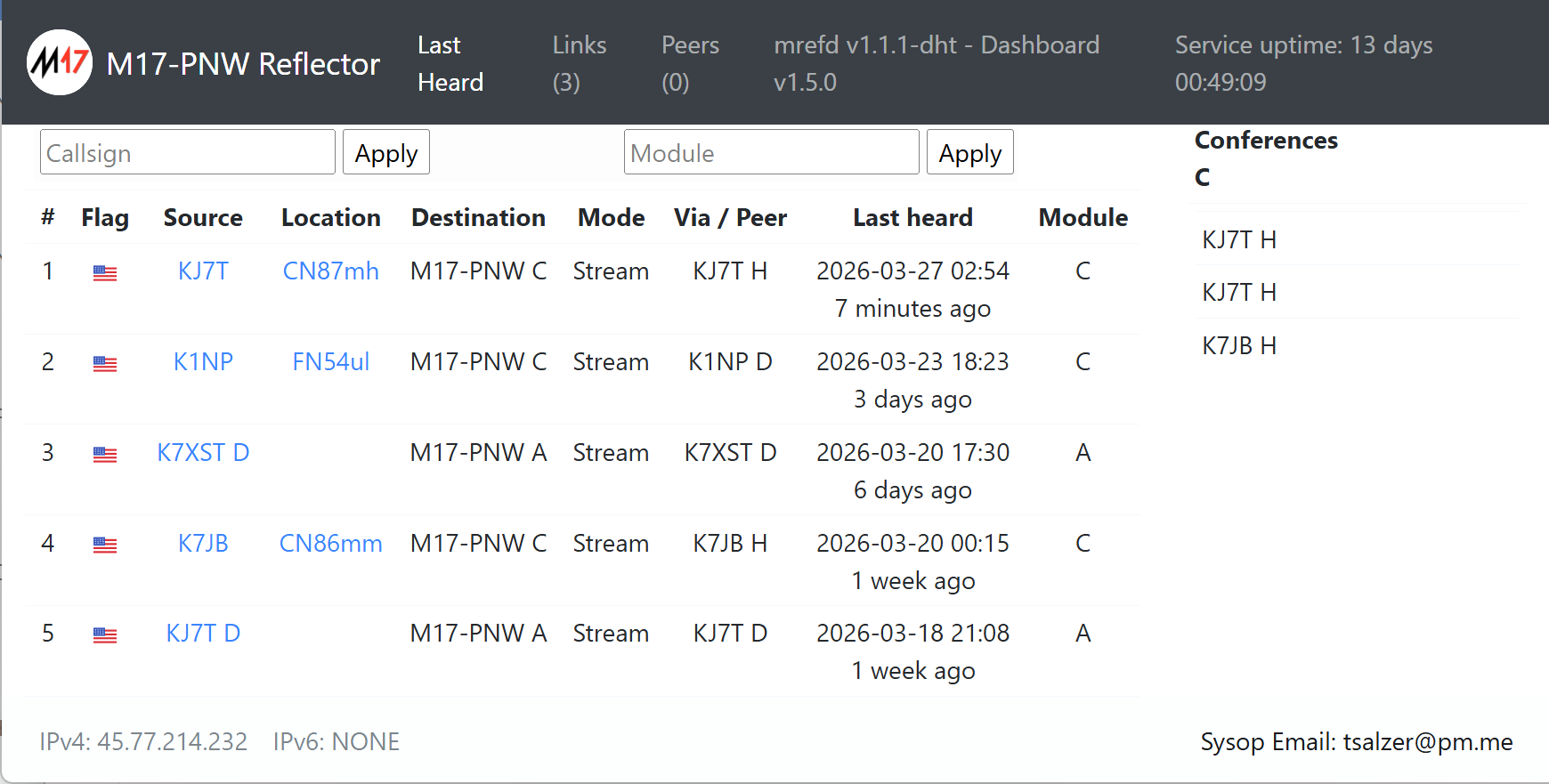
I thought about trying to write a tutorial on upgrading this radio, but honestly, I’m so confused by the several hours of work I did that I don’t think I can. Translation: I don’t remember what I did that worked. If you know of a clear tutorial, please do share it.
Catch Up with M17
Let’s catch you up with some significant happenings in the world of M17.
m17-gateway 0.5.0 released (March 6) — A significant update was announced for the M17 Go tools project. The new release adds support for three hardware platforms: the CC1200 Pi HAT (original), the SX1255 Pi HAT (newly added), and MMDVM-compatible hotspots and modems. All three platforms now support the full M17 feature set including voice, SMS messaging, and GNSS-based station position mapping. Both the SX1255 and MMDVM platforms support full duplex operation, meaning they can be used as full M17 repeaters, not just hotspots. More at: m17-gateway now supports three hardware platforms including SX1255 HAT.
LinHT hardware continues to advance A new LinHT image was uploaded on February 28 by Andreas OE3ANC, featuring updated repos, removal of gr-bokeh dependencies (making builds faster), updated raylib, and a changed default sample rate to 125k. PCBs and stencils for Rev A are in Czech Republic and ready for assembly, with Rev B still in the works. More at: LinHT – Yocto image update.
Active GitHub development The M17 Project’s GitHub repositories show active commits through mid-March 2026, with updates to the SX1255 HAT hardware, LinHT utilities, Remote Radio Unit firmware, and the Raspberry Pi interface for digital voice modes. More at: M17 Project.
One notable background item from mid-2025 worth knowing about: MMDVM dropped support for M17 in July 2025, which was a significant development for the ecosystem. WPSD was forked to temporarily continue support for M17 on MMDVM-equipped hotspots. The m17-gateway 0.5.0 release adding MMDVM-compatible hardware support appears to be part of the community’s response to that. More at: MMDVM Project Drops Support for M17 Mode.
As long as I’m dwelling for a moment on M17, you might be interested in how it compares to some other common digital modes. I crafted this side-by-side summary with the help of Claude:
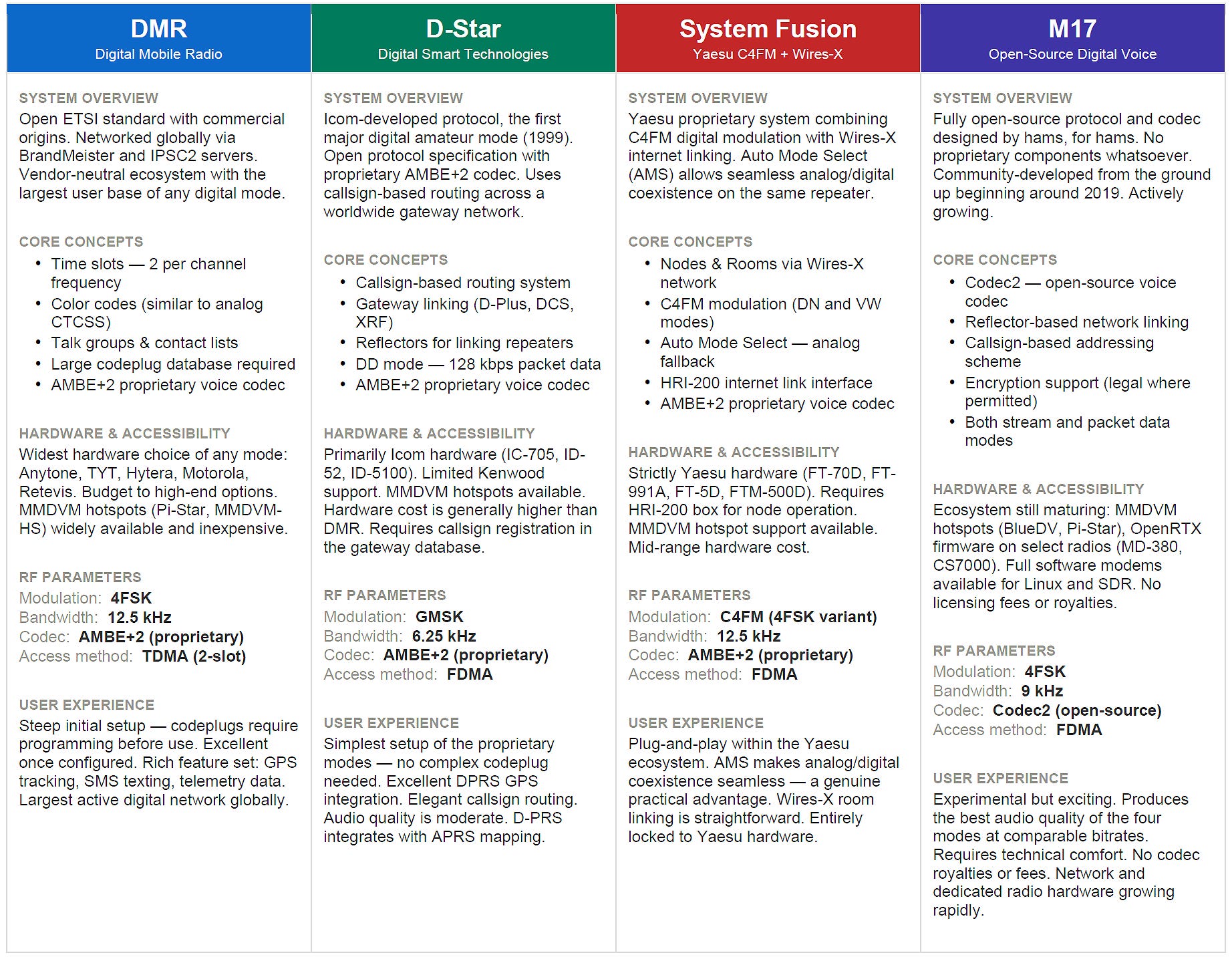
Note: DMR, D-Star, and System Fusion all use the proprietary AMBE+2 codec (DVSI). M17 uses Codec2, a fully open-source alternative developed by David Rowe. All four modes require a valid amateur radio license to transmit.
UPS Hat on a Raspberry Pi Zero 2W
This proved to be too long of a write-up for the Random Wire newsletter, so I’ve published it at EtherHam.com: UPS Hat on a Raspberry Pi Zero 2 W
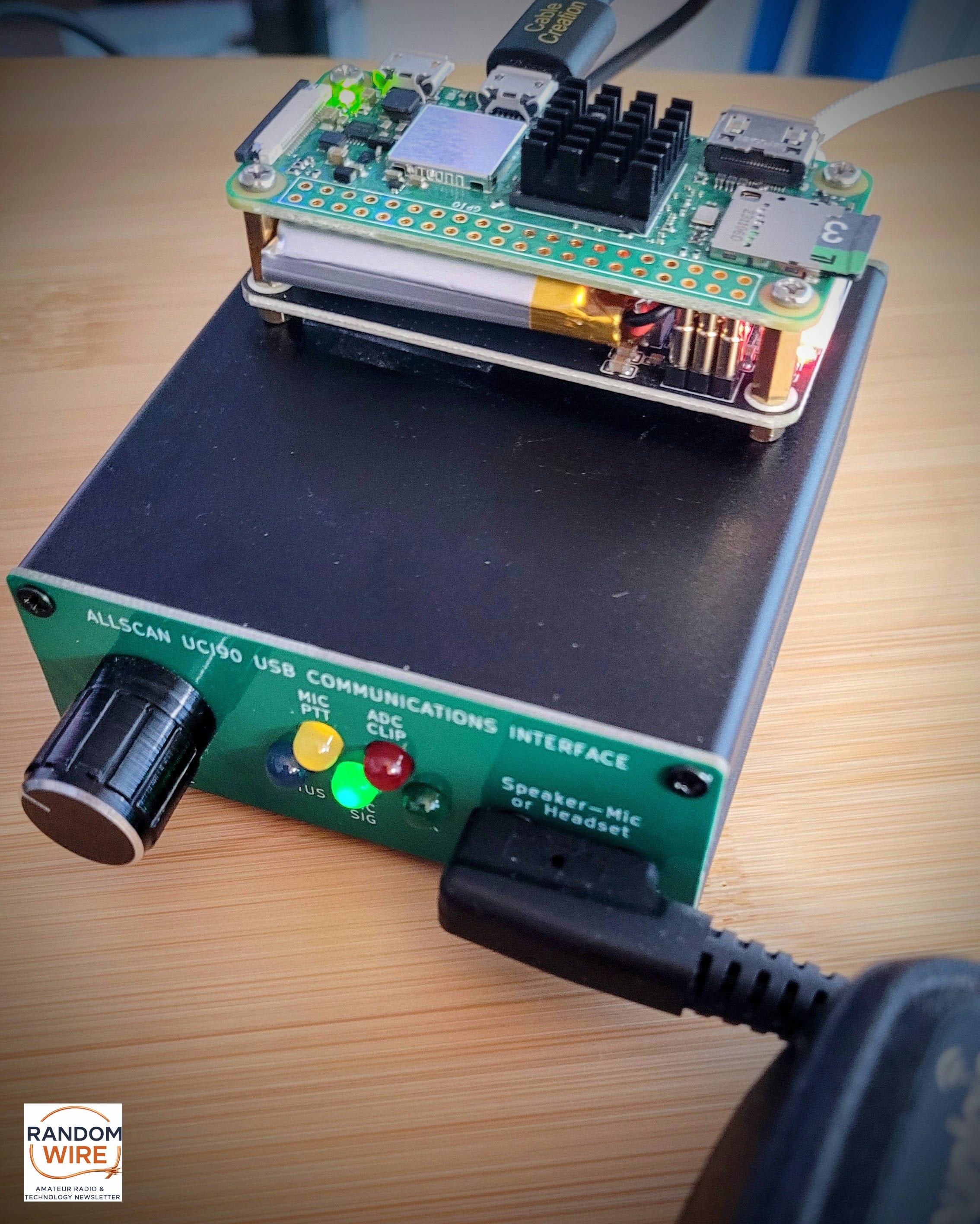
Is this a useful modification to a Raspberry Pi Zero 2 W? Yes, it definitely is. This project should have gone smoothly but, as is my way, it didn’t. The things that might trip you up are explained in the article.
One of the great benefits is after shutting down the node, I can slide the UPS switch to the “off” position to completely sever power to the node. Starting the node amounts to simply sliding that switch to the “on” position. No more plugging and unplugging the microUSB cable on the Raspberry Pi. That’s handy.
EtherHam Updates
What an interesting couple of weeks over at EtherHam.com. Interesting how? The site has been getting attacked by bad actors trying to log in as me. I deleted that identity and created a new one that is more obscure than my name. (To all you IT security folks, yes, I know: security through obscurity doesn’t work. Except it actually is helping in this case, because now I can trigger lockouts based on the invalid user name.) I have multiple security layers in place on the website that are working well together.
I added the Contest Calendar’s 8-day contest calendar feed to the EtherHam Mega Feed. The Contest Calendar is an amazing site, chock full of information. If you enjoy contesting, or maybe you are thinking about checking out some contests, head over to Contest Calendar by Bruce WA7BNM at https://www.contestcalendar.com/.
For accessibility, I also enabled a Listen to this service that will read a post to you. It’s a button at the top of each post that looks like this:

I have to say, though: it’s really not all that great. I selected a male UK voice because the US male voice was way too boomy. When I listen, I hear the endings of sentences running right into the beginning of following sentences. Listening to long blocks of code being read back to you is about as boring as it gets. However, for some of us, if we can listen and read at the same time, it helps with comprehension and retention. There are also some of us who need or prefer to hear it, rather than read it. I’m going to give this a try and see which way the comments lean: pro or con. If it’s important to you, please weigh in.
Short Stack
Here it is, the Short Stack of interesting items from the interwebs.
Radio
Could JS8Call Become a Gateway for Resilient Communication Networks? — “Unlike many traditional digital modes, JS8Call is designed specifically for structured messaging, not just contacts…JS8Call fills the long-range messaging gap between local mesh systems and global communication.”
SDR
Rundown and Ranking of SDR Radios for Amateurs — A comparative guide to SDR hardware specifically for the amateur market. Essential reading if you’re choosing your first or next SDR. Included are some comments identifying two SDR radios missed in the original review.
OpenWebRX web-based SDR receiver — “OpenWebRX is a multi-user SDR receiver that can be operated from any web browser without the need for any additional client software. It is the ideal solution to provide access to the HF spectrum at your location of choice to a wide audience. All you need is a computer, an SDR device and network access.”
SIGINT: Relying on CW Capture with your SDR — Julian OH8STN explores using SDR for CW signal capture in off-grid scenarios — a practical intersection of digital tools and traditional operating.
Scott recommends the new Echo Global SDR iOS App — “Echo provides connectivity to over 2,000 remote SDR receivers (KiwiSDR, OpenWebRX, WebSDR, and FM DX), accessible by multiple search capabilities including a world map display, offline frequency library, station logging, and, owing to its native iOS development, features full background audio for uninterrupted listening. The iOS version supports both iPhone and iPad. More information is available at https://echosdr.com.”
Mesh / Off Grid / Lora
Introducing an AREDN Chat Client — New chat functionality for the AREDN mesh network ecosystem. A notable development for anyone building or operating RF-based data networks.
GhostNet and the Future of Off-Grid Communication: From Concept to Architecture — An ambitious conceptual piece on building resilient off-grid communication architectures using amateur radio digital modes.
T-Display-P4 devkit with ESP32-P4, ESP32-C6, and SX1262 LoRa transceiver — New hardware combining a capable MCU with a LoRa transceiver in a compact form factor — interesting for digital experimenters building portable nodes.
IP / Computing
IP400 Project Marks Halfway Point — Progress update on the IP400 project, which aims to bring IP networking to amateur radio infrastructure. Worth watching.
Newsletters
Zero Retries — Steve Stroh’s weekly newsletter is consistently the best single digest of what’s moving in the amateur digital radio space. If you read only one newsletter, make it this one.
Random Wire 175 — Last week’s issue touched on WiRES-X, AllStarLink 3, the Icom IC-7300 MK2, M17, and more — a broad sweep of the digital voice landscape in one place.
Amateur Radio Weekly — Also recommended is Amateur Radio Weekly. It always has a variety of interesting finds and is one of the few weekly items I look forward to receiving. For even more, check out the daily edition at https://daily.hamweekly.com/.
📡 Band Conditions This Week
New this week is a summary of HF band conditions. This digest was generated on Wednesday, April 1, 2026. On Thursday, conditions were changing. The K-Index has bumped up to 3.0 (unsettled, minor degradation possible), the A-Index is 27 (active), and the Sunspot Number has increased to 59.
Solar Flux Index (SFI): 113.0 — Moderate — reliable HF propagation
K-Index: 2.0 — Quiet — good conditions
A-Index: 14 — Unsettled
Sunspot Number: 44
Active Solar Regions: 297
Solar activity is sitting in a comfortable middle ground this week, with an SFI of 113 and a relatively calm K-index of 2, meaning the higher HF bands are worth your time — 17, 15, and even 10 meters should be showing some life for DX, particularly during your daylight hours. The A-index of 14 is slightly elevated, so don’t be surprised if propagation feels a little unsettled at times, but nothing severe enough to keep you off the air. If you’ve been waiting for a good window to chase some DX or work some long-haul contacts, conditions are decent enough to reward the patient operator.
Source of data: NOAA Space Weather Prediction Center
Generated: 2026-04-01 17:02 UTC
📻 This Week in Radio History
Also new this week is a look back at radio history.
Notable events from March 27 through April 3, across the years:
1933 — On April 1st, the Amateur Radio Relay League officially moved its headquarters from Hartford to Newington, Connecticut, where it has remained ever since. What started as a relay network connecting operators across the country had grown into an organization substantial enough to need a real home, and Newington became that anchor. If you’ve ever made the pilgrimage to visit the ARRL or toured the W1AW station, you’re walking ground the organization has called its own for nearly a century.
1964 — On March 27th, the most powerful earthquake ever recorded in North America — a magnitude 9.2 — struck Alaska on Good Friday, devastating Anchorage, Valdez, and the surrounding region. The tsunami that followed reached as far south as Oregon. When the shaking stopped, virtually every conventional communication system in the state had failed. What filled the void was amateur radio. Hams across Alaska — Anchorage reportedly had more licensed operators per capita than anywhere else in the country at the time — took up posts at critical locations around the city and became the primary link between stricken communities and the outside world. Their work was significant enough that the USPS issued a commemorative 5-cent Amateur Radio stamp later that year, with the first-day ceremony held in Anchorage. The Alaska-Pacific Emergency Preparedness Net, established in the earthquake's aftermath, still operates today on 14.292 MHz — a living legacy of that Good Friday response.
1973 — On March 30th, the last regularly scheduled commercial transatlantic radiotelegraph service wound down, closing a chapter that stretched back to the earliest days of wireless. Those point-to-point Morse circuits had carried everything from stock prices to wartime dispatches, and their operators were among the most skilled in the world. It’s a quiet reminder that the code skills hams still practice today once formed the backbone of global communications.
Signing Off…
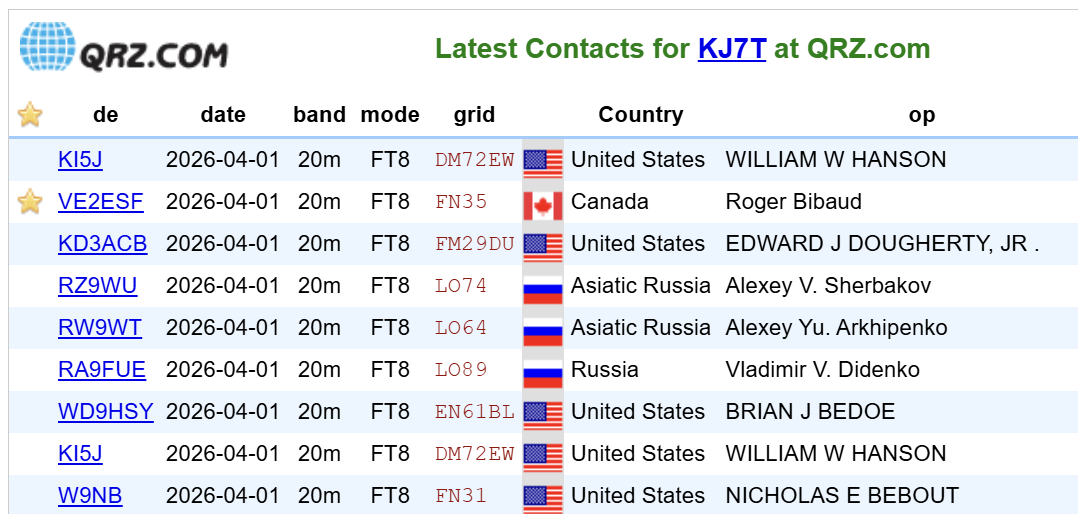
I had a busy weekend, working on the UPS hat for the Raspberry Pi Zero 2 W and then taking a day to pop down to Portland to take care of things at the Oregon QTH. After that, I got pulled into the rabbit hole called Python coding. On Tuesday, after checking into our local 10-meter net, I tried to work FT8 for a little bit but band conditions that evening weren’t good. However, I had sporadic luck on 20 meters via the polar route, perhaps reflecting increased ionization of the atmosphere.
Meanwhile, the local weather here on Planet Earth has been unsettled: sunny one day, big fat raindrops the next. It’s spring in the Pacific Northwest so this is to be expected.
I’ve been experiencing really overwhelming noise on 10 meters, and in talking about this with a local ham, I’m going to take a look at my battery chargers. He mentioned that his Ryobi-brand charger was emitting a lot of noise so I’m going to unplug all of my charging devices and see if that makes a difference.
As always, I wish you and yours health and happiness. I look forward to hearing about your radio activities, and particularly about what went right and about those learning moments we all have.
73, and remember to touch a radio every day!

I eagerly read your weekly issues. One problem: I usually start on my Android cell phone while eating breakfast. The issues are too long to read the email delivered, so I click on the "view entire message" link at the end of the email. That takes me to a version of the issue that is vrey difficult to read on my phone because the lines of text are so long that I must shrink the issue to see the entire lines and the font becomes so small that I usually can't read the issue, and must retire to a computer to comfortably read the issue. Is there a way to make the issue more responsive to the device I am using?
Great Job Tom! Entirely Zero Retries Interesting!