

0 ~ QRV: Ready?
Hamvention
How was Hamvention? I wasn’t able to go, but during the event, I got emails from ham friends who were there. It sounds like it was a grand time.
As I expected, Yaesu did announce the new DR-3X repeater series. I’m sure we’ll be learning how some of the new/advanced features play out and what that means for your existing Yaesu radios.

1 ~ Thank You to…My Local Club Members
When I was a brand new ham with a shiny Technician ticket, I had a handheld transceiver. With that, I participated in nets on the local 2 meter repeater and worked satellites with a handheld Yagi antenna. I got a lot of mileage out of very little gear and I learned a lot.
Today, I want to say thank you to my club members — the ones who helped me get started, who encouraged me along the way, and who continue to help others join and enjoy this great hobby.
There really are too many to list, but some stand out for me. (If I left you off the list, I blame age and memory!) Some of the folks who have been impactful in my amateur radio journey include:
Gary AC7VA — That free MFJ antenna tuner made it possible for me to get on HF once I built my antenna and got an HF rig!
Lee W7FBI (SK) — I have an old Kenwood TS-520S I bought from W7FBI (SK) in good but “well loved” condition. It still has Lee’s #2 pencil marks on the Drive dial. I enjoyed this radio very much during the earliest part of my amateur radio journey, getting on HF with a homemade off-center-fed antenna.
Dave N7HT — I never — never! — would have been able to get my Extra Class ticket without his tutelage. His patience with me was astounding. I didn’t understand most of the terms so he built my knowledge from the ground up.
Brian NT7Y — Brian held the club together during the challenging Covid years and I usually chat with him in person every week.
Jeff W7NEE — Leading the charge into digital radio for our local ham radio community, including standing up a YSF/WiRES-X repeater.
Ben AB7I — Club president for several years, expanding meeting content and pulling in new members. A local POTA master.
Anne AI7PS — She has picked up the POTA torch and is running with it!
There really are many other folks who have been great to me. I feel lucky to be part of such a great group of amateur operators who also like to help others.
2 ~ No M17 Net on Saturday
It is Memorial Day weekend. Last Saturday, Jeff AE5ME announced there would be no M17 net on Saturday, May 23, because of the Memorial Day weekend. This net is normally held every Saturday at noon Central time and is carried over America’s Kansas City Wide Network.
3 ~ New on EtherHam
It was another big week for deeper content on EtherHam.com with five new articles: three articles relating to Raspberry Pi computers, one about selecting a computer for your home AI platform, and a very deep dive into updating a stubborn MMDVM hat.
Headless Raspberry Pi 4 in the Home Lab: A Practical Setup Guide — “Setting up a headless Raspberry Pi 4 as a utility machine in the home lab sounds straightforward — until you’re forty-five minutes in and wondering why you can’t connect to your own machine. This guide covers OS selection, SSH, IP reservation, RustDesk remote desktop, firewall setup, and a few hard-won lessons about dummy plugs and drifting IP addresses.”
How to Back Up and Restore a Raspberry Pi microSD Card with Win32 Disk Imager — “MicroSD cards fail. If you run Raspberry Pi-based AllStarLink nodes long enough, it’s not a matter of if — it’s when. Win32 Disk Imager is a solid free tool for creating and restoring card images, but the interface offers almost no guidance and there’s a gotcha when restoring to a replacement card that trips up a lot of people. This guide covers the complete workflow, including a tool called PiShrink that most Pi users probably don’t know about.”
You Want a Home AI Machine. You Can’t Find a Mac Mini. Now What? — “The standard advice for running AI locally has been consistent for over a year: get a Mac Mini M4. Apple Silicon’s unified memory architecture is well-suited to the task, Ollama works out of the box, and the thing runs nearly silently. The problem is that right now, in mid-2026, Mac Mini M4 models are scarce and expensive — $1,000 or more if you can find one at all. The eBay refurb play that used to work on Apple hardware? Gone. So let’s talk about what you can actually buy today.”
Undervoltage Shutdown Monitor for Raspberry Pi AllStar Nodes — “Most inexpensive USB power banks aren’t true pass-through devices — connect or disconnect a charger while the Pi is running and you’ll get a hiccup just long enough to cause an unclean shutdown and risk microSD corruption. Here’s a lightweight bash script and systemd service that uses the Pi’s built-in
vcgencmdto detect undervoltage and shut down cleanly before the bank dies completely.”Unlocking the “Locked” MMDVM Dual Hat: A Firmware Recovery Guide — “If your MMDVM Dual Hat hotspot is throwing a “locked by vendor” firmware update error, don’t order a new board yet. There’s another way in — and it involves a $10 tool that embedded developers use every day but most ham operators have never heard of. This guide walks you through the complete procedure for recovering and updating your board’s firmware using an ST-Link V2 programmer, written by a ham operator who learned it the hard way so you don’t have to.”
4 ~ Gear
Another AllStar Node
Since I had put together the Raspberry Pi 4 for an EtherHam post, I decided to purchase another AllScan UCI80M and Motorola microphone to make a new AllStar node. It took just a few minutes because I already had the Raspberry Pi 4 built and configured.
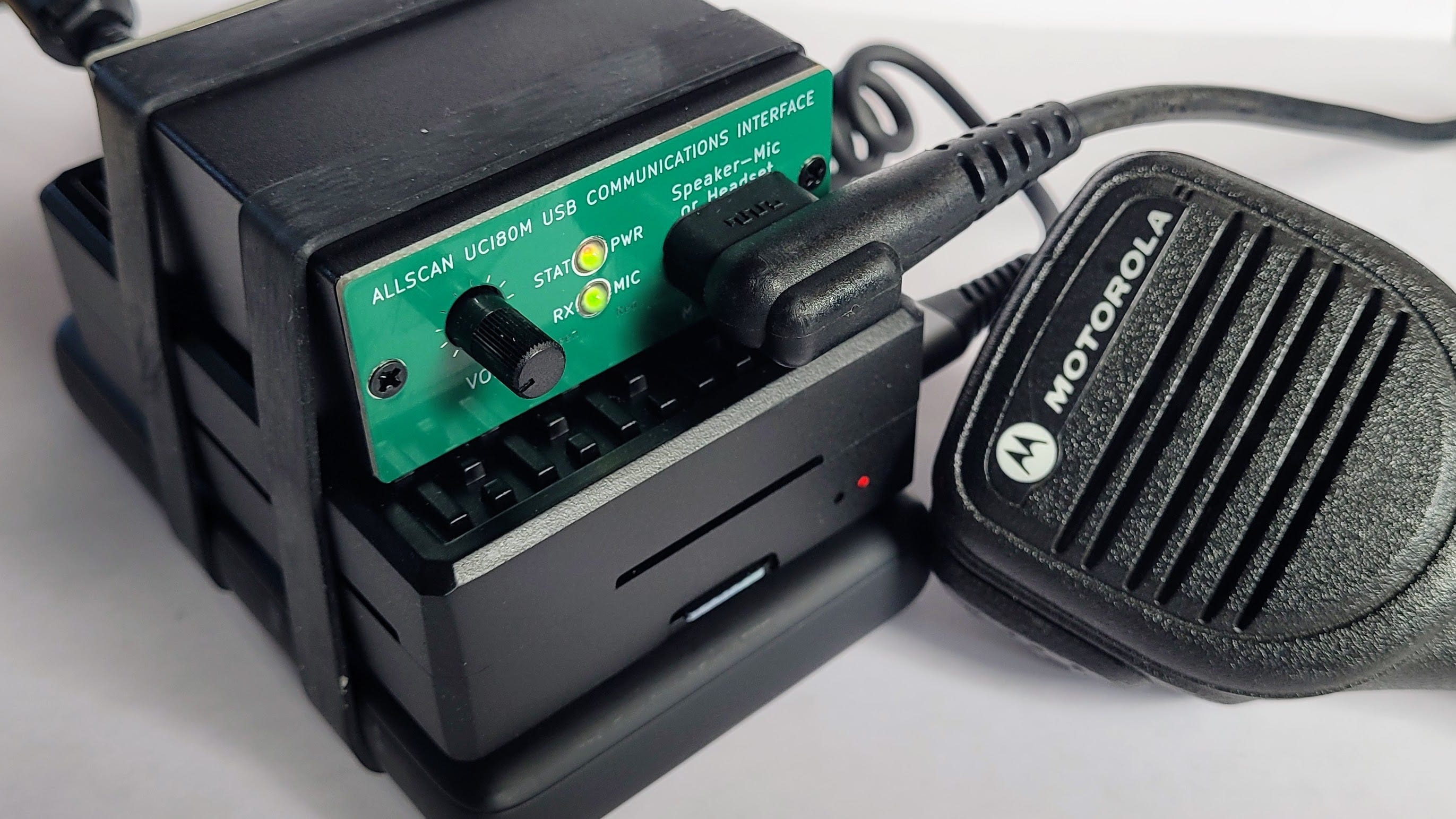
There are three layers in this stack: hardware, software, and configuration settings. The resources I used for this build are documented in these four EtherHam posts:
I now have an AllStar node that announces the IP address when it boots up and I can shut it down with three clicks of the speaker-mic. I also installed one of my favorite AllStar apps:
I set up this node to use my home wifi or my cell phone when the phone is in hotspot mode. When I travel, I’ll hear the IP address of the connection with my phone, allowing me to open AllScan on my phone.
AllStar Node: Case With UPS
I continue my experiments with using a battery system to power an AllStar node. In fact, I wrote up my work about a shutdown script that is supposed to safely shut down my node when the battery voltage starts to sag. Unfortunately, my premise was faulty. I expected USB power banks would show declining voltage as they neared exhaustion. That’s not what happened. The onboard battery management system on these USB banks has maintained voltage until it couldn’t any longer, then it abruptly shut down the power bank.
Aligned with my interest in using a battery with an AllStar node, I ordered a Pi-Shop Raspberry Pi 4 case with room for an uninterruptible power supply hat. This will be for an AllStar node that will be used at home and mobile. The reason for the UPS is to allow me to disconnect the node — while it is running — and move it to the vehicle without shutting it down.
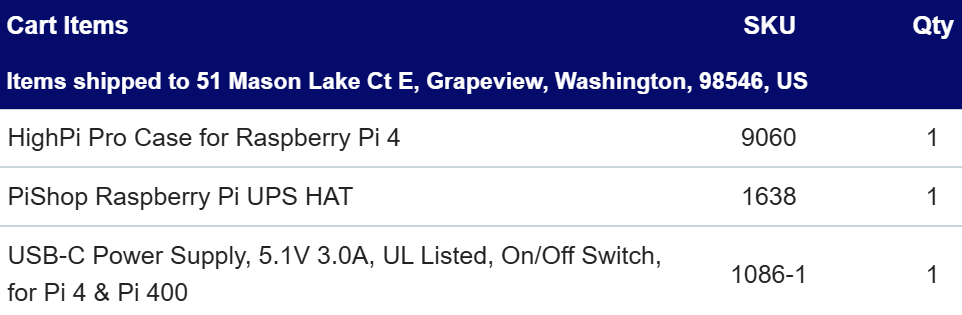
This package is scheduled to arrive next week. I’m looking forward to putting it together. I continue to experiment with USB power banks as a power source for an AllStar node, but building a system with a built-in battery just makes sense.
Running rtl_tcp.exe as Service on Windows 11 Pro
If you’re using an RTL-SDR dongle as a network source for SDR++ or other software, you may want rtl_tcp to start automatically when your PC boots — without having to remember to launch it manually. The obvious solution is to register it as a Windows service. The problem is that rtl_tcp.exe is a console application, not a proper Windows service, and the Service Control Manager expects a program to “check in” after launching. When it doesn’t, you get Error 1053 and the service dies.
The fix is a wrapper called WinSW (Windows Service Wrapper), available at https://github.com/winsw/winsw/releases. Drop WinSW-x64.exe (renamed to winsw.exe) in the same folder as rtl_tcp.exe, then create a simple XML config file (named winsw.xml) alongside it:
<service>
  <id>RTL_TCP</id>
  <name>RTL_TCP</name>
  <description>RTL-SDR TCP Server</description>
  <executable>C:\SDRPP\rtl-sdr\rtl_tcp.exe</executable>
  <arguments>-a 192.168.68.65</arguments>
</service>
From an admin PowerShell in that folder, run .\winsw.exe install followed by .\winsw.exe start. Your RTL-SDR TCP server will now survive reboots on its own.
5 ~ If You Want to Work the ISS on APRS
It appears the only working APRS radio on the ISS at the moment is the Kenwood D710GA in the Zvezda Service Module, call sign RS0ISS. More information is available on the ISS Ham Radio Status page. and you can check recent activity on APRS.fi.
As of now, the active ISS APRS station is:
Callsign: RS0ISS
Frequency: 437.825 MHz FM
Mode: 1200 baud APRS packet on 70cm/UHF
If you plan to work the ISS on APRS, remember that Doppler correction matters much more on 437.825 MHz than it did on 145.825. This means pre-programming multiple memories (±10 kHz steps) is now much more important for successful packet decoding.
6 ~ Short Stack from the Interwebs
Radios & SDR
I turned my browser into a worldwide radio scanner, and I wasn’t ready for what I heard — “Then I discovered KiwiSDR, which made radio scanning and OSINT way more approachable. It takes a High-Frequency (HF) receiver a step further and adds a built-in Ethernet port and web server, making it visible and controllable online. Now, instead of needing expensive transceivers, I can open a browser and control radio receivers that other people have already set up, connected to real antennas, across the globe.”
Comparing the Icom R75, JRC NRD-545, Yaesu FTDX 1200, and Perseus SDR on Shortwave — “For shortwave listeners and radio hobbyists trying to decide between a tabletop communications receiver, a ham transceiver, or an SDR setup, this comparison offers practical insight into how these radios perform in actual listening conditions rather than on paper specifications alone.”
Digital Radio
Rhizomatica releases Mercury, a fully open-source modem for data communications on HF — “Rhizomatica is pleased to officially launch Mercury, a completely open-source Digital Radio OFDM protocol for HF broadcast and peer-to-peer ARQ connections with compatible TCP interfaces, built for reliable store-and-forward email and file transfer over HF radio links.”
Beta/test version: PinPoint APRS v2.2 Build 260517 (May 17, 2026) — I’m running this beta version and it seems fine. Find the details here.
APRS status on the ISS — “Please note we're still in the process of troubleshooting and testing this radio. APRS is currently active on 437.825 MHz. Feel free to check out status reports here.”
AREDN Mesh – Beginners Guide For Joining A Network — “Presentation on AREDN mesh for beginners.”
Antennas
Guide to Prepping for ARRL Field Day 2026: Part 3, Antennas — “In Part 3 of our series on prepping for ARRL Field Day 2026 (June-27-28), we’ll be looking at some of the Field Day antenna options available at DX Engineering…”
Computing & Artificial Intelligence
GMKtec Mini Gaming PC, 1TB SSD 32GB RAM, AMD Ryzen 7 8845HS(Up to 5.1GHz), Mini Desktop Computer, Oculink, Dual RJ45 2.5G, NucBox K8 Plus — If you are thinking of a standalone AI platform on your network, this PC may fill the bill. A Mac Mini M4 is ideal, but they are scarce as hen’s teeth now…and if you do find one, they are priced accordingly. This GMKtec has a desirable AMD CPU, fast DDR5 memory, and the option to add an external GPU via the Oculink port. This is the best price I’ve found for this platform. (Not an affiliate link.)
Local LLMs have one advantage ChatGPT and Claude can’t match, and it’s why I’m switching — “With a local LLM, when you're working strictly on your computer, your material and your work don't have to leave your computer, go to a server, and then come back. No third party collects or stores your information — it stays entirely on your device…This is where a local LLM shines: it’s one you truly control. Yes, if you don't have a supercomputer, it's not going to be the same experience as a cloud AI.”
Top Raspberry Pi Gear for Ham Radio Enthusiasts — “The Raspberry Pi is a small, affordable computer that opens up a world of possibilities for amateur radio enthusiasts.”
5 things my Raspberry Pi travel router can do that other travel routers can’t — “The travel router I built out of a Raspberry Pi can do everything a regular travel router can, but it can do almost anything else you can imagine.”
7 ~📋Digital Radio News Digest
Summary
Recent developments in amateur radio digital voice and VoIP linking modes include updates to AllStarLink, with new API and automation features, as well as discussions on M17 packet mode data and activity at Hamvention. Additionally, there have been updates to the MMDVM Host and app_rpt software. The OpenRTX firmware has also been updated with a new ADC driver for the AT32F423.
Per-Mode Breakdown
DMR
The MMDVM Host software has been updated to modify the JSON to be more consistent. A new Brandmeister DMR app for Windows/Linux called VoxDMR has been announced on Reddit.
D-STAR
There is no significant recent development for D-STAR in the collected items.
YSF/C4FM/WiRES-X
There is no significant recent development for YSF/C4FM/WiRES-X in the collected items.
M17
The OpenRTX firmware has been updated with a new ADC driver for the AT32F423. The M17 Users Groups.io has discussed various topics, including M17 packet mode data, activity at Hamvention, and the use of the MMDVM_HS_Dual hotspot in M17. The m17-gateway has added SX1255 HAT support and an experimental messaging bridge.
VoIP Linking
AllStarLink has introduced a new API and automation features, including a REST API and guarded AI tool access for ASL3 nodes. The app_rpt software has been updated to version 3.9.1, with additional commits to fix issues with locks and Echolink audio processing. The Amp-ASL amp-server has also been updated with several commits to fix defects and improve functionality.
Cross-Mode Developments There are no significant cross-mode developments in the collected items.
Generated: Last run: 2026-05-21 17:16 UTC -- 50 items collected
Download the collection (with URLS): https://etherham.com/download/179602489/?tmstv=1779385736
8 ~📡Band Conditions This Week
Conditions have settled nicely heading into the weekend, with a current K-index of 1 and a predicted A-index of 7 pointing to quiet, stable propagation — good news for anyone planning some air time. With an SFI of 93, the higher HF bands aren’t exactly on fire, but 40 and 20 meters should be reliable workhorses for both regional contacts and modest DX, and 80 meters will reward the night owls. Worth noting, though: the week wasn’t all smooth sailing — that 7-day max K-index of 6.3 means we had at least one genuine geomagnetic storm roll through, so if your logbook looks a little thin from mid-week, that’s likely why.
By the way, May often coincides with strong sporadic-E propagation in the Northern Hemisphere.
Solar Flux Index (SFI): 93.0 — Fair — lower bands performing better
K-Index (current): 1.0 — Quiet — excellent conditions
K-Index (7-day max): 6.3 — Storm conditions — significant HF disruption
A-Index: 7 — Quiet (predicted)
Sunspot Number (NOAA/USAF daily): 20
Sunspot Number (SIDC daily EISN): 87
Active Solar Regions: 8
Source: NOAA Space Weather Prediction Center (swpc.noaa.gov) + SIDC (sidc.be).
Generated: 2026-05-21 17:02 UTC
9 ~ 📻This Week in Radio History
May 18, 1980 — Mount St. Helens Eruption and Emergency Communications
The eruption of Mount St. Helens knocked out telephone infrastructure across a wide area of southwestern Washington, and amateur radio operators stepped in — supporting search and rescue coordination, damage assessment reporting, and liaison with government agencies. What's less widely remembered is that hams had been providing informal communications support during the weeks of precursor activity beforehand, as earthquakes and steam venting drew researchers and observers to the area starting in late March. The mountain gave plenty of warning; people were already watching it closely when it finally let go.
I am sharing this because it was impactful to me but not in the way you might think. The month before Mount St. Helens erupted, I had moved to Nevada to take a job as a mining geologist. As a geologist, I had watched for an eruption for years. I was tremendously disappointed to have missed this one.
10 ~ QRT: End Transmission
Another thank you
Hiding in my emails late last week was one from Michael, noting his donation to support the Random Wire and EtherHam, and telling me a bit about himself. If you’ve donated support for the Random Wire and EtherHam and I didn’t get in touch, please reach out to me. Michael, I’m glad I saw your message! I do want to say thank you because I appreciate the support very much. It helps.
Still working on the TIDRADIO TD-H9 radio
I’m still trying to figure out automatic beaconing on the TD-H9 radio. It’s mysterious. It beacons sometimes, but not predictably. I thought maybe it has Smart Beaconing built in, which would mean it would slow down beaconing while stationary and increase the frequency of beacons while moving. Nope, that didn’t happen. The beacon timing setting is also a bit of a black box as it doesn’t seem to make a difference what I enter there. I think my next angle is to install firmware updates and start over. The radio does beacon, but I can’t tell why it sometimes does and sometimes doesn’t.
Websites crashed
Several of my WordPress websites crashed this week. It turns out that one plugin was responsible for all of those white screens with the “critical error” message displayed. I found a couple of other helpful plugins: one that will automatically identify and disable a plugin that causes fatal errors and another that allows you to easily rollback a plugin to an earlier release. And then a fourth website crashed, but this time I was prepared. Five minutes later, it was running smoothly again. That felt like success.
Installed Open Media Vault
I did have fun — and learned a ton — by installing Open Media Vault on a Raspberry Pi 4 with an NVMe drive. I’m using an external USB drive for the file shares. This is preparation for installing and configuring OMV on my Proxmox server. First, I need to acquire a larger external drive so my daughter and I will have plenty of storage space!
A Bittersweet Memorial Day Weekend
Every year around Memorial Day, a few of my siblings and I make the trek to the other side of Washington State to take care of family graves. It’s an event that brings us closer together. Last year, I missed it because my spouse had a major medical event. This year I will miss it again because the medical condition has not resolved. My younger sister’s husband is also having some issues, so this year, she’ll miss it. I know all of our relatives in various cemeteries would understand. Me? I get a deep sense of peace visiting my grandparents, my mom and dad, my aunts and uncles and cousins. The great-grandparents. I will see them all again, and just wish conditions were right to visit them this year.
73, and remember to touch a radio every day!