
00 QRV: Are You Ready?
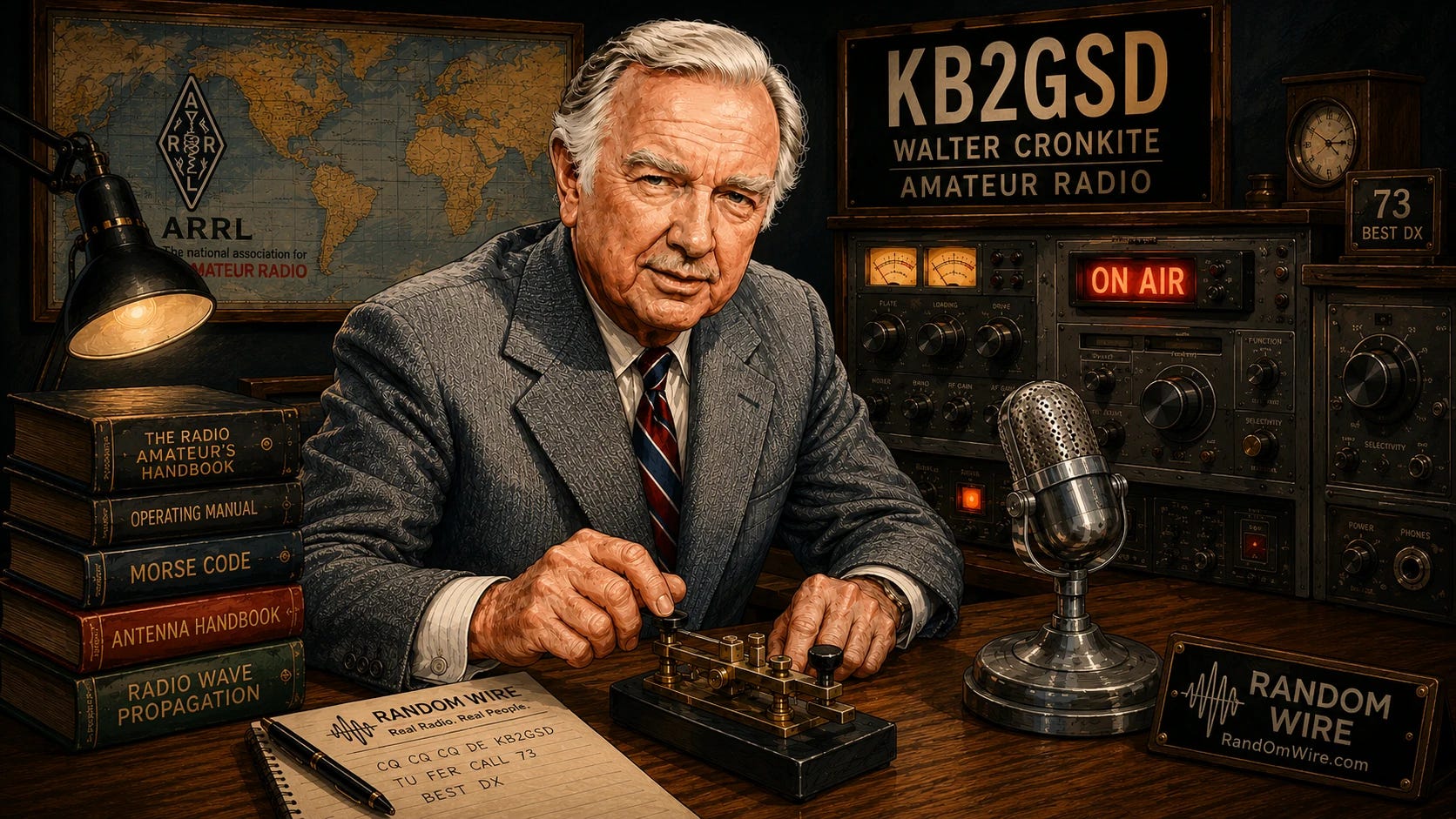
Walter Cronkite has been a silent key since 2009, so there is now an entire generation who know nothing about him…but I remember him. I remember his calm demeanor. I remember the feeling that this is someone who is telling me the truth. And I remember the origin story of Cronkite becoming a licensed ham. This strongly influenced my decision to seek my license, so Random Wire 187 opens with a thank you to Walter Cronkite KB2GSD (SK).
RW 187 also brings you:
Four new EtherHam articles
Some shack notes
An APRS device I ordered
The ARRL radio comparison table
A new music player on my network-attached storage box
Some gadgets (headphones and USB hubs)
My Panasonic CF-54 ToughBook needs a battery
An opinion piece about using AI as an assistive tool for hams that need some help
And the Short Stack of Interesting Internet Finds

01 Thank You, Walter Cronkite KB2GSD (SK)
Walter Cronkite was born on November 4, 1916 in St. Joseph, Missouri. His family later moved to Texas, where he spent most of his childhood, and his passion for journalism ignited when he read an article in Boys’ Life as a young boy. He enrolled at the University of Texas at Austin to study political science, economics, and journalism, but left school to take a position at the Houston Post — and never looked back.
His career accelerated during his time at the United Press, where he served as a World War II correspondent and afterward as Chief Correspondent for the Nuremberg trials. He joined CBS News in 1950 and was named anchor of the CBS Evening News in 1962. The defining moment that made him a household name was his announcement of President Kennedy’s assassination. Over nearly two decades behind that desk, he was the calm, steady voice that walked Americans through the moon landing, Vietnam, Watergate, and a string of national tragedies that might have broken lesser men.
He is the last news anchor I fully trusted, and I don’t think I’m alone in that. There was something in his delivery — no spin, no wink, no performance. He became something of a national institution, known as “Uncle Walter” to many, with an unflappable delivery and a voice that guided viewers through national triumphs and tragedies alike. On March 6, 1981, he anchored his final newscast and signed off with: “Old anchormen, you see, don’t fade away, they just keep coming back for more. And that’s the way it is.” For me, the world felt a little less reliable after that.
Now here’s the part that matters to us. At CBS, Cronkite was surrounded by hams — most notably his friend and the program’s radio engineer, Steve Mendelsohn, W2ML, who over time talked about the hobby often enough to ignite a slow-burning interest in his news anchor friend. Cronkite had even purchased a receiver and would listen on the bands from time to time, but he resisted taking the licensing exam because of the Morse code requirement.
The breakthrough came in the studio one evening before the nightly broadcast, when Mendelsohn needed to test the tone of the audio recorders. He grabbed a copy of the New York Times and sent Morse code with the tone key for ten minutes. After the broadcast, Cronkite walked into the control room and presented his script — on the back of it was the entire text Mendelsohn had sent in code. Mendelsohn and CBS Evening News Director Dick Muller, WA2DOS, exchanged a look and told Cronkite he had just passed the Morse code test. Cronkite laughed and asked when the formal exam was scheduled — only to learn that with two licensed general class operators present as witnesses, he had already passed.
Weeks later Cronkite took and passed the written test, and became officially licensed as KB2GSD. His first QSO was on 10 meters. He was immediately snubbed by a Midwestern ham who didn’t believe the famous newscaster was who he claimed to be: “That’s the worst Walter Cronkite imitation I’ve ever heard!” followed by, “Walter Cronkite is not even a ham, and if he was, he certainly wouldn’t be here on 10 meters.” Mendelsohn said the two of them laughed about that one for weeks. Walter Cronkite, KB2GSD, passed away on July 17, 2009 at the age of 92 — but this story of hams helping others become licensed is exactly the kind of thing that makes this hobby worth thanking people for.
02 New on EtherHam
After Elwood: A Survey of HamClock Successors and Alternatives — I take a look at the variety of HamClock-like systems available and manage to extend appreciation for Elwood Downey’s great contributions to our hobby.
Getting the Arduino UNO Q Running Headless with Remote Desktop — This is cutting-edge stuff for me and I’m enjoying it. The Q has been running quite well for a week. Since I booted it up, I’ve also learned you can run WSJT-X and GridTracker on it! I’ve not tried that…yet.
One Step Better: The Gamma 601 and the Bitaxe Firmware Underneath — The key takeaway: for three times the cost of the lightweight Nerd Miner, I’m getting 1,000 times more hashing.
Weekly Report: June 18, 2026 — Band Conditions This Week, Digital Radio News, and the Groups.io Digest.
03 Radios
“Touch a radio every day!” is my closing tagline for this newsletter. I certainly did that this week. I organized the chargers for various handhelds:
Yaesu FT-3D and Yaesu FT-5D
Connect Systems CS 7000-M17 Plus
Baofeng UV-5R Mini
Various TIDRADIO handhelds
I discovered that when I rebuilt the hotspot I use for YSF/C4FM, I changed the frequency. Rather than revert to the old frequency, I chose to manually reprogram two radios. I got the FT-3D configured with split TX and RX frequencies but have not completed that task with the FT-5D radio.
While I was doing these things, I was listening to our local C4FM repeater, to the W6EK repeater, to America’s Kansas City Wide network, and to the ISS. These regular stops provide good company all week. I also participated in the weekly M17 net held every Saturday on KC-Wide; I always learn new things there.
A radio friend asked for help so I spent some time testing an installation package for a radio system. Yes, I’m being a little cagey here because this package is not yet ready for prime time, but it is coming along very nicely. I’ll have more on this in a future issue.
On the HF side, I started organizing my HF rigs, too. I brought multiple Ten-Tec Scout radios with me to the lake house to test and haven’t had time to try them. My tried-and-true Yaesu FT-450D is in a Pelican-brand case next to my desk. The Icom IC-7300 MK2 is in my wife’s room. The other radios are in Harbor Freight cases, ready to be shifted to the garage.
04 APRS
I’ve been wanting to stand up a small fill-in digipeater, but I rarely have a lot of time to dig into projects like this. That’s why I was very pleased to see the LightAPRS Gateway by QRP Labs. I have one on order and am looking forward to getting it on the air.
Since I’m using my sister’s lake house right now, I can’t really drill holes in the wall to pass coax through. However, there are a few unused TV cable pass-throughs available. I have the bits and pieces coming to run coax from the galvanized chimney cap to a TV pass-through. While I know the TV F-connector and cable have 75-ohm impedance and we want 50 ohms, I don’t think it is going to make a lot of difference for this application.
What will make a difference is getting a good mag-mount above the roofline with a reasonable metal ground plane under it.
Maybe this will work fine, maybe it won’t. As is my way, I’ll try it and let you know how it goes.
05 ARRL Radio Comparison Table
This may be useful for radio amateurs: Find the Right Rig: New Comparison Tool for ARRL Members.
In the screenshot below, I tested by selecting handheld VHF/UHF radios with APRS capability:
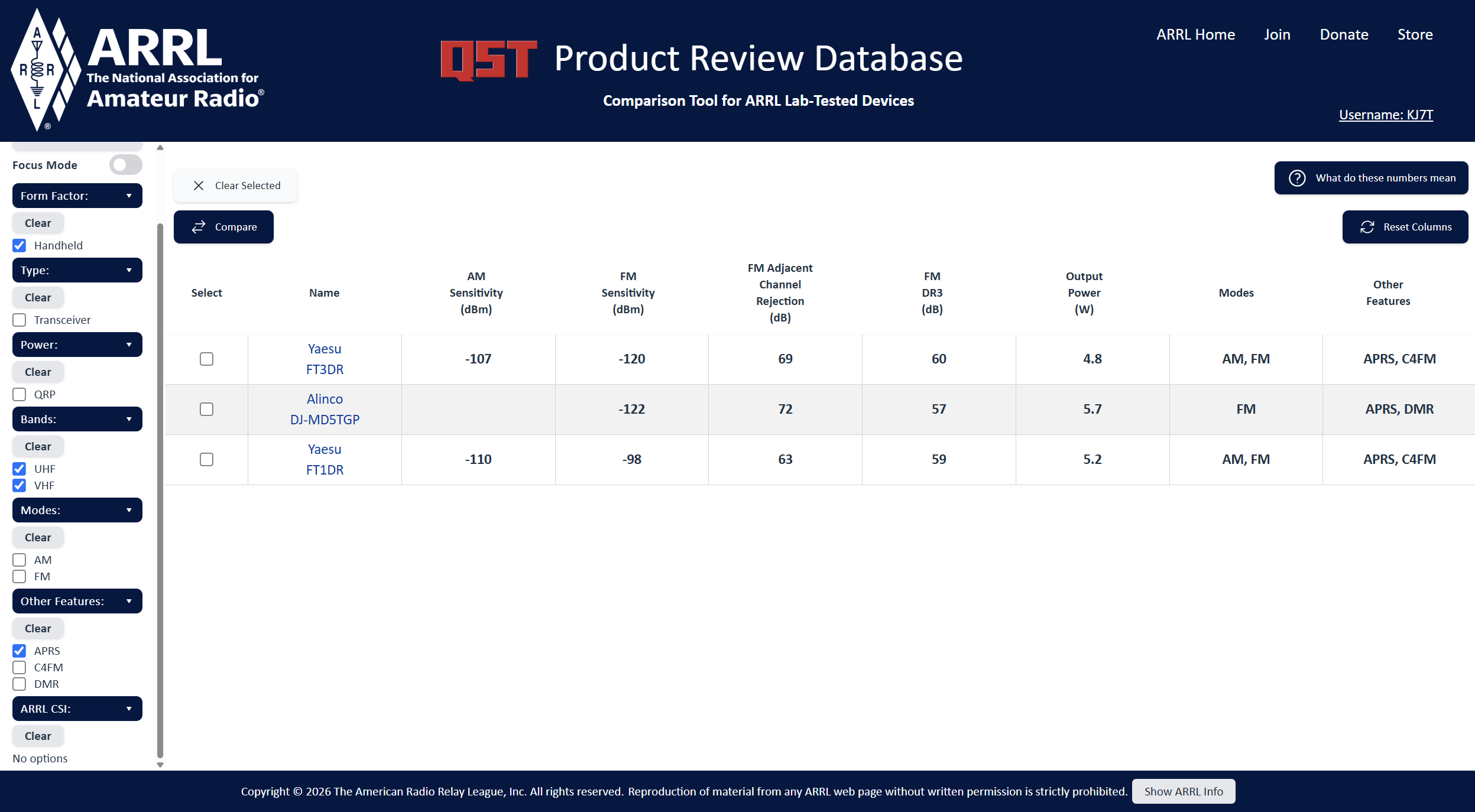
As you can see, there are a number of well-known APRS-capable radios missing from the list, including the Kenwood TH-D74/75 radios. Why? Because the database only covers radios tested by ARRL. If a radio wasn’t tested, it’s not in the database.
Testing by the ARRL is generally thorough, so if a radio is listed, you can have confidence in the summarized results and the detailed review of the device. If a radio is not listed, that does not mean it performs poorly — it just means ARRL hasn’t reviewed it yet.
06 New Music Player for the NAS
I got tired of the OwnTone interface — slow, clunky, and not particularly friendly. This week, I installed Navidrome, an open source music player/streamer. It is working quite nicely. Fingers crossed that it continues to do so.
I could have installed it in a Docker container, but there was no good reason to do so. Instead, I followed the Linux installation instructions to install it directly on the Beelink network-attached storage box. All went well and the interface looks very nice:
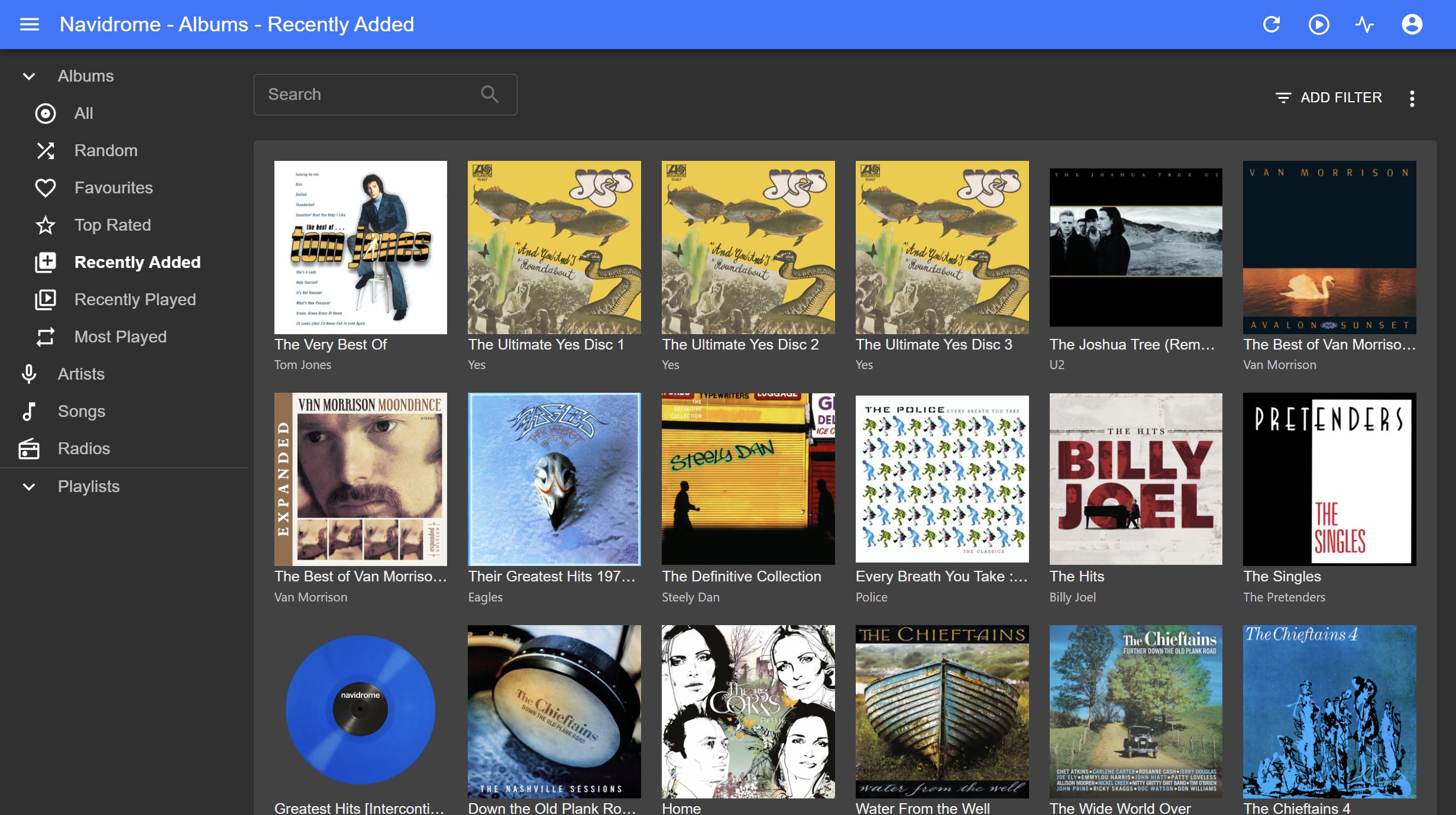
There are a variety of client applications for iOS, macOS, Android, Linux, and Windows that can pull from the Navidrome instance. It’s nice to have choices.
I’ve kept OwnTone for now because I have some audiobooks in it. In the meantime, I’ve installed AudioBookShelf as a potential replacement.
07 Gadgets
Headphones
I’m always on the lookout for comfortable headphones that sound good. I’m not an audiophile — my hearing is no longer good enough to hear the very highest notes. I’m also not a bass head, so that opens up possibilities with off brands.
I am pleasantly surprised by a pair of wired headphones that arrived this week:
NUBWO Studio Monitor Headphones, Hi-Res Wired Over Ear Headphones with 1/4 inch to 3.5mm Jack, 45mm Drivers, Professional DJ Headphones for Piano Guitar APM Recording Mixing-HD01 (Black) (this is an affiliate link)
They sound pretty good. I got them on a deal for $50 and so far, I think they are worth more than that. They are comfortable on my head and ears, and the sound is crisp and clear. These headphones come with two cables.
At this price point, long-term durability is always a question. Nevertheless, I like them. My test? Listening to The Ultimate Yes, a three-disc album set. I’m pushing the volume and not encountering distortion. If you are a Yes fan, you know the bass work is exceptional, and while the bass is probably a little light for some folks, I find it just right. The sound has some sparkle in the upper registers, I can clearly hear the bass line, and the mid-range is ample.
Even Nickelback and the Bee Gees sound good with these phones.
USB Hubs
I bought two USB hubs, one for the Arduino Uno Q and one for my desk. The UGREEN hub I bought for the Q did not work for me, but this Acer model did:
acer 6 in 1 USB C Hub with Ethernet, 4K@60Hz USBC to HDMI Multiport Adapter, 100W PD Charging, USB A/USB C Data Ports USB C Splitter for MacBook Neo/Pro M5/Air, Acer, iPad, iPhone 17/16/15 (this is an affiliate link)
The UGREEN got quite warm when it was connected to Ethernet but the Acer 6-in-1 hub is staying nice and cool. More important for me is I’m able to pass data and power through the single USB-C port on the Q. Also, the Acer hub is about the size of my Roku remote control, meaning it doesn’t take up much real estate on the desk.
The other hub I picked up for the edge of the shelves beside my desk.
ORICO Clip Docking Station, 8-in-1 Clamp USB C Hub with 4K@60Hz HDMI, 100W PD, Gigabit Ethernet, 4xUSB Port, AUX, 10Gbps Clamp Docking Station for Laptop, MacBook, PC (Adapter Not Included) (this is an affiliate link)
This device clamps onto the edge of a shelf where it stays close at hand but still out of the way. Unlike many other hubs, this device features a variety of ports. Very handy.
08 My Panasonic ToughBook CF-54
I picked this up a few years ago, finding it to be a solid — if unspectacular — performer. However, the batteries (yes, there are two) are not holding a charge for very long. When I pulled them, I saw they are Panasonic-brand batteries which means they are probably original to this ruggedized laptop.
Time to go shopping.
Buying specialized batteries online can be a hit-or-miss proposition. In this case, I headed to Amazon and started looking at reviews. I found the reviews not entirely helpful. It feels like there is a lot of gaming of the system going on when it comes to battery reviews.
Eventually, I picked one that had a very large number of reviews. It wasn't the highest-rated battery, but a large review count feels more trustworthy than a handful of five-star ratings.
I had one other surprise with the CF-54. With nice weather, I like to take a laptop or tablet out on the deck from time to time. My Kindle Paperwhite works brilliantly in the sunshine, but my laptops become very hard to see due to insufficient nits (brightness) and their highly reflective screens. Then I tried the CF-54 in full sunlight and was shocked at how well it performed, once I turned the screen brightness up. Of course, this consumes a lot of battery power, which is why (and now the story comes full circle) I need a new battery!
09 Keeping Every Ham at the Table
A friend of mine has some special needs that make conventional computer use difficult. Thinking about his situation in the wake of setting up a self-hosted AI agent on my home server, I realized: this could open a door for him that other technologies have kept closed. The agent can speak, listen, remember, and respond — offering an alternative path around the screen and keyboard entirely. That thought led to a bigger one: how many hams are in situations like his, and are we paying any attention to what technology like this could mean for them?
Here’s the thing: you’ve probably already worked someone over the air who has significant special needs. You didn’t know, because they were smooth. They had figured out how to do what the rest of us unthinkingly do, just by a different route. That legally blind net control operator running a clean, efficient session. The ham with tremor who has adapted their keying. The operator whose memory isn’t what it was but whose passion for the hobby hasn’t dimmed one bit. They’re already in our community. They’re already on our repeaters. And most of us have no idea.
We don’t talk much about accessibility in the amateur radio community, but we should. The demographics of our hobby are skewing older. A significant portion of licensed amateurs are in their post-retirement years, and with age comes a familiar constellation of challenges you’ll hear on many repeaters: vision changes, arthritis, tremor, hearing loss, cognitive shifts. These are not reasons to leave the hobby. They’re reasons to think harder about the tools we use and the tools we build. Organizations like Blind Hams (blindhams.network) and BlindHams.com have been doing this work quietly for years. The conversation is not new. What’s new is what technology now makes possible.
What I’ve been experimenting with is called an AI agent. Specifically, I’m trying Hermes Agent, an open-source project from Nous Research. Unlike the chatbots most people are familiar with, an agent is persistent — it remembers what it learned. It can be given tasks and then carry them out autonomously. And critically, it doesn’t have to live in a browser tab on a bright screen. It can live on a server in your shack, accessible through a phone, a voice interface, or a messaging app. I've not seen it examined anywhere. Who has explored what this kind of tool could mean for operators with special needs? That gap is what this piece is trying to close.
That last point is where accessibility enters the picture in a new way. One of the most interesting configurations I’ve been contemplating pairs the agent with Telegram, a messaging platform available on any smartphone. With that connection in place, a ham could interact with an AI agent entirely through voice messages. Speak your question into your phone; the agent transcribes it, thinks it through, and speaks the answer back. No keyboard. No screen that needs to be read carefully. No bright display in a dark room. On the other side of the microphone, you’d never guess the radio operator had any difficulty because the tools help instead of hinder.
The applications practically write themselves. Imagine an agent that knows your callsign, your equipment, and your operating habits: one that can tell you current band conditions, look up a frequency, summarize what’s happening on a net, or walk you through a procedure step by step in plain language. For someone with macular degeneration, that’s not just a convenience. It’s the difference between staying active in the hobby and stepping back from it. For someone with arthritic hands who finds typing painful, a voice-commanded assistant could dramatically change the calculus of using a radio and logging contacts.
Dexterity issues affect more hams than we acknowledge. Essential tremor, post-stroke motor changes, the simple stiffening that comes with decades of living: these make keying harder, tuning harder, and interacting with software harder. An AI agent that responds to voice, that can look things up and report back, that doesn’t require precise finger movements on a keyboard, addresses a real need we rarely discuss. The hams managing these challenges mostly figure it out on their own, quietly, without asking for help. We could be doing better by them.
Cognitive support is another frontier worth taking seriously. Early-stage memory changes are more common than people let on, and they don’t disqualify someone from enjoying the hobby they’ve spent decades building. An agent with persistent memory, one that knows your station, your typical contacts, your preferences, can serve as a patient, non-judgmental assistant that helps fill in the gaps without any stigma attached.
The self-hosted dimension matters here too. Many hams in this demographic are rightly cautious about privacy, about subscriptions, about depending on services that might change their terms or disappear. A self-hosted agent runs on hardware you own, on your local network, with no data leaving your house. It doesn’t require a monthly fee. It works when the internet goes down. These are not small things for someone on a fixed income who has learned, over a lifetime, to be skeptical of anything that requires a recurring payment and a Terms of Service agreement.
I don’t have a complete solution to offer yet. The Telegram voice interface I described is still in development on my end, and there’s real work ahead in making any of this genuinely accessible rather than just theoretically possible. What I have is a working experiment, a growing conviction that this is worth pursuing seriously, and a question for the community: who among us has thought about this? The AI tools now exist to make amateur radio more accessible in ways that weren’t previously possible.
The need is real, and the people who could benefit are already part of our community: running net control, logging contacts, maintaining repeaters, Elmering new hams, doing extra things we never have to think about, just to stay at the table. They deserve tools that make that easier. And the rest of us? We benefit, too. Those are experienced voices, hard-won skills, and decades of institutional memory. We are all made better when we keep the table full.
10 Short Stack: Interesting Internet Finds
Radio
New Annual Verification process by RadioID.net — “Beginning July 1, 2026, RadioID.net will implement an annual verification process.”
Beyond the Sunspots: Understanding 10 Meter Propagation — “…the dramatic differences we see between seasons on 10 meters are driven by complex changes in the Earth’s atmospheric chemistry and magnetic field.”
Unbox the Affordable HamSpot 5 Digital Hotspot Today — “The HamSpot 5 is a notable innovation in the world of amateur radio, offering a versatile and affordable solution for digital voice communication.”
Ham Radio: The Hobby of a Thousand Hobbies — I chuckled at this title because when I describe amateur radio to my friends, I call it a hobby of hobbies.
BTECH FRS-A1 All-Purpose Walkie Talkies — Not all of our family members are licensed, so sometimes an FRS radio is the way to stay in touch. The selling point for me? USB-C charging.
Comms Cards by Ready Radio — “Comms Cards are quick-reference guides for radios that give you instant access to frequencies, channel layouts, and key settings without needing an app, signal, or memory.”
M17
LinHT Rev B status: what works, what broke, and why Rev C is next — “This post summarizes that progress. It starts with what Rev A proved, then goes through what we changed in Rev B, how we built the first boards, what worked during testing, what failed, and what we need to fix before Rev C.”
SDR
SDR++ Setup Guide: How to Install and Configure SDR++ — “For years, SDR# (SDRSharp) was the default recommendation for most SDR enthusiasts. While SDR# remains extremely popular, many hobbyists have migrated to SDR++ because of its modern interface, excellent performance, and support for Windows, Linux, and macOS.”
I Built My Own Flight Tracker with a Raspberry Pi — “For this project, I’m using the FlightAware Pro Stick Plus, which combines the filter, amplifier, and SDR receiver into one USB dongle. You plug it into the Raspberry Pi, connect an antenna, and install the software.”
Meshtastic
Meshyface — “Meshyface is a chat-first Meshtastic dashboard that runs as a single Python service and serves a single-page web UI over HTTP.” As near as I can tell, it’s a web interface that shows the topology of a Meshtastic network.
AI
How AI Is Changing Ham Radio (And What Operators Can Use Today) — “Artificial intelligence is rapidly finding its way into amateur radio, and many operators are already using AI-powered tools without realizing it.”
Google’s Gemini-Enabled Home Speaker Is Officially Available for Preorder — “Google's chatbot is fully integrated into its newest smart speaker, known as the Google Home Speaker, and it's almost here: You can preorder it today for $99.99, and it will officially launch on Thursday, June 25.”
I’ve tested so many desktop AI tools, but Hermes with Ollama is my new favorite - here’s why — “Local AI is the way to go, and Hermes with open-source Ollama is my preferred setup right now.”
11 KJ7T Shack Notes
Using the Groups.io Digest script means I can eliminate a bunch of daily emails in my inbox! Find the script on GitHub.
A subscriber made some needed corrections to my code in the HFWatch repo, and I appreciate those improvements.
The Great Plains Super launch is gearing up for the weekend. Many balloons beaconing on APRS.
I’ve been noticing more stations popping up on 6 meters in my HamClock display, so the “magic band” season must be upon us.
When I started reading about Tailnet Lock for Tailscale users, I became quite interested…until I realized this is really an edge case that is unlikely to affect my use case. Shared here in case it lands for you.
Internet failures are happening more frequently at the lake house than they have for several years, so I’m thinking about a low-cost cellular hotspot for resiliency.
You may be aware of a service called Ham.live that allowed net control operators to also check in people over the internet and have side chats during radio nets. Well, Ham.live is going dark but the dev has released the code on GitHub. Want to run your own version? Now you can.
12 QRT: End Transmission
I did not get as much writing time in this week as I wanted. Instead, I spent last weekend preparing for a board of directors meeting for my state association — the one meeting each year I think of as The Most Important Meeting. Why important? Because the board debates and decides on our annual budget, and this year, we had to pull from reserves to balance the budget.
Why did it weigh on me so heavily? The state association exists to serve our 45 member districts, and they in turn deliver programs communities depend on. When the association hits a budget speed bump at the same moment state agencies are being squeezed, the ripple effects are real. That's the context — and it's why I didn't sleep much last weekend.
The good news? My board adopted the budget as proposed. The bad news? We know we’ll have a tremendously difficult challenge next January, so we’re going to be investing a lot of time and energy preparing for that. Making this even more complicated is the turnover in the state legislature — we won’t know until early November who will be representing Washington State citizens when the Legislature convenes in January.
Fortunately, I have a lot of radio things and thoughts to keep my mind busy. Thank you for sharing this journey, and as always, please let me know your ideas and feedback. Without you, there would be no Random Wire newsletter or EtherHam.com website.
73, and remember to touch a radio every day!