
1. QRV: Are You Ready?
This week has raced by. It’s Thursday as I type this, and I’m behind schedule because of, well, life.
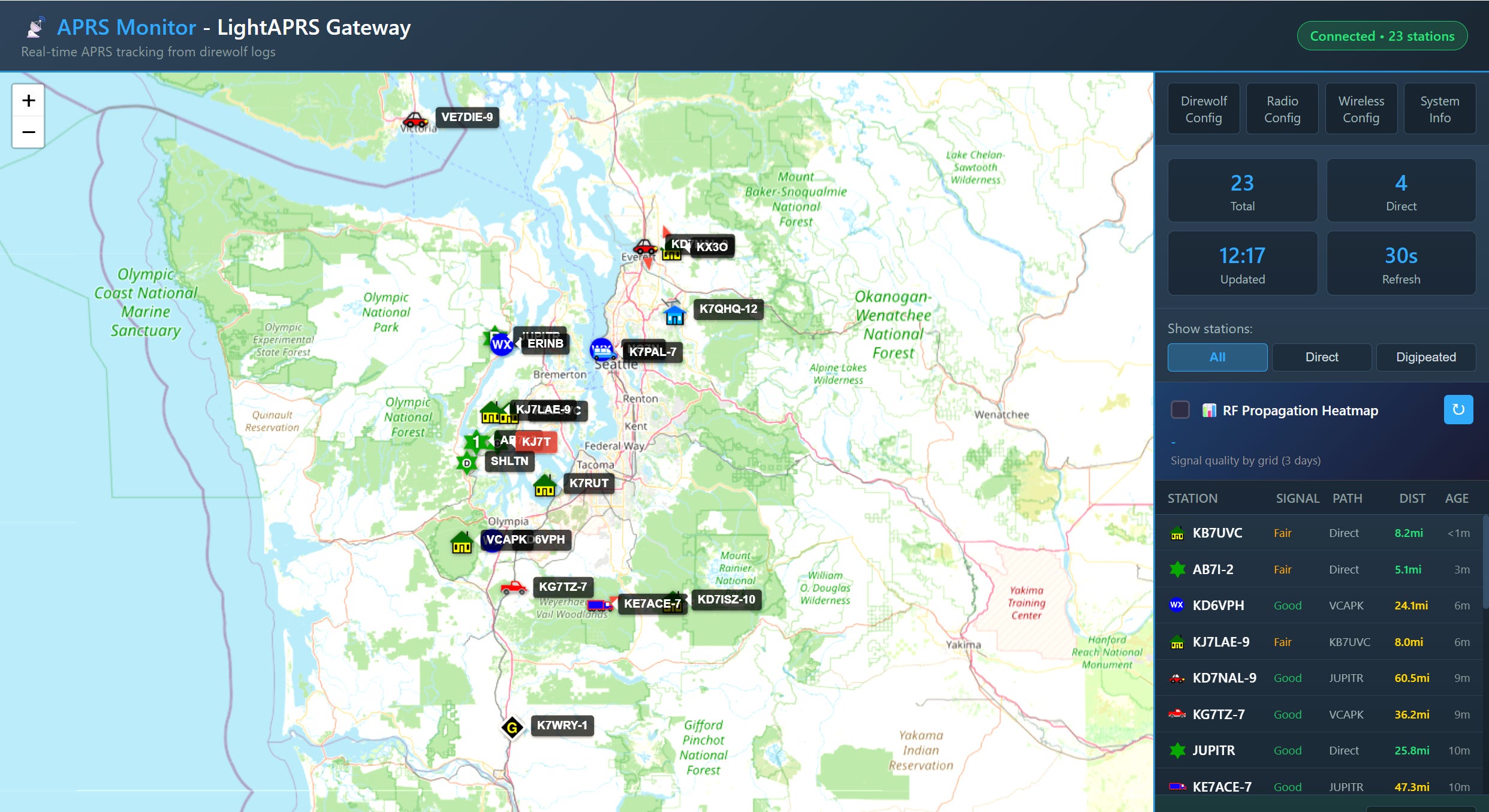
On the good news front, I got my LightAPRS Gateway device working. The story is on EtherHam. What I didn’t write about is learning about APRS over LoRa 70cm radio. While that has nothing to do with the LightAPRS device, it does touch APRS. I’m curious about this so I ordered a device (T-Deck Plus with GPS on 433MHz) to experiment with. Here’s the kicker, though: when I look at a map of APRS stations using LoRa, I find exactly one in Washington State. It’s an APRS-over-LoRa desert here. However, if I get my device running properly, maybe I can make a contact with the other station about 30 miles away. I might have to find a hill with line-of-sight to Seattle to make this happen. We’ll see!
For the LightAPRS device, I have a small dipole VHF antenna coming. I intended to set that a bit higher in the air on a fiberglass painter pole because I’d like to get a better signal in and out of the digi. I’m feeling pretty good about one watt through a small mag-mount, though:

2. Thank You…Supporters!
I have several people to thank for their support over the past few months. Most support comes in through the “buy me a coffee” system but there have also been EtherHam store purchases. Everything helps and is greatly appreciated.
Coffees: Thank you to Rich, Ray, and David.
EtherHam store: Thank you to Jeff, Rich, Joe, and Ren.
3. New on EtherHam
Buying Push-to-Talk Over Cellular Without Getting Taken — I researched the current market, and this sent me down a deep rabbit hole. The push-to-talk over cellular field is confusing, and that confusion leans in favor of vendors, not buyers. If you’re thinking about buying one, or you already bought one and discovered it wasn’t quite what you expected, this guide walks through what nobody tells you upfront — using a car-lot analogy that will feel uncomfortably familiar. Read more in this EtherHam-exclusive guide.
Concept: Using the Arduino UNO Q for Home Power Monitoring — What really drew me to this idea was the Arduino UNO Q's split-brain design: one board handling both real-time sensor capture and higher-level computing. These are jobs that used to require two separate devices. I sketched out (conceptually — not yet built) a whole-house power monitor with non-contact current clamps on the split-phase legs and an isolated voltage sensor. These are all read by the microcontroller side while Linux handles the math, logging, and dashboarding — no direct contact with bare conductors, ever. Full write-up, with parts list, firmware split, and dashboard options, is up on EtherHam.
LightAPRS Gateway iGate Beacon Success — Troubleshooting Log — A week of ruling out CGNAT, firewalls, servers, and a suspicious libc6 upgrade led nowhere. The real fix turned out to be something I hadn’t considered: the callsign’s SSID itself. This post walks through the manual
nctests, the reboot comparisons, and the variable-isolation process that finally got KJ7T’s iGate beacons landing on aprs.fi — even though the server-side root cause remains a mystery. Bottom line: the digipeater is now working well, and I feel comfortable recommending the LightAPRS Digipeater, available from QRP Labs, as a fill-in digipeater and igate.Crossing the Chasm: Which Amateur Radio Technologies Actually Made It — Why did DMR and FT8 become fixtures in the shack while D-STAR and Fusion have not yet achieved that status? This piece maps ham radio’s real technology winners and still-rising projects — CW, SSB, FM, AllStarLink, AREDN mesh, and more — onto the classic “crossing the chasm” adoption curve. Borrowing a framework shared by an amateur radio friend, it asks what actually separates a solved problem from a brilliant piece of engineering still waiting for its moment. Along the way, it builds context to help you place your own favorite radios, modes, and projects on that same curve.
Weekly Report: July 9, 2026 — The weekly report covers band conditions, digital radio news, and a digest of Groups.io messages. The Repeater Builder group was the most active this week with 142 messages posted.
4. QSO One: A New Way onto AllStarLink
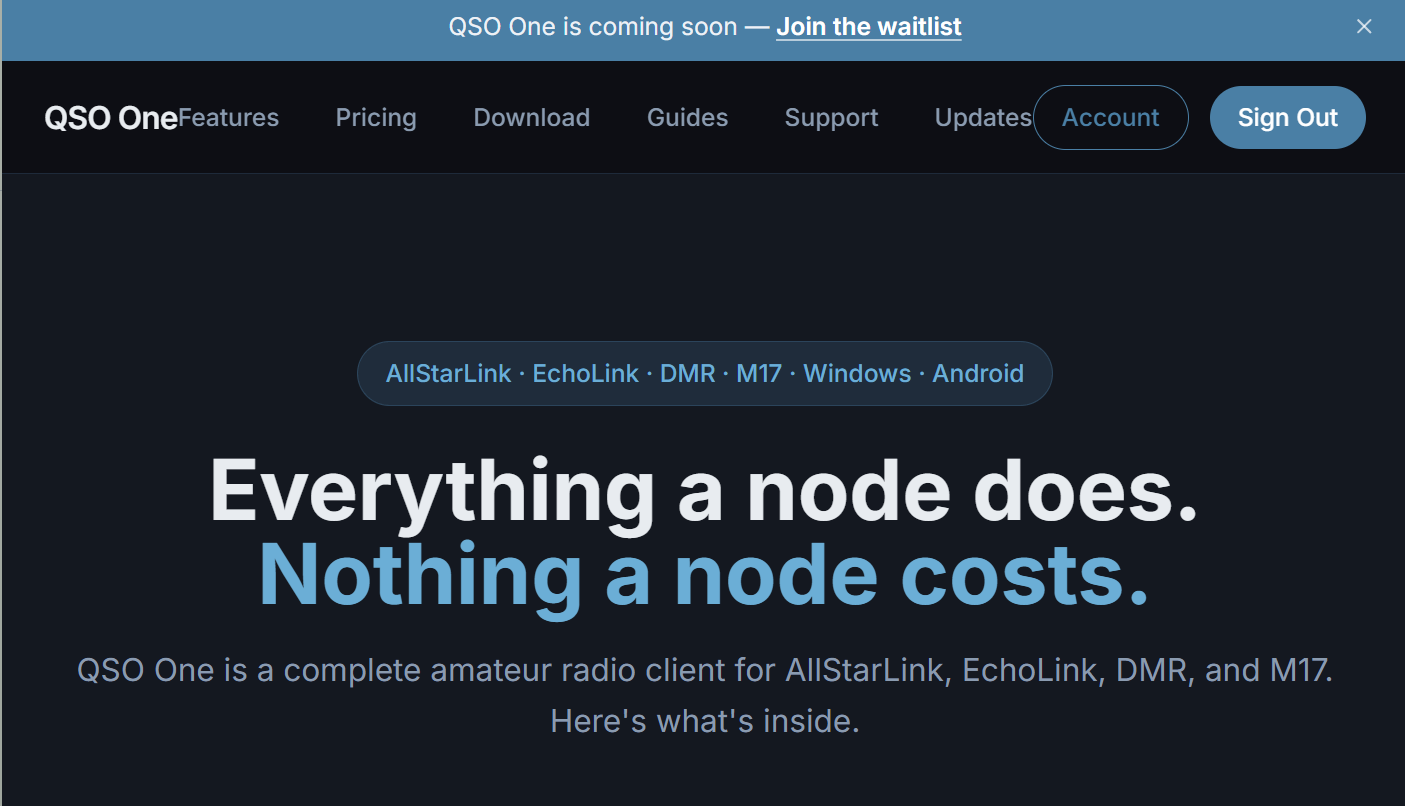
There’s a new app making the rounds in the AllStarLink and EchoLink space, and it’s worth a mention here even though I’m not ready to give it the full workbench treatment over at EtherHam. It’s called QSO One, and the pitch is simple: get on AllStarLink, EchoLink, DMR, and M17 from a Windows PC or Android phone, with no node to build, no hotspot to flash, and no radio interface to wire up. Twenty-five dollars, five minutes, and you’re keyed up.
I’ve spent some time this week reading through the developer’s own posts on the AllStarLink community forum, and the backstory is a good one. A ham out of Willoughby Hills, Ohio — Frank, KD8JKK, node 46369 — got pulled back into the hobby by a bad storm earlier this year, found his local repeaters quiet, drifted over to EchoLink, heard AllStarLink had grown, went looking for a modern Windows client, and found nothing. IAXRpt has been abandoned since 2019. So he built his own, reverse-engineering the IAX2 protocol frame by frame rather than leaning on an existing library.
That’s the kind of scrappy, solve-my-own-problem origin story I have a soft spot for. It’s also exactly why I’m not writing this up as a proper EtherHam review yet.
The open beta only went live in early May. As recently as this month, the developer rebuilt the entire audio engine from scratch — giving each network its own dedicated audio lane — because testers were reporting stuttering and garbled audio, the kind of thing one beta tester colorfully described as “wrestling the alligator to the ground.” Early reports since the rebuild sound genuinely improved, but that’s a few weeks of data, not a few years. There’s also been at least one credential-storage bug that could silently drop saved logins, but that has since been patched with a self-healing backup.
None of that is damning for a young project. But it does mean the honest way to describe QSO One right now is “promising and moving fast” rather than “proven.” Worth noting, regardless of how the audio engine matures: this is, as far as I can tell, a one-person operation. One developer wrote the IAX2 stack from scratch, runs the beta, answers the forum posts, and — per the latest update — now runs the backend account system that stores your saved nodes and favorites.
It's also a closed codebase, so there's no way for the community to audit the IAX2 reverse-engineering work, verify what happens to saved credentials, or fork it if Frank stops maintaining it. If Frank steps away for any reason, there may be no one else who understands that code well enough to keep it running. That’s a real single-point-of-failure risk for anyone thinking about leaning on it for a regular net check-in.
So this is an app worth watching, built by someone clearly solving a problem, at a price low enough that trying it costs you little. I find it a very interesting project and hope it continues to mature and grow. I’ll keep an eye on it, and if it’s still standing — and sounding good — in a few months, it’ll earn a proper look on the EtherHam workbench.
5. Claude’s Wild Two Weeks: Export Bans and a New Default
I’ve been seeing changes over the past few weeks in the models made available in Claude, so I naturally wondered what was going on. I learned that Anthropic just had one of its busiest stretches yet. If you use Claude for anything, here’s what you should know.
I’m on the Pro subscription, so the default model change described below affects me, and that change is what caused me to dig into this topic.
The default model quietly flipped. On July 1, Claude Sonnet 5 became the default model for Free and Pro users, replacing Opus. That’s not a small swap — Sonnet 5 ships with a 1 million token context window and performs close to flagship-level Opus 4.8 on many tasks, at a fraction of the cost ($2/$10 per million input/output tokens through the end of August, then $3/$15). Opus is still there if you’re on Max, Team, or Enterprise, but it’s no longer what most people get by default. Anthropic is clearly betting that “good enough and cheap” wins more users than “best but pricey.”
If you are a Claude Pro user, three things change in practice. For those using a Claude Pro subscription, you’ll see three basic changes when you use Claude with the default Sonnet 5 engine:
Speed and quota: Sonnet 5 is cheaper to run than Opus (roughly a fifth the cost per turn), so on a usage-capped plan like Pro, the same 45-prompts-per-5-hours allowance now stretches much further before you hit a limit. Responses also tend to come back faster since Sonnet is a lighter model.
Capability: for the bulk of everyday tasks — writing, coding, research, general Q&A — Sonnet 5 performs close enough to Opus 4.8 that most people won’t notice a quality drop. Its 1M token context window means it can also handle very large documents or codebases in one go, which Opus couldn’t always do as cheaply.
What you lose: for the hardest problems — deep architectural decisions, gnarly debugging, subtle reasoning tasks — Opus 4.8 still has an edge. On Pro you’d now need to manually select Opus for those cases rather than getting it automatically; Max, Team, and Enterprise plans keep broader access to it.
Net effect: most people get faster, more plentiful, “good enough” responses by default, with the option to reach for Opus deliberately when a task actually needs it.
The government forced Anthropic to pull its own flagship model offline. This is the wilder story. Claude Fable 5 and its sibling Mythos 5 launched June 12 — and three days later, the U.S. Commerce Department issued an export-control directive ordering Anthropic to cut off access for any foreign national, anywhere, including Anthropic’s own foreign employees. The trigger, reportedly: Amazon researchers found a jailbreak that got Fable 5 to write exploit code for a real software vulnerability, which was enough to get it treated like a controlled technology. Anthropic complied, access came back starting July 1 once the controls were lifted, and the company extended Fable 5’s free trial as an apology of sorts. It’s a preview of a regulatory fight that’s probably not over — frontier models getting treated like export-controlled hardware is new territory.
Opus 4.1 is on its way out. Deprecated on June 5, hard retirement on the API August 5. Anthropic wants everyone on Opus 4.8 instead, which also came with a real price cut — down from $15/$75 per million tokens to $5/$25, about a 67% reduction. If you’ve got anything hardcoded to claude-opus-4-1, you’ve got a month to migrate.
Cowork is leaving the desktop. Anthropic’s file-and-task agent tool, previously desktop-only, is expanding to web and mobile, with workflows able to keep running without an active browser session. Small item, but it fits the pattern: Anthropic is pushing agents further into everyday, non-coding work.
The takeaway: Anthropic is optimizing for cheaper defaults and broader access, while getting a real taste of what “AI as a national security concern” looks like in practice. It’s worth watching whether the export-control precedent becomes a recurring headache or a one-off situation. This is new ground for all of us.
Sources: Anthropic, TechCrunch, Forbes, Anthropic export control statement, Claude Platform Docs, Claude Sonnet 5 vs Opus 4.8: Price, Limits, and Benchmarks (SmartScope), Opus 4.8 vs Sonnet 5 vs Haiku 4.5: Which Claude Model to Use (The AI Career Lab)
6. An AI Price War Is Underway
While Anthropic was busy reshuffling its own model lineup, a bigger story has been playing out across the industry: the major AI labs are cutting prices against each other, hard.
It started at Google’s I/O conference in May 2026, where Google cut prices on its AI subscription plans — its top-tier Ultra plan dropped 20% — and rolled out a cheaper Gemini tier. Google’s Sundar Pichai pitched the math directly to enterprises: shift 80% of your AI workloads to Gemini and save over $1 billion a year. That was a shot aimed squarely at OpenAI and Anthropic.
Both companies responded. OpenAI has pricing pressure of its own to manage, and Anthropic followed with steep cuts on its side: Opus 4.8 came down from $15/$75 to $5/$25 per million tokens, and Sonnet 5 launched even cheaper at $2/$10. Meanwhile, cut-rate entrants like DeepSeek are underpricing all of them, competing with frontier-class models at a fraction of the cost.
The catch is this isn’t discounting from a position of strength. Running these models is genuinely expensive, and by most reporting, OpenAI and Anthropic are both still losing money at scale even before the price cuts. One data point making the rounds — Uber reportedly burned through its entire 2026 AI budget in four months after Claude Code adoption jumped from 32% to 84% of its engineering division. Cheaper per-token pricing helps users, but it raises the obvious question of how long labs can keep pushing prices down while costs stay high.
Sources: Welcome to the OpenAI, Anthropic, and Google price wars (Sherwood News), Following Google Gemini price cuts, OpenAI also set for price reduction wave (TradingKey), AI Price War: OpenAI and Anthropic Face New Economics (The AI Chronicle)
7. Retevis RA89R Radio: FM and Weather Radio
Retevis advertises that the RA89R includes NOAA weather radio and weather alerts. I did not find pre-programmed weather frequencies in the radio. You can enter those frequencies directly in VFO mode, or program them yourself into the radio. That seems different from other radios that advertise NOAA weather channels — at least in my experience, with most including those as pre-set frequencies in the radio and accessible with the press of a button or two.
Here’s where the mini-manual let me down. How to tune to FM broadcast radio stations and how to receive NOAA weather broadcasts are not made clear. Exploring the Retevis app on my Android phone makes it evident you can set FM broadcast radio frequencies in the app, and when you write the data to the radio, they are also saved there.


The only place I found to set NOAA weather radio frequencies is in the app, then you write the data to the radio and call up those frequencies as saved channels.
So: if you are looking for FM broadcast radio frequencies or NOAA weather stations in your new Retevis RA89R radio, they aren’t there. The easiest solution is to use the app over Bluetooth to program those into the app and then write those settings to the radio.
8. EFHW Came Down
Monday morning dawned, and since I was up early, I thought I’d fire up the IC-7300 MK2 transceiver and work some FT8 while my wife was waking up. First things first, though: check the antenna. And surprise: it had come down from the tall branch above the deck!
This could be the catalyst for me to finally finish soldering the last few wires on my pneumatic launcher kit.
9. QRT: End Transmission
Another interesting week is in my rearview mirror.
I’m on my high school class reunion committee. A few years ago — at my urging — we formed a 501(c)(7) nonprofit “social club” to govern the finances and provide activities for our surviving classmates. Why? Because some classmates have substantial net worth and did not want to be held personally liable if something went wrong at/after a reunion event. The nonprofit social club approach tackles that exposure (along with event insurance), and it also helps us not to lose track of each other in the years between events.
We actually have a great time when we get together. This year will be a picnic and barbecue, and we’ll take lots of pictures for our classmates who could not attend.
On the IT side of this, I’m in charge of the class database and the website. We had more than 500 students in our senior class, so it’s a bit of a lift to keep up with all of them. Many people have passed and we’ve lost touch with quite a few folks, but we remain in contact with more than 200 classmates. All in all, I think our news reaches about 300 classmates. While I wish it could be more, that’s pretty good, considering how many years it has been since we flipped our tassels and walked off stage.
The other big challenge this week was a medical issue with my wife, resulting in a trip to the emergency room. I always figure a minimum of four hours to get in and out of the ER — this one consumed eight hours. The ER was swamped with people, so my wife’s procedure was done in the hallway, and that’s where I stayed by her side that entire time. The important conclusion to this: she’s back home and feeling better.
73, and remember to touch a radio every day!