
Running ASL on Debian 13? Time to Update
Here’s the headline: New Debian 13 “Trixie” Kernel Security Update Fixes 68 Vulnerabilities. The takeaway: If you’re running AllStarLink (ASL) on Debian 13, it’s time to update.

1. QRV: Are You Ready?
Welcome to Random Wire issue 194. Sometime in the past week, subscriber numbers hit 2,300…and kept climbing. This was a surprise because a few dozen subscribers ended their subscriptions last week, too.
This week, I got my MeshCore repeater functioning. The problem was a simple on-off switch I failed to see when I put the repeater into service the first time.
I also got a T-Echo (not the newer Plus version) configured as a LoRa APRS Tracker. It is communicating with my LoRa APRS igate/digipeater in the garage.
2. New on EtherHam
Building a MeshCore Node — Part 2: The Repeater That Should Have Been Easy — Part 1 ended with a MeshCore repeater configured in ten minutes and beaconing right on schedule — a clean win, or so it seemed. Part 2 is the two weeks that followed. I encountered a debugging tool that was quietly resetting the very device I was troubleshooting, my antenna’s blind spot, a paywalled feature with a free workaround that didn’t actually work, and a repeater that went dark for five days over something hiding in plain sight the whole time. By the end, the hardware and firmware check out clean. What doesn’t check out, it turns out, is the ten miles of Pacific Northwest terrain standing between me and my nearest MeshCore neighbor.
LoRa APRS: Part 2 — LoRa APRS Tracker with a T-Echo — A brand-new LilyGo T-Echo goes dark after a routine firmware flash — no display update, a red LED blinking like an alarm, and every obvious fix leading nowhere. What follows is a genuine debugging rabbit hole: a Windows error that’s secretly good news, a bootloader chase that turns out to be a red herring, an independent firmware swap that finally proves the hardware was fine all along, and a BLE pairing quirk that ends up eating more time than everything else combined. If you’ve ever stared at a “bricked” board and had to figure out which symptoms were real and which were noise, this is that story, from first red flag to a live beacon on aprs.fi.
Weekly Report: August 6, 2026 — Catch up on band conditions, digital radio news, and the Groups.io digest.
3. My Talk2Me Radio is Working Well
My little Talk2Me PoC (push-to-talk over cellular) radio is working quite nicely. Last Saturday, I had a long drive to a high school class reunion. Unfortunately, that drive coincided with Saturday’s weekly M17 net. The M17 net is always interesting and I learn a lot every time I tune in.
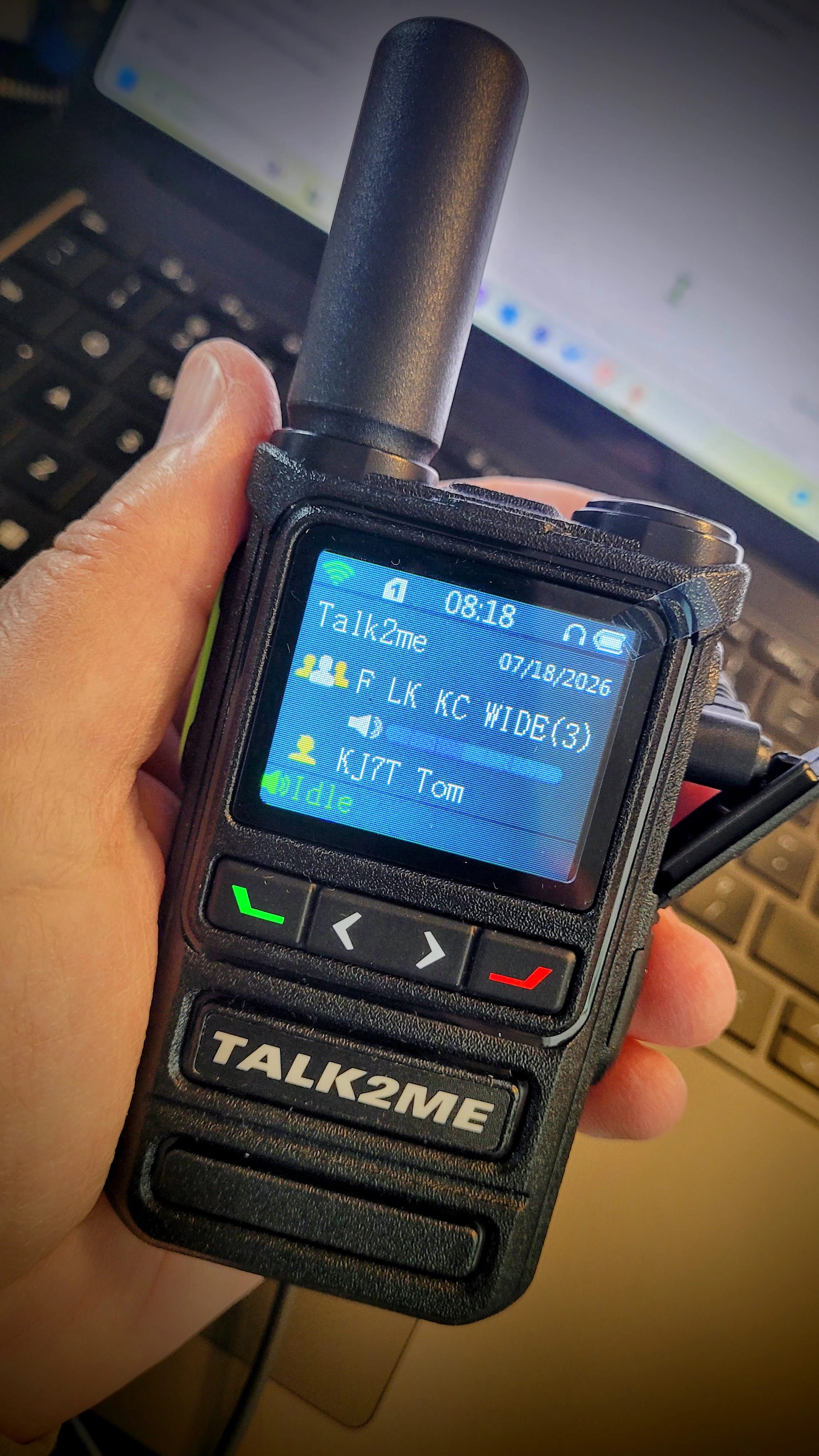
To the rescue: my Talk2Me radio. I already had it set to listen to America’s Kansas City Wide network using Hamlink PoC (programmed into the radio by the vendor). So while driving at 60 MPH toward Tacoma, Washington, I turned it on, turned up the volume a couple of notches, and slipped it into the chest pocket of my shirt. I listened to the complete net during the drive and even checked in from the pickup truck.
I usually pick up the M17 net at home over my hotspot, or with BlueDV on my laptop, or with my M17 radio and an M17 hotspot. Before the Talk2Me radio, I could not get KC Wide over RF while I’m driving in the Seattle-Tacoma area. Now I can listen in and participate, thanks to my Talk2Me STANDARD PLUS radio.
Honestly, I’m quite impressed. Because of this fabulous little radio, I was able to enjoy one of my favorite nets while I traveled to my reunion. The radio? It. Just. Worked. Isn’t that what we really want? For our devices to just work? This one does.
4. My MeshCore Repeater Made the Map
I finally got my MeshCore repeater working. I don’t know why I so often get a product without any instructions, but in this case, there was supposed to be a card inside the box…and there wasn’t. So I experimented for days, trying different things. Finally, I put my magnifying visor on and took a careful look at the boards inside, only to discover an on-off switch! It was a small little slider, hiding from my unmagnified view.
After sliding it to the on position and charging the 18650 battery, I put the repeater outside on top of the gutter. (By this time, I had been up and down the ladder at least a dozen times to place/retrieve the repeater on the roof. Testing on the gutter was a lot easier and safer than climbing up on the roof over and over.) And it worked. It beaconed on startup, but more importantly, it beaconed regularly after that.
About a day later, it showed up on the MeshCore map:
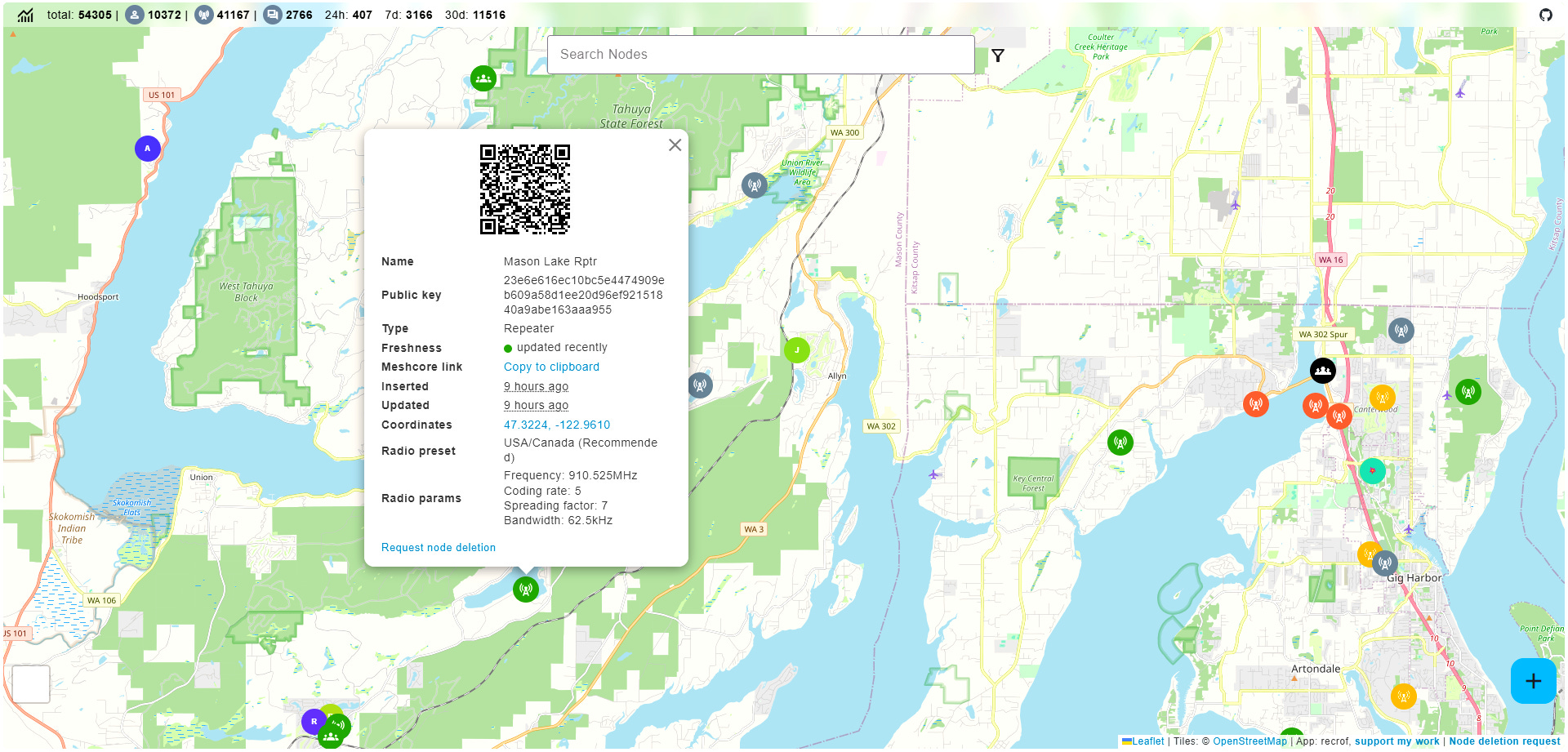
I’m still getting to know how this all works. I can’t reach other stations directly with my handheld device (T-Deck Plus), which is why I put up a repeater. Currently, my local MeshCore chain has three pieces: a repeater, a relay, and an app. The PeakMesh repeater is on the roof. A LilyGo T-Echo Plus at 910MHz with Bluetooth serves as a relay between the repeater and my phone. The MeshCore app is on my Android phone.
I also have a LilyGo T-Deck Plus at 910MHz with internal antenna that is a portable, handheld device. It isn’t a necessary part of my MeshCore chain.
If you happen to be using a MeshCore device, try adding the #etherham channel and pushing a message my way. That would be fun to try.
5. My LoRa APRS iGate/Digi Works
It works! The LoRa APRS igate/digipeater I installed in the garage actually works. The range? Minuscule, but more on that in a moment.
I bought a second LilyGo T-Deck Plus on 433MHz and configured it as a LoRa APRS tracker. Then I went for a drive. My igate/digi (KJ7T-2) picked up the mobile tracker (KJ7T-3) about 1/8 mile from the digi. It works.
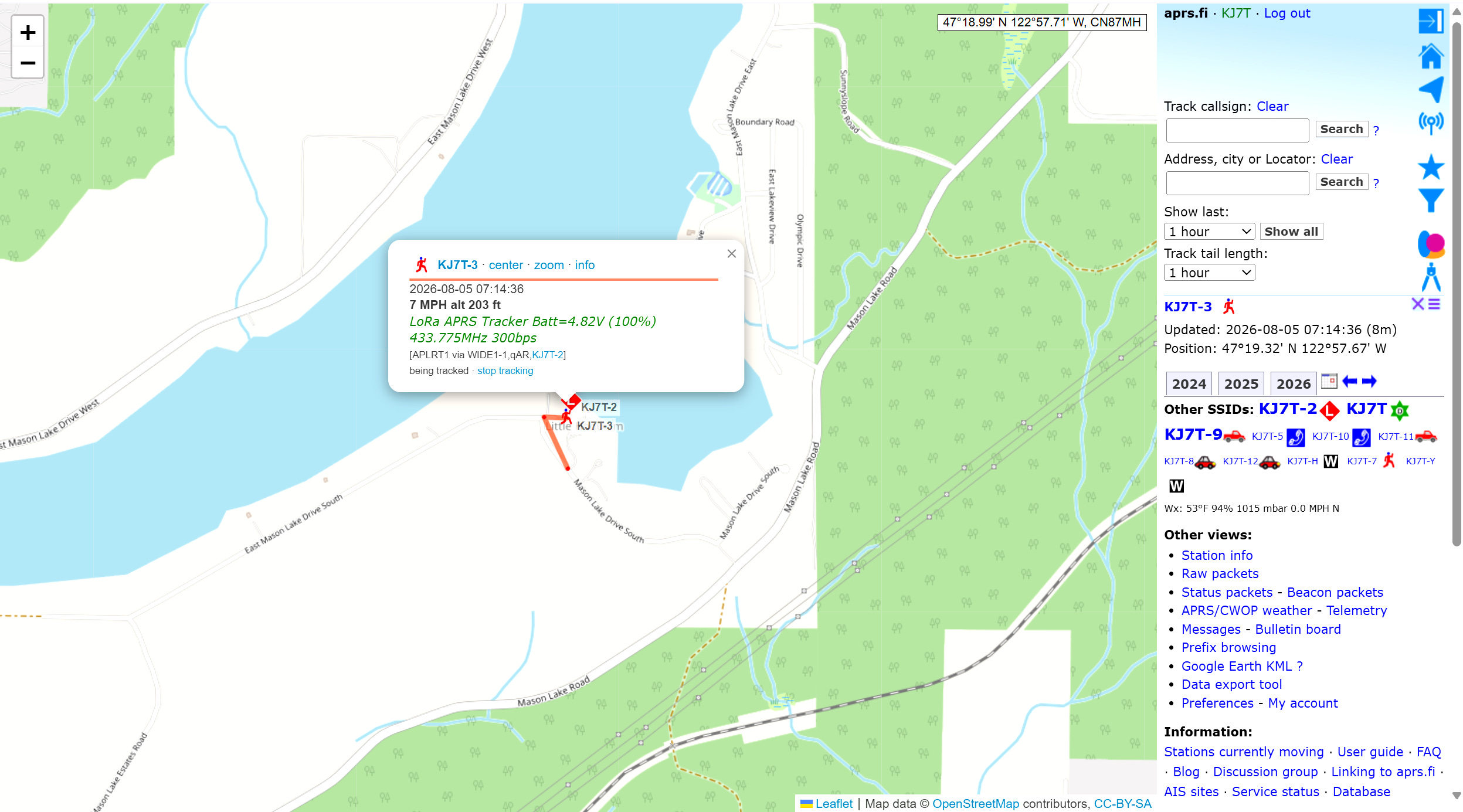
But it only works for a short distance. The small external antenna on the T-Deck Plus is insufficient for much range when the igate/digi is located in a basin…and that is what a lake is: a topographic low filled with water. I’m surrounded by hills so that tiny antenna doesn’t stand much of a chance of getting a signal out.
You can actually see the signal strength (RSSI = Received Signal Strength Indicator) drop off as I drove away from my igate/digi (KJ7T-2) yesterday morning.
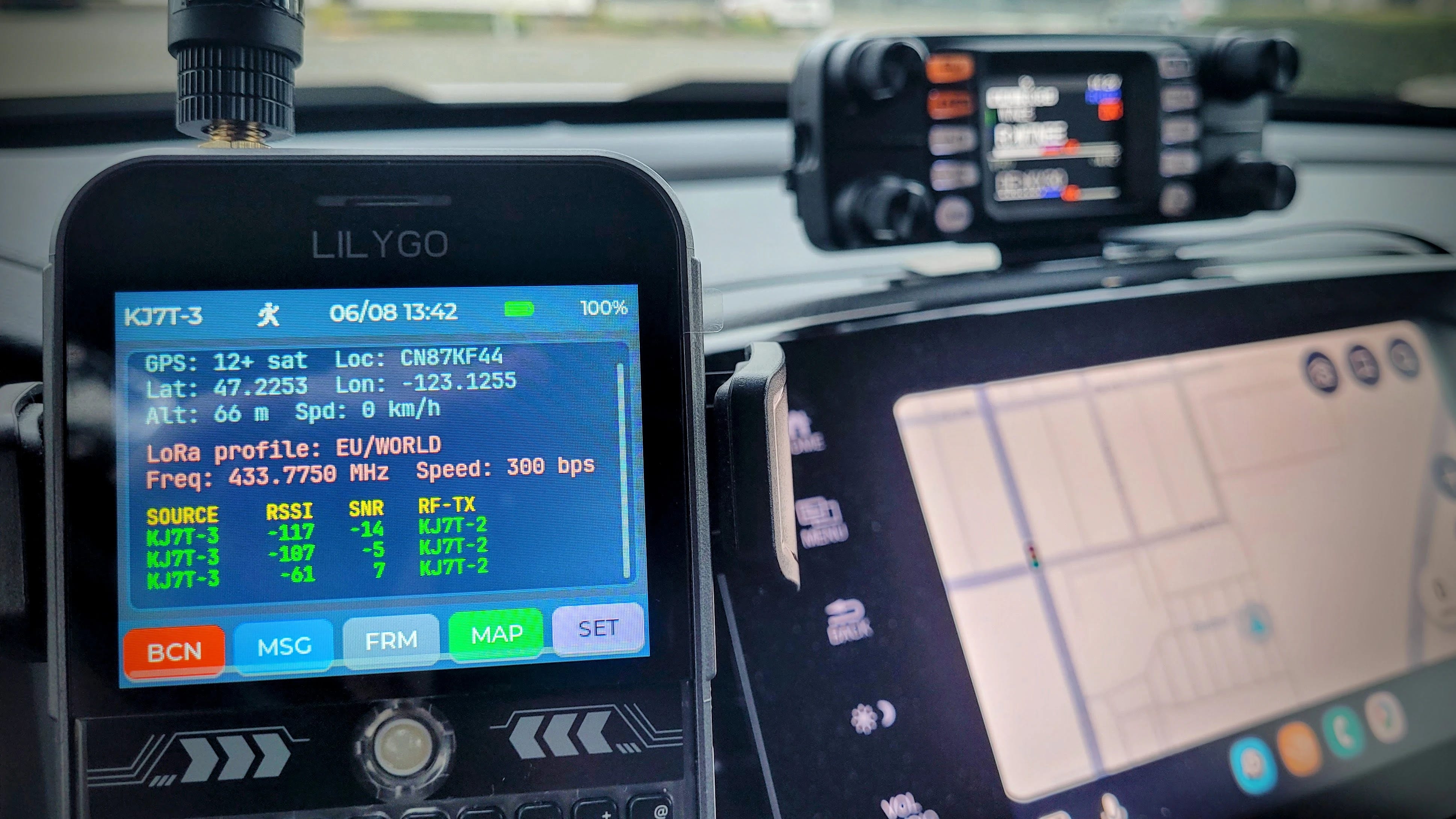
SNR (signal-to-noise ratio, in dB) is arguably the more meaningful number here. It describes how far above the noise floor the signal actually was, which is what determines whether the receiver can hear it well enough to decode it at all.
Looking at the photo, the oldest is at the bottom of the list of three exchanges. The signal went from -61 RSSI/SNR 7 (strong, near the start of the drive) down to -107/-5 and then to -117/-14 as I drove farther away, right before it dropped out entirely around 1/3 mile distant.
Here’s something worth noting: successfully decoding at -14 dB SNR is a real demonstration of LoRa’s advantage over conventional radio. FM APRS generally needs a positive SNR to decode anything — LoRa’s chirp spread-spectrum modulation (especially at SF12, which you’re running) has enough processing gain to pull a signal out well below the noise floor. That last successful frame wasn’t a fluke; it’s LoRa working as designed, right up until the combination of distance and terrain finally buried it.
I’m considering putting up the dual-band dipole antenna I have on order (note: ordered more than a month ago and my emails to the company are bouncing!) on a pole outside the garage. Maybe I can try a diplexer and run the LightAPRS Gateway on the VHF dipole and the LoRa APRS igate/digipeater on the UHF dipole. Two devices, one feedline, a diplexer, and the dual-band antenna. Just another 10-15 feet in clear air and I’ll bet I can reach at least a mile away on LoRa.
As noted in the New on EtherHam section above, I configured the T-Echo (not the Plus) as a LoRa APRS tracker. The advantage of the T-Echo is long battery life. It’s a small device so I can easily tuck it out of the way inside the pickup truck cab.
6. AI: Trying DeepSeek
I use Claude. I use ChatGPT. At the suggestion of a friend, I’ve started using Gemini a bit more. And now I’m exploring DeepSeek, which I’m finding to be very fast…but also more shallow than those other engines. Whether it will stand up to Claude when it comes to coding, I don’t yet know, but I doubt it. I’ve added DeepSeek to my Open Notebook instance running on my Proxmox server.
One thing to be aware of with DeepSeek: it stores API data on servers in China and its terms permit training on your inputs by default. I don’t plan to use it for anything important, but if you handle sensitive information, you’ll want to bear this in mind if you choose to use DeepSeek.
Me? I still lean toward Claude for the things I do.
7. Short Stack from the Interwebs
Pulled from the aggregated feeds on EtherHam (etherham.com/feeds/), items from July 30–August 5. This Short Stack turned into a Long Stack!
SDR & Signal Hacking
Scanner Command: Mapping Incidents from Live Radio Calls and ADS-B to Airband Voice with AI — RTL-SDR Blog — A follow-on to DeepSDR: another public-safety-scanner-plus-LLM incident mapper, this time tied to airband/ADS-B traffic.
Turning a Local ADS-B Feed Into an Easy to Read Dashboard — N3BKV’s Ham Radio Hacks — Building a clean dashboard on top of a SkyAware feed to see what’s flying overhead.
Large-scale LoRaWAN deployments become easier through QR codes and relays — CNX Software — QR-code provisioning and relay support aimed at simplifying big LoRaWAN rollouts.
Digital Modes & Data
bkjbbs: A Node.js Packet Radio BBS Library for Direwolf — Hamradio.my — A modern Node.js library for running a packet BBS on Direwolf, with full AX.25/KISS support and TypeScript types.
Retevis C62 OpenRTX port and the cskburn update — M17 Project News — Progress notes on the OpenRTX port for the Retevis C62, alongside LinHT work.
Gear, Builds & Reviews
Wanneton UV5F Ham Radio Handheld Dual Band Two-Way Radio Review — Amateur Radio Today — A hands-on look at a budget dual-band HT aimed at entry-level and emergency-prep users.
The Best Inexpensive HF Antennas for Amateur Radio — Amateur Radio Today — Pushing back on the idea that HF requires an expensive antenna.
Chameleon LEFS Feather Antenna QRP with the Elecraft KX3 — J-Pole Antenna — QRP field pairing of the Chameleon LEFS Feather with a KX3.
Build Your Own DIY Compact FM Transmitter — Hackster.io — A step-by-step 88–108 MHz FM transmitter build.
A Homebrew Workbench from Norway — Please Comment: What would you have done differently? — Solder Smoke — A reader’s shack workbench, with Bill Meara asking for critique.
But did he really create this device? What do you think? — Solder Smoke — A skeptical look at a dubious “invention” video making the rounds.
POTA, SOTA & Field Ops
A Wet POTA Experiment: Hunting, Calling CQ, and Changing Modes — QRPer — Mark (KB2PIZ) on how long to stick with a band/mode before switching things up during an activation.
CE7ET: Mini POTA DXpedition to Rapa Nui (Easter Island) CL-0105 / 3G0YT — QRPer — A POTA activation report from one of the more remote parks you’ll see on the air.
DF7CW: Field Testing the IC-705 and SOTAmāt in Märkische Schweiz (DE-0083) Before a Swedish Trail Adventure — QRPer — A newly-licensed German ham field-testing gear ahead of a bigger trip.
The best-laid plans do work out, after you pivot a few times — QRPer — Vince (VE6LK) on activation plans that only came together after repeated pivots.
More POTA notes, 7/30/26 — KB6NU — Dan’s real-world notes on running down the limits of a 9 Ahr BioEnno battery across activations.
9M LLOTA: Malaysia Joins Lakes and Lagoons On The Air — Hamradio.my — Malaysia’s entry into the Lakes and Lagoons On The Air program, with a growing reference list.
Shortwave & Listening
A New Novel from DXer Ralph W. Perry: Pacific Dream — The SWLing Post — A longtime DXer’s new novel gets a nod from the SWLing community.
Illustrated Radio Listening Report reaching Nepal — The SWLing Post — Cartoonist Carlos Latuff’s illustrated QSL-style reports have made it further than he expected.
Radio Prague: “Microphones against tanks” — The SWLing Post — The latest in Radio Prague International’s history series on Czech broadcasting.
BBC Radio 5 Live Closing More AM Transmitters — The SWLing Post — The BBC continues trimming its mediumwave footprint.
Pirate Radio on the HF Bands: The Hidden World of Shortwave Broadcasting — Amateur Radio Today — A survey of the pirate shortwave scene for hams who make contacts but rarely just listen.
Podcasts & Community
Ham College 142 — Amateur Radio Weekly — General exam prep covering transmitter power rules and 60-meter operation.
LHS Episode #624: National Jamboree 2026 — Amateur Radio Weekly — Linux in the Ham Shack’s coverage of this year’s National Jamboree.
Amateur Radio Weekly – Issue 432 — Amateur Radio Weekly — This week’s roundup, leading with a Kentucky family suing after a school resource officer seized a student’s radios without a warrant.
Legendary DXer Bob Locher, W9KNI, Presents Tales from a Serial Sniper Part 2, “Looking South” — On All Bands — Part two of Bob Locher’s DXing memoirs.
Talking to Silent Keys — With Varying Frequency — A reflective piece on how the community keeps engaging with the memory of hams who’ve become Silent Keys.
One lump or two (or three)? — KB6NU — Dan’s take on the perennial argument over how many license classes ham radio should have.
Linux, Homelab & Self-Hosting
Proxmox releases full support for the Arm64 architecture, with a few key caveats — XDA Developers — Arm64 support lands, but access is request-only for now.
Proxmox ships with a broken repo by design, and here’s the 30-second fix every home user needs — XDA Developers — The rite-of-passage repo fix for every fresh Proxmox install.
NightRun UEFI application boots a local LLM on Raspberry Pi 5 and x86 PCs without an OS — CNX Software — Running an LLM straight from firmware, no OS required — relevant if you’re squeezing extra life out of Pi-based nodes.
3 Raspberry Pi Projects I Use Every Day — Raspberry Tips — Practical, daily-driver Pi projects rather than one-off builds.
Jellyfin vs Plex on Raspberry Pi: Which Is Best? — Raspberry Tips — A head-to-head for anyone running a Pi as a media server.
A Mac Mini server is running headless in my closet — it manages my photo library and handles my backups — Tom’s Hardware — A refurbished Mac Mini pulling backup and photo-library duty.
AppFlowy finally feels like real Notion, and self-hosting it fixed my biggest complaint — XDA Developers — A self-hosted Notion alternative that’s matured enough to switch to.
Issue 522 – Minimus Releases Hardened Images For Free – What Does It Do Differently? — Awesome Self Hosted newsletter — Free hardened container images, and what sets them apart.
My router was doing 5 things that I never asked it to, and I wish I had changed them earlier — XDA Developers — Default router settings worth turning off.
This E-Ink Home Assistant display cut my phone notifications in half — How-To Geek — An always-on e-ink dashboard for Home Assistant that pulls attention off the phone.
I turned an old Android phone into a Home Assistant voice satellite—no speaker needed — How-To Geek — A cheap way to repurpose old hardware, in the same spirit as hotspot/node builds.
Also Noted (Tech)
AI enthusiast unlocks and mods BIOS with Claude Code — AI defeats RSA-2048 signature checks and unlocks 55 hidden settings — Tom’s Hardware — A Redditor used Claude Code to unlock a laptop’s hidden BIOS settings.
8. QRT: End Transmission
Radio history
I do enjoy reading radio history, and The Discovery of Radio Waves was an article I found very interesting.
“When the concept of electromagnetic waves was first proposed around 1864, it was met with great skepticism…It took several decades for a handful of dedicated persons — infatuated with the mysteries of electricity and magnetism — to finally put the theory on a solid footing.”
Just proves to me once again that we all stand on the good work of those who came before us.
Claude and CSS debugging
As I was debugging a CSS load problem (the problem being a specific file was not loading) on a website, I started to use a tried-and-true method: turn off plugins one by one, test, re-enable, move to the next plugin. Well, this site has 67 plugins and that takes an awfully long time.
And then I thought: I wonder if Claude can help me with this? Using the Sonnet model, Claude had trouble understanding what I wanted and kept trying to hand it back to me. So I switched to the Opus 5 model and was delighted when — after I gave it permission — it proceeded to walk through all 67 plugins and test them, without me having to intervene.
Claude found one plugin that no longer parsed CSS after the plugin was recently updated. We rolled that back to a previous version, resolving the problem. That saved me hours of digging.
LoRa radio
I’m enjoying learning about this technology. New? Not…but it feels new to me, simply because while I’ve dabbled my toes in the LoRa waters, I haven’t taken a dive like in the past several weeks. It’s interesting stuff, especially how it is able to send and receive data way below the noise floor.
73, and remember to touch a radio every day!