

Contents
Happy Friday
More About Amp-ASL Server (EtherHam)
Backing up Windows 11 Pro (EtherHam)
AIOC: All-in-One Cable
New / Not New Handheld Radio: FT-70DR
BTECH DA-7X2 Digital & Analog Dual Band Two-Way Radio
For Space Weather Fans
OpenHamClock
Difference in btop Display on Debian
Time to Put up a Wire
Short Stack
Other
Closing

Happy Friday
One of the nice things about publishing on Substack is it produces a pseudo podcast with a computer-generated voice reading my words. This is through the Substack app on my Android phone. I do find this handy when I’m driving as I can listen to my newsletter (and others, too). Hearing it makes it easier to find confusing sentences and wrong or missing words. And like so many of us, I’d rather not hear my own voice. I rather like the computer voice!
It’s Thursday afternoon as I start to tie a ribbon around Random Wire issue 168. I just learned that a bill my association is concerned about is scheduled for a hearing tomorrow at 10:30. We are scrambling to line up folks to testify, prepare talking points and testimony, and get people there. Yes, we were surprised by how swiftly this legislation is moving. What this means is if I misspell a word or two in this issue, please excuse me. I am suddenly and unexpectedly being pulled away from this newsletter.
You know what they say (and I am paraphrasing): Life Happens!
More About Amp-ASL Server
I continue to fiddle with this interesting project. What did I do this week? Tried to add a WiFi adapter to the Dell 3040, swapped the speaker-mic, and tried my Heil K-1 headset.
I do have this node running. It is AllStar node 578499.
Learn more about More About Amp-ASL Server on the EtherHam.com site. Although I’m not prepared to report on it, I hear that Ampersand-ASL Server has some improvements surfacing any day now.
Backing up Windows 11 Pro
I’m looking for suggestions for open source backup software that will allow me to create an image of my entire Windows system and will allow me to also do full or partial backups. Those two things could be solved by two programs, not one.
For now, I’m using Macrium Reflect. I don’t really like it, but it is working.
Read more about this in Backing up Windows 11 Pro.
AIOC: All-in-One Cable
I’ve waited long enough. It was time to order an AIOC device, so I did. It is probably arriving today so too late to include much about it in this issue of the Random Wire.
First, though: what is an AIOC? “The Ham Radio All-in-one cable (AIOC) is a small PCB attachment for a popular series of radio transceivers which adds a USB-attached audio interface and virtual TTY port for programming and the push-to-talk function.”
See also:
The All In One Cable thingy – AIOC by G1LRO
AIOC Cable Review - Should You Buy One? by Direbox
Introducing the Ham Radio All-in-One Cable (AIOC): The Ultimate Multi-Purpose Interface for Your Radios! by Hamradio.my
For official information:
Works with:
APRS with Direwolf
AllStarLink (ASL3)
WoAD: “Bringing the functionality of Winlink to your Android device”
I’m looking forward to trying this. It’s not new, just new to me.
New / Not New Handheld Radio: FT-70DR
I needed another C4FM handheld but didn’t want to spend a ton of money. Lately, I’ve heard several people on Kansas City Wide nets share that they were using the Yaesu FT-70DR radio. Most of those transmissions sounded pretty good, so I ordered one from HRO in Portland for $169.95 (the $20 discount has since expired). Two days later, it arrived. (Don’t buy it on Amazon. It is overpriced there.)
I already have my Raspberry Pi 4 hotspot set to Yaesu System Fusion on 431.250 MHz. I charged the FT-70DR battery, turned on the radio, entered my call sign through the keypad, and entered the hotspot frequency. Boom, I was immediately hearing conversations. Later, I tested my audio with a parrot and it sounded good.
Now for the true confession: I already have a FT-70DR that I acquired a few years ago but that first unit doesn’t sound good. It doesn’t sound nearly as nice as the new radio. I don’t know why. While I’m not completely happy about the first radio, I’m pretty tickled with the second one.
I live in a wet place, so weather resistance in a handheld radio is important. The FT-70DR is IP54 rated, providing protection against dust and splashing water. It is considered splashproof and ruggedized but it is not submersible. That works for me.
And surprise! I was really pleased when I figured out how to store separate transmit and receive frequencies in one memory in my Yaesu FT-5DR. Surely the FT-70DR won’t do this, too, right? I found it in the Advanced manual. Yes, it will. In my mind, this means the FT-70DR is the budget choice if you want to get on C4FM. The sound quality is good, it’s a durable and reliable radio, and it has some of the features of the much more expensive FT-5DR. Nobody I know with an FT-70DR wishes they had not acquired it.
BTECH DA-7X2 Digital & Analog Dual Band Two-Way Radio
I confess that I think I like this radio. No, I don’t have one in hand, but if it’s anything like the BTECH UV-PRO (affiliate link) I do have, the quality will be quite acceptable to me. What is so attractive? Dual-band, digital (DMR) and analog, air band, and dual receive. That translates to me as usable with a full-duplex AllStar node and with my hotspots. It would be a great radio to travel with.
Here is BTECH’s blog announcement of the radio: BTECH introduces the DA-7X2. True Dual Receive. True VFO. Built to evolve. And here is the BTECH online shop listing: https://baofengtech.com/product/da-7x2/
Amazon has it available for very fast delivery at the same price as the BTECH store:
I am very, very tempted.
For Space Weather Fans
The Live Solar Events page is a great resource, and is part of the G7IZU Radio Reflection Detection website. If you want to include some of the G7IZU screens in your HamDashboard, please take note of G7IZU’s request:
NOTICE: Please do not link my map images directly into dashboards etc. My web hosting will not handle the load of hundreds of simultaneous connections!
For HamDashboard, take a look at a variety of user-submitted examples. I could use the Vancouver BC example with very few changes for my neck of the woods. Want a video with instructions? KM4ACK has a good one:
I have a HamDashboard running on my node-in-the-cloud server just to see if it would overload the system. It does present significantly more load when it runs, with CPU usage jumping to 15% and disk I/O spiking. Let me know if you want to see what it looks like and I’ll send you the link. I don’t want to actually publish the link because I don’t want my ASL node 57945 system to get hammered!
OpenHamClock
By now you’ve probably become aware that HamClock will sunset in June and several projects are emerging as potential replacements. One that looks usable right now is OpenHamClock.
Here’s what that looks like on my laptop screen:
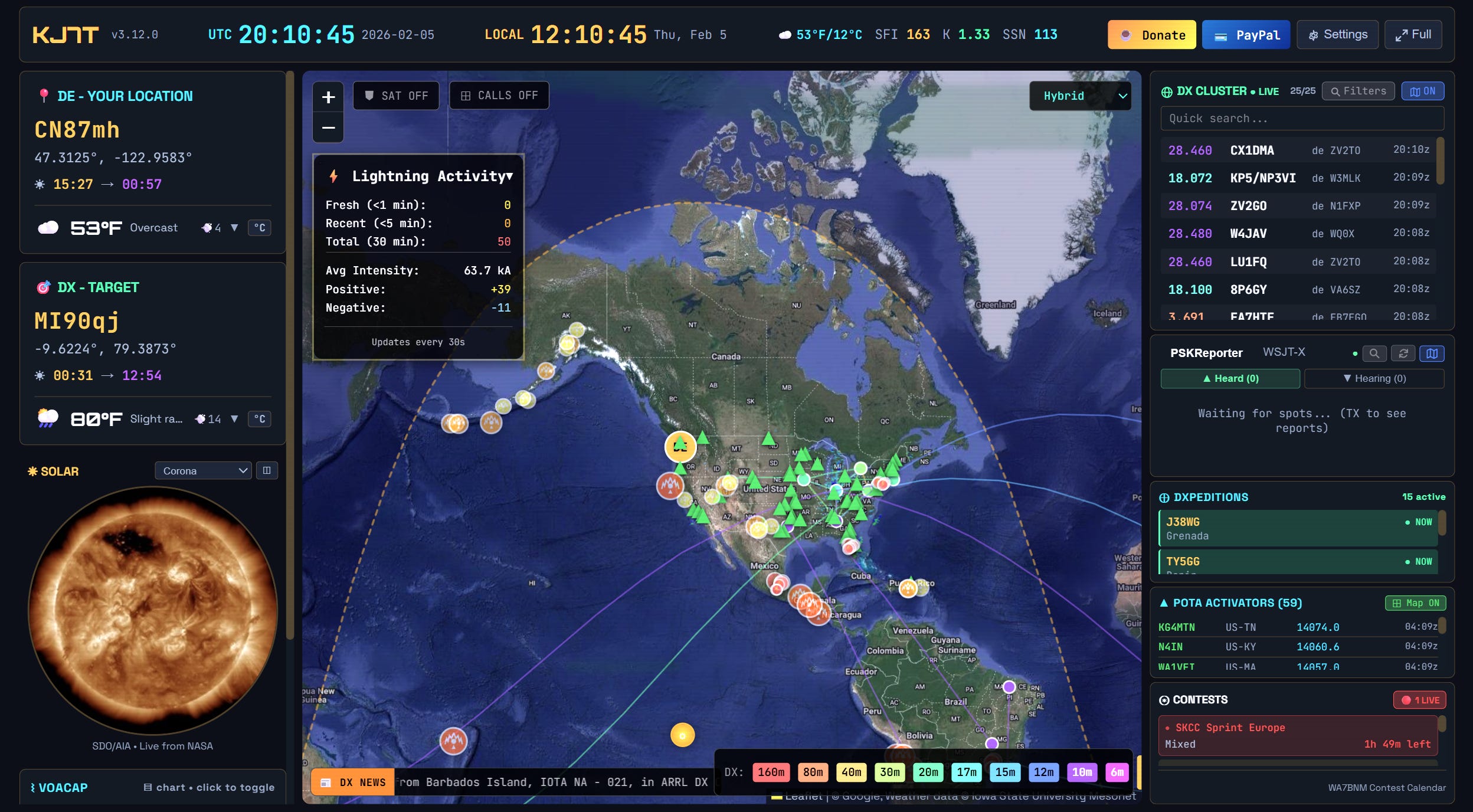
This is a young project that shows a lot of promise. If you like HamClock, you’ll want to monitor OpenHamClock.
Differences in btop Display on Debian
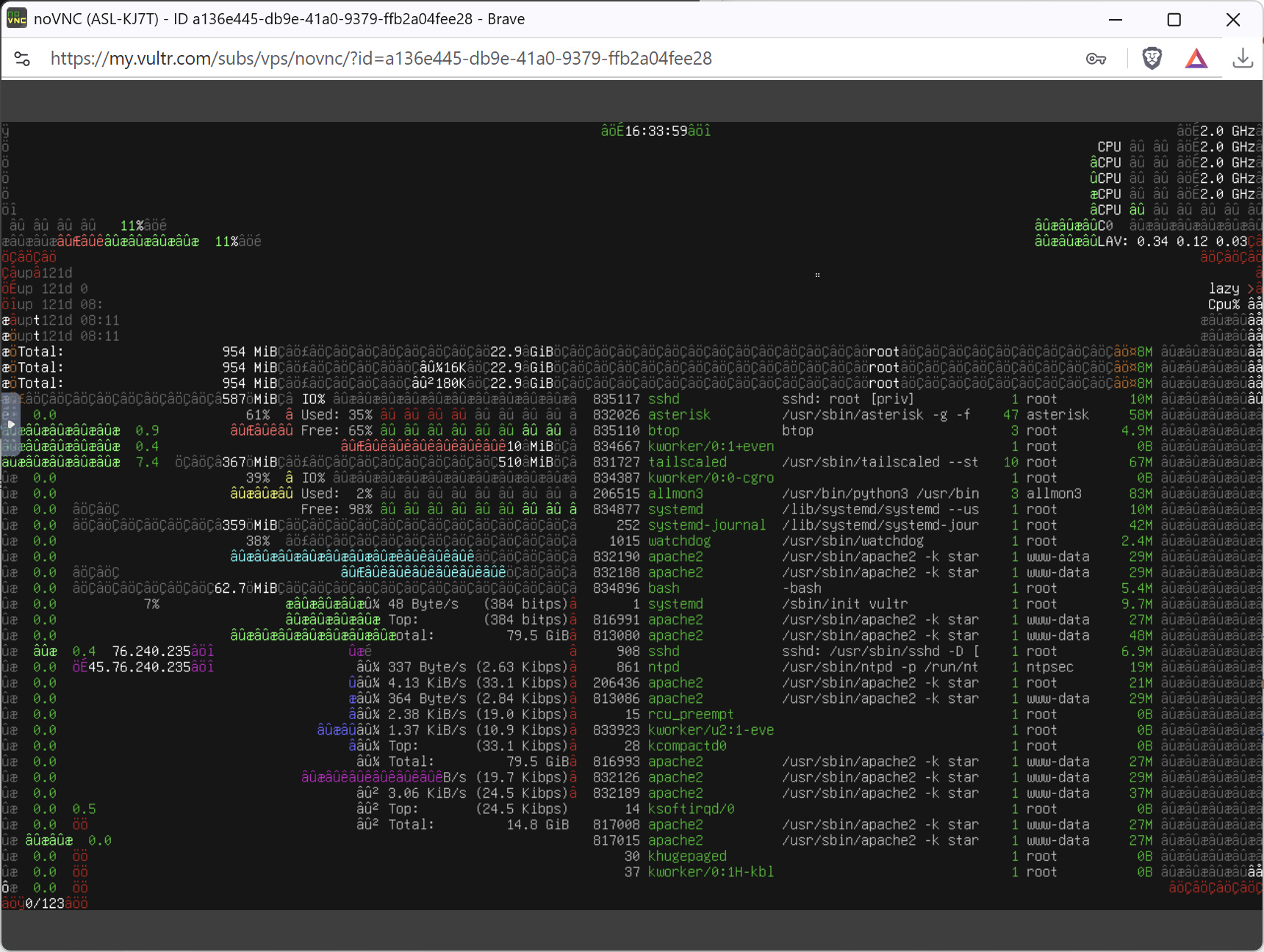
In the process of looking at my HamDashboard instance, I installed btop on my server. Unfortunately, something is wrong with the fonts in my Debian 12 terminal. This is interesting because my other Debian installations don’t have this problem.
For example, below is the btop display in the cloud server terminal. This is a Debian 12 server and the terminal is the one provided through the Vultr.com dashboard.
And here is btop running locally on a Dell Wyse 3040 under Debian 13, viewed in the terminal via an SSH connection:
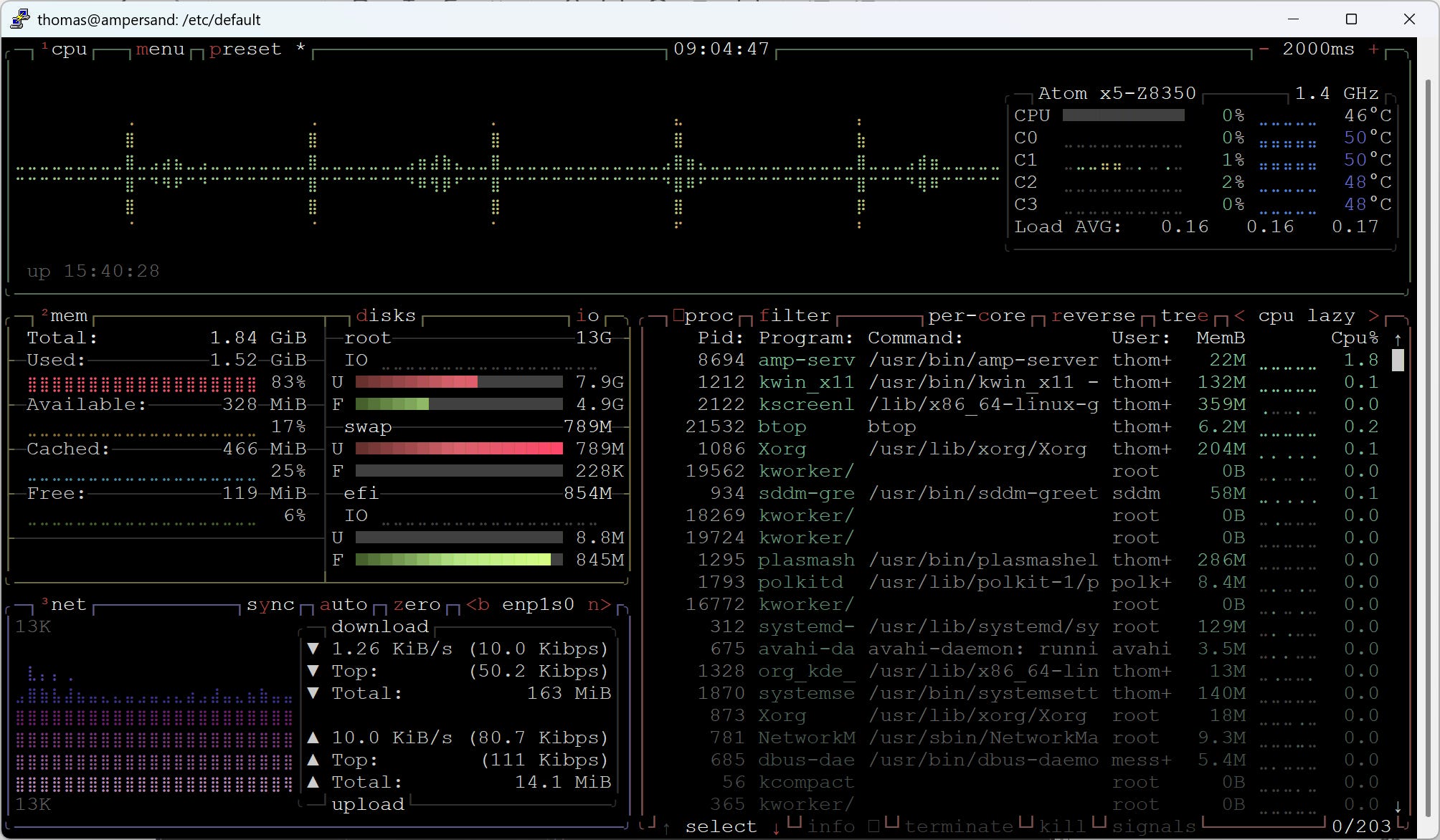
I made sure that the contents of /etc/default/console-setup for the cloud server were identical to the same file on the 3040. I also made the language settings in /etc/default/locale the same. I forced a font cache refresh on the cloud server (fc-cache -r). The two outputs remain different. I wonder if it is simply a difference in terminal apps. That is probably it. The 3040 uses a Bourne shell; I don’t know what the cloud server uses but it must be different.
And…yes, that is the difference. Usually, I use the terminal on the Vultr cloud server that is provided in the hosting dashboard. But if I use PuTTY on my laptop to SSH to the cloud server, btop looks normal:
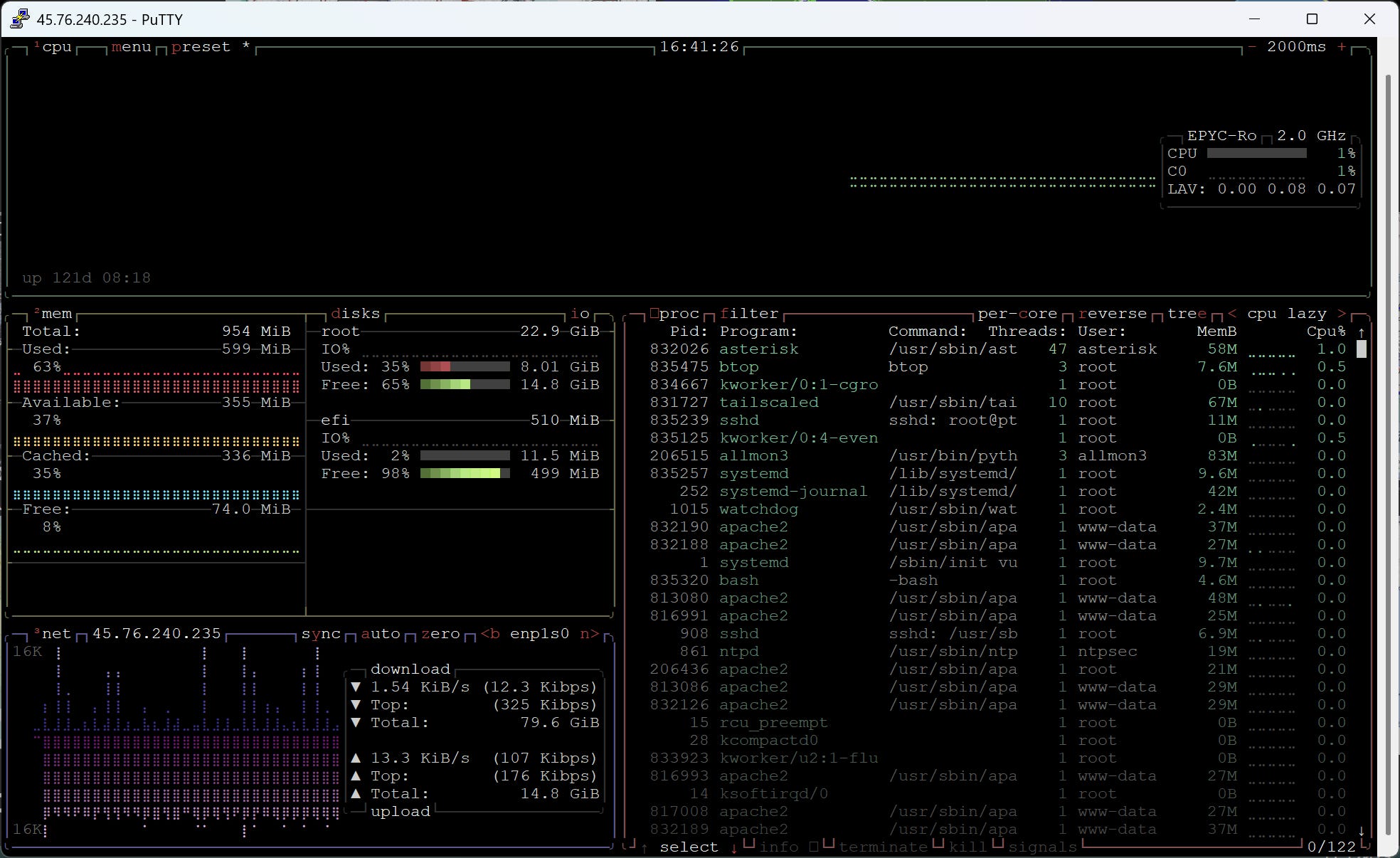
This is an oddity with the Vultr server hosting system. As long as I can work around it (and I can), it’s no big deal. I really wanted you to see how helpful the btop display is when you are looking at what is running on your Linux machine and the loads your programs are presenting.
Time to Put up a Wire
I need to finish my pneumatic launcher. It is a kit by JARC (Joplin Amateur Radio Club) called the Mark-2 Pneumatic Launcher. I’ve finished the mechanical assembly but I still have a bit more soldering to do on the switch before I can use it.
Outside the lake house are two Douglas Fir trees growing close together. The property line goes right between them. The taller tree is more than 150 feet tall and is on my aunts property. Our tree is about 100 feet tall and that should be plenty for what I have in mind.
I flew the drone a few days ago to be able to show you the trees and the proximity to the house. I set the camera at zero degrees (pointing out at the horizon) and checked the altitude when the tops of the trees were centered in my control screen.
The one-minute video is posted on Flickr: https://flic.kr/p/2rVe8NF
Short Stack
Ham Radio Isn’t Growing and it’s All Your Fault. The curmudgeon in me had to smile when I read this post. “Having exhausted all those notions about what’s “wrong” with ham radio we now arrive at the conclusion du jour – we simply aren’t very friendly people. And they could be on to something. After decades of being told that the hobby is dying and we are the problem, after all the self-flagellation from it being all our own fault, we’ve become a pretty damned grumpy lot.” (Thank you to Amateur Radio Weekly for publishing this link.)
Winter Field Day 2026 Reflections: Is Ham Radio Relevant For Emergency Communications And Prepping? Interesting perspective. “This amateur radio EmComm system need not serve an agency, rather be a parallel, free-standing, inclusive and accessible, publicly available, ham-led service meant to disseminate information, provide comfort and support, and overall reduce panic. A calmer public is a safer public.” (Thank you to Amateur Radio Weekly for publishing this link.)
open-hamclock-backend Aims to Keep HamClock Ticking. “A group of ham radio operators have stepped up to keep HamClock operating beyond it’s scheduled sunset in June. An open source replacement for the backend processes required to keep the popular HamClock project alive is well underway.” (Found on Amateur Radio Daily.)
9M2PJU APRS Web Messenger. I tested it and it works. All you need is your call sign, your APRS pass code, and an internet-connected browser. (I’m running it while I work on this newsletter.)
Other
KeePass password manager
I use KeePass (and variants on different operating systems) for password management. I have to use a manager because I have so many passwords for work, home, amateur radio, and more. There are too many passwords to remember, and if I make them simple enough to remember, they aren’t very strong.
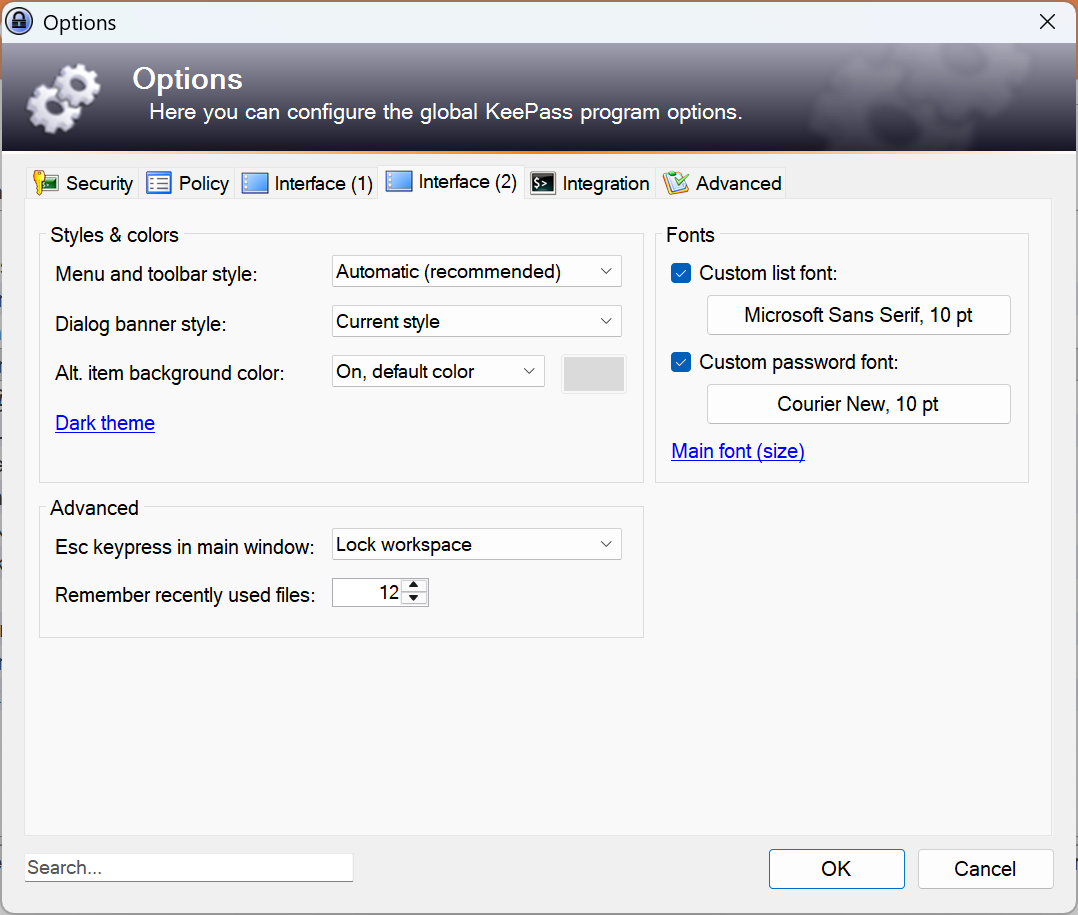
However, the font size in KeePass is quite small. I just found where to change that setting: Tools —> Options —> Interface (2). I bumped up the size of the fonts and now they are much easier to read.
Looking for a ham radio domain name?
This one was available on February 4th at a normal (not premium) price: rxandtx.com.
Or how about amateurqso.com. It’s available, too. Finally, a short one, also at a normal price: weqso.com.
There’s no better time than right now to claim and build an amateur radio identity!
I broke Zorin OS
I wasn’t really thinking about it when I booted up my old MacBook Air that runs Zorin 18 Pro, opened a terminal, and ran sudo apt update && sudo apt upgrade -y. The results looked…odd. It looked like a kernel file was removed. So then I ran the built-in software updater and it was not happy. OK, I’ll reboot. Ah no: a kernel panic. I actually did delete the kernel.
I downloaded a fresh .iso file, burned it to a USB thumb drive with balenaEtcher, and plugged that into the MacBook Air. Holding down the Option key, I powered up, selected the USB thumb drive as the boot media, and began answering questions. Yes, I reinstalled the whole thing. No reason not to.
Closing
The early morning (6:00 am) conversation on the repeater a few days ago was very interesting, as always. I learned that one of my ham friends grew up in a mining town in Idaho. I worked for five years for a mining company based in that area so I am familiar with his hometown. As we talked, I grew a bit nostalgic, remembering how interesting it was to be going down a vertical shaft into the earth every day and seeing rocks no human had ever seen before. I miss that. What I don’t miss is the sense of being a professional transient. As a geologist, I was rarely in one place for more than a handful of years. That worked fine until we started a family and then that lifestyle no longer worked for us.
It’s been a very interesting couple of weeks in space and on Planet Earth. We saw an incredible coronal mass ejection (CME) event on the Sun that affected conditions down here on Terra. Locally, we experienced the coldest days in some time in the Pacific Northwest. With the high humidity of our maritime climate, there were several days where freezing fog made driving treacherous due to the formation of black ice. Our family and friends in the central part of the United States saw much colder temperatures and snow…sometimes substantial amounts of snow. I worried about them from afar.
Radio has become as interesting as mining and geology for me. It certainly allows me to pursue my interest in a way that doesn’t disrupt my work and personal lives, except when I choose to do so. There are so many aspects to amateur radio that I know I’ll never be able to touch all the areas I find fascinating. “Amateur radio” is such an all-encompassing term for a plethora of topics that range from circuit design to solar weather. It truly is a hobby of hobbies.
This is real life, not radio life. Most of the time, I just don’t have time to put up an HF antenna and crank up one of my HF transceivers. (Well, let me be more truthful: I don’t make the time to do these things.) I’m beginning to think I should just put a mobile HF station in my truck (Honda Ridgeline) since I spend so much time in it! The more I think about that, the more attractive that approach sounds, especially if I could get on 6, 10, and 20 meters from the truck. I’ll have to dig out my FT-891 rig and stare at it a bit to see if this is something I really want to commit to. I think it would be worth the time and investment to add this capability, and since I travel frequently, I’m sure I would find some time to operate. The current solar cycle may be on the wane but I’ll bet I still have at least a year of good 6 meter and 10 meter propagation to enjoy. The next solar cycle isn’t too far off: ”Solar Cycle 26 is expected to begin some time between January 2029 and December 2032.”
What a great time to be a radio amateur!
73 to all, and remember to touch a radio every day!

I was a little disappointed to find the AIOC device won't fit in the B-Tech UV-Pro's speaker mic jack. The TRS sockets are closer together than normal Kenwood style speaker mic connectors.