

Following up: WiRES-X 2.0
Random Wire 174 published at 5:00 am Pacific last Friday. RW 174 opened with a mention of the update available to take WiRES-X from version 1.57 to version 2.0, but noted only one Yaesu-hosted instance that supported this as an official release.
Later that day, Yaesu posted a WiRES-X 2.0 webinar online, announcing and describing this significant software update. It’s an odd way to release information to a community of users (release it, publish update instructions, but don’t tell anyone until later) that feels like it was not well thought out or orchestrated.
The webinar video is about 45 minutes long, providing a thorough review of the major differences between the releases, including changes, limitations, and more. While I would have preferred to embed the video here as a convenience to you, Yaesu seems to have disabled embedding. Why? I have no idea. The link worked for a day and then the video was pulled and a replacement video was published. Note that it, too, won’t embed, so click the “Watch on YouTube” link to get to it. (Maybe this will have changed by the time RW 175 goes to press.)
A major change in WiRES-X 2.0 is it allows room owners to mute (or boot) individual users from the room. This desirable feature was requested by WiRES-X room owners.
An important consideration in deciding whether to update to version 2.0 is that the updated software requires IPv6 addressing. We’re all familiar with IPv4 addressing (you know, formats like 192.168.0.12). IPv6 is different and not all internet service providers (ISPs) provide IPv6 addresses to their customers. If you don’t have IPv6 and your ISP won’t provide it, don’t upgrade to WiRES-X 2.0, because it won’t work for you.
My provider at the lake house does not provide IPv6 addresses. My TP-Link Deco router (affiliate link) does support IPv6 addresses, but without the ISP supporting them, IPv6 is not available to me. If you are running a WiRES-X system and are thinking about upgrading to 2.0, it will be worth your time to track down whether your ISP provides IPv6 addressing.
This story continues to evolve. For example, this popup appeared on Tuesday when I visited the America’s Kansas City Wide Network home page:
KCWide has reverted to the 1.57 release of Wires-X due to problems in 2.0. Unfortunately, those who have updated their home Wires-X nodes to 2.0 will no [sic] be able to see KCWide. The only solution is to reinstall 1.57. Note that these issues do not affect those connecting via YSF, DStar, DMR, etc.
What does this mean? It means we haven’t heard the last of this update and what happens if you install it.
On Wednesday, I noticed this brief article: Yaesu Screws Up Wires-X. Steve K9ZW is more direct and succinct than I am.

Speaking of WiRES-X…
I still need to get my FT-5D working on WiRES-X. I found a YouTube that provides great guidance on this:
This gives me hope I’ll finally break through the mysterious barrier that has prevented this from working.
TechNote 13 — Using Python and Three Microphone Key-Ups to Safely Shut down an ASL3 Node
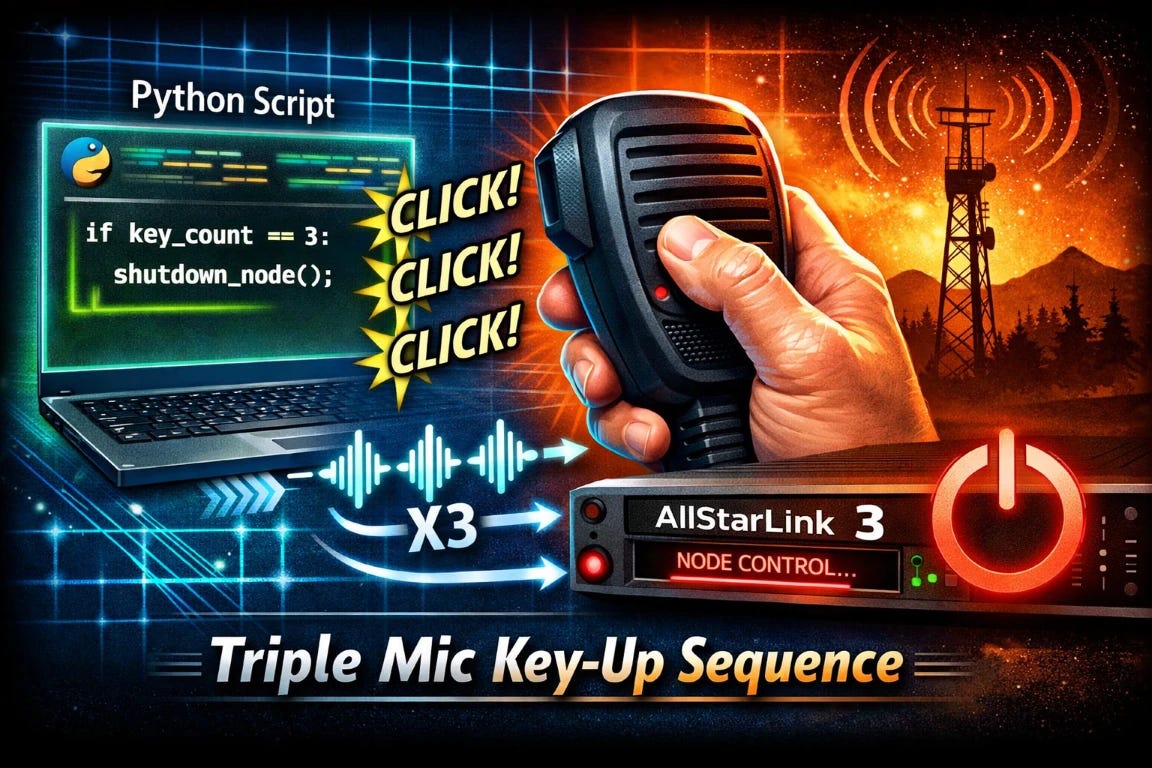
I got frustrated with one of my tiny nodes because to shut it down properly, I had to either log into the Cockpit interface with a browser or open an SSH session with PuTTY. I went looking for another way to accomplish a clean shut down with a minimum of fuss. My solution? A Python script that listens for three quick microphone key-ups. Learn more in TechNote 13 — Using Python and Three Microphone Key-Ups to Safely Shut Down an ASL3 Node.
Icom IC-7300 MK2 Transceiver
Microphone connector
One of the nicest things about the new radio is very much a trivial thing, but I like it: pressing the round 8-pin microphone connector to the microphone port is silky smooth. It’s not supposed to feel like that! On all of my older radios, doing this is not smooth. The older radios all take a bit of fidgeting to get everything lined up just right, and then some conscious effort is required to actually make the connection. With the 7300 MK2, it’s like using a brand new, nonstick frying pan: slick, smooth, easy. Sometimes it’s the little things.
Desktop microphone, part 2
The W2ENY adapter and foot switch arrived. I haven’t had much time to play with them, other than to hook things up once to make sure the physical connections work.
As I’ve thought about my need to operate the radio quietly in the same room as my wife, the very affordable W2ENY headset sounds like a great option. I ordered one for the Icom IC-7300 MK2 radio. It won’t arrive before this issue goes to press, but I’ll show it in a future issue of the Random Wire.
VARA
I bought a license for VARA and installed it on my amateur radio computer, the Panasonic Toughbook CF-54 MK2. Then I installed Winlink Express. After testing Winlink over a telnet connection to make sure it would work, I configured it for the IC-7300 MK2. It looks like it worked. Now I just need to find someone I can try messaging with Winlink on HF.
Winlink.org has helpful guidance on configuring an IC-7300 transceiver (PDF format).
Pebble HF Kit
“An ultra-affordable HF radio for anyone.” This intersects with the Random Wire because digital modes will be supported with an adapter.
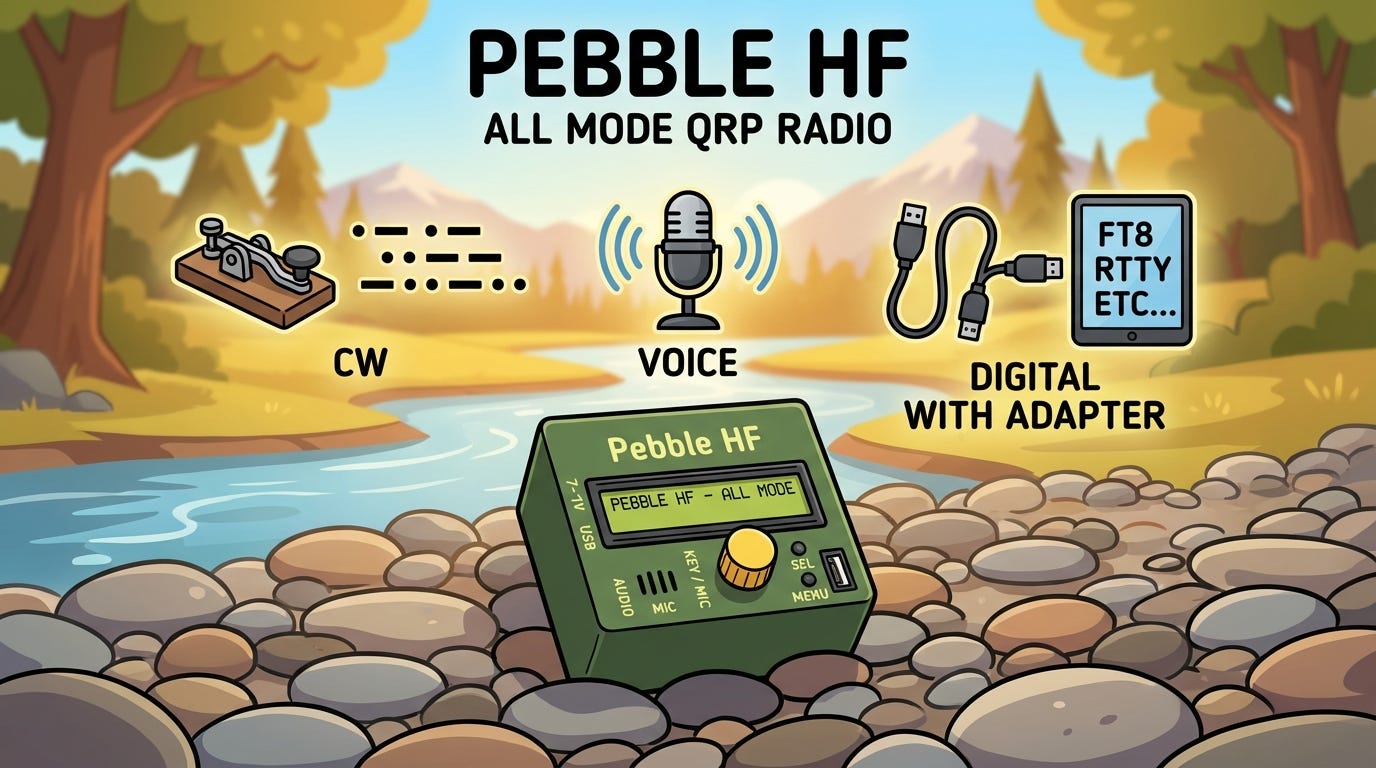
Pebble HF is an ultra-affordable, ultra-portable HF radio kit for anyone to get into HF amateur radio. Easy to build says the website, 5W output with 12V input, built-in CW key and microphone. Technical details are available on GitHub.
Pebble HF is coming spring or early summer 2026, for under $50.
Is it another QCX hack? I don’t really care. AI explanation of a QCX hack:
A QCX radio hack is a modification, most commonly known as the uSDX project, that transforms the QRP Labs QCX—a 5W CW (Morse code) transceiver kit—into an Arduino-powered all-mode (SSB) transceiver. This popular hack enables voice communication on a radio originally designed only for Morse code, typically involving firmware changes and minor hardware tweaks.
The price is great and the rig, if it works acceptably well, would make a great portable device. I signed up. This would be a fantastic kit to build and then throw into a rucksack with some wire.
This news was also picked up on QRPer: Pebble HF: An Ultra-Affordable QRP Radio Kit with Big Potential!
D75Link Bridges Voice to D-STAR Reflectors
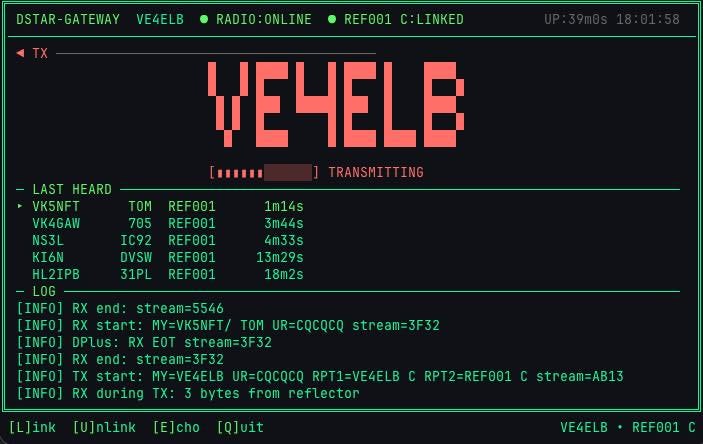
Fabian VE4ELB is working on a command-line D-STAR reflector client for the Kenwood TH-D75 radio that runs on a Mac or Linux.
A D-STAR reflector client for the Kenwood TH-D75 radio. Connects via Bluetooth to the radio in DV Gateway Mode and bridges voice to D-STAR reflectors (REF, XRF, DCS) over the internet. The radio handles all audio encoding and decoding with its built-in AMBE chip. d75link bridges the radio’s MMDVM serial protocol over Bluetooth to reflector UDP packets, with a retro command center terminal interface.
Fabian wrote:
I’ve been working on a custom Linux/macOS command-line tool that connects the Kenwood TH-D75 over Bluetooth to use your computer as a portable hotspot. It’s currently in alpha, but it’s working great for getting on the reflectors without extra hardware.
Painter Pole Antenna Project, Part 2
Before I embark on a DX Commander-like build using a painter pole, I needed to find an adapter for the top of the painter pole. It turns out that Buddipole makes just such a thing (hat tip to Jim K0RGI for this lead). (How did I forget about the world-famous Buddipole?) It takes a couple of pieces to accomplish my goal:
The Buddipole Center Tee Adapter mates to the top of a standard painter pole and terminates with 1/2” pipe threads. Made of Delrin, it should be durable.
The VersaTee™ has standard 1/2” pipe threads on the bottom and has standard 3/8” x 24 threaded mounts on top, so it will accept standard whips and hamsticks. It also has wire attachment points for the feed line and counterpoise.
To this, I added a Long Telescopic Whip which will allow me to extend the pole-plus-whip to about 34-feet. That should work with a tuner for multiple bands between 10 and 40 meters in a base-fed configuration. I think it will still need at least a 1:1 unun.
Those items are making their way to me from Buddipole.
Two Inexpensive SDR Devices
I tried two software-defined radio (SDR) devices. Both were quite affordable.
RTL-SDR Blog V4 R828D RTL2832U 1PPM TCXO HF Bias Tee SMA Software Defined Radio with Dipole Antenna Kit (this is an affiliate link)
That is a complete kit with everything you need except the software. See/hear a one-minute video and learn more on EtherHam.com.
This next device is simply the tiniest SDR dongle I’ve seen so far, so it piqued my curiosity. Would it actually work? Only one way to find out!
NESDR Nano 2 Plus - Tiny Black RTL-SDR USB Set (RTL2832U & R820T2) with Ultra-Low Phase Noise 0.5PPM TCXO, MCX Antenna (this is an affiliate link)
I spent a few hours with the RTL-SDRv4 device…and some of that time was quite frustrating. I do have it set up and running.
Now about the frustrating bits. RTL-SDR requires a special driver for some SDR software applications. That driver is not signed so my Windows 11 machine blocked it. I turned off “secure boot” on my laptop to try to get past this problem, and while that should have worked, it didn’t. Part of the problem is undoubtedly because my CPU is an ARM chip, not an Intel or AMD chip.
What this means is I can’t run the SDR app and direclty access the RTL-SDR device on my ARM-based Windows laptop. (Well, to be more exacting: I can run the app but I can’t access the RTL-SDR dongle.) Instead, I’m running it on a spare mini PC and streaming it over my home network. I was listening to a classical FM station earlier today on my Windows laptop, and now I’m streaming that station to my iMac. Nice.
M17
MSeven M17 app tutorial
I was asked if I knew of a tutorial for the MSeven app for iOS devices. I did not find anything like that so I asked Claude to help me make one. Claude produced it in moments, formatted in HTML. I asked Claude to reformat it in DokuWiki syntax and that only took a few moments. After reviewing the output and modifying a few items, I posted the result at: https://m17.etherham.com/resources/mseven-tutorial. Let me know what you think of it!
History of M17
During the M17 net on Saturday morning on America’s Kansas City Wide Network via M17 reflector M17-KCW module A, Jeff AE5ME recited some of the history of M17. I wondered if Claude knew about this, so I asked. The results are very interesting and available at https://m17.etherham.com/about/history.
What is Claude? Here’s the Google AI explanation:
Claude is a next-generation AI assistant developed by Anthropic, designed to be safe, accurate, and secure, often excelling in creative writing, coding, and complex analysis. It is a large language model (LLM) known for its large context window, allowing it to process long documents.
One note about ChatGPT and Claude. ChatGPT can create graphics and remembers what you were working on. You can go back to ChatGPT tomorrow or next week and it will have context for the continuation of your work. Claude doesn’t d graphics remembers nothing from your previous session...but I’ve had better luck with the information Claude has provided, especially on technical topics. I’ve had to learn to ask for a detailed summary at the end of an important session so I can upload that to Claude when I want to resume work.
Are You Still Running AllStarLink 2?
This surfaced for me as I worked on TechNote 11: Automatically Connecting/Disconnecting an ASL 3 Node. As I dug around, I came to realize that many hub nodes (AllStar nodes that are used to connect many nodes at the same time) are still running the previous version of AllStarLink.
For those folks, I want to be sure you know that the wiki for AllStarLink 2 is no longer available!
If you are still running ASL 2, please don’t panic. The old wiki content is still available in PDF format at this link: https://wiki.allstarlink.org/archive/. I will say that digging through PDF files is not as easy as using the wiki, but at least that resource has been preserved.
For ASL 3, the new manual is available at https://allstarlink.github.io/
Raspberry Pi 500+
Thank you to Steve Stroh N8GNJ, maestro of the Zero Retries newsletter, for sharing a link to Jeff Geerling’s interesting video on the Raspberry Pi 500+ keyboard computer. It was a fun and interesting video because (a) I have an RPi 400 keyboard computer and (b) the RPi 500 and 500+ models offer much more capability. I’ll confess here that the 400 keyboard didn’t really float my boat, but the 500 and 500+ models do sound much more capable.
I never would have thought to try eGPU with the 500+, but Jeff makes it work.
Pretty amazing stuff.
Computer: Upgrading the Surface Pro 4 to Windows 11 Pro
Background
I have a Windows Surface Pro 4 computer. You know, the one that is a tablet with a cover that doubles as a keyboard. You’ve probably seen it on newscasts and sports shows where the computer in front of the media personality has a stand that angles out from the back of the screen. That was most likely a Surface Pro machine.
Mine sports an i5 CPU, 8 GB of RAM, and 256 GB of storage. This is enough to run Windows 11, but my machine is stuck at Windows 10 because the TPM (Trusted Platform Module) chip does not meet Microsoft’s requirements for Windows 11. (Snark: Hey Microsoft, that seems as if it was a bit short-sighted, don’t you think?)
AI explanation of why the Surface Pro 4 isn’t eligible for Windows 11:
The Microsoft Surface Pro 4 cannot officially upgrade to Windows 11 because its Intel 6th Generation processor is not on the supported list, and it lacks the mandatory TPM 2.0 security requirement. Microsoft restricts Windows 11 to devices with newer hardware (post-2017) to ensure security and stability.
The rest of this gets technical, so I’ve posted the full article on EtherHam.com as a TechNote if you’d like to learn more.
Opinion: Do the Terms YL and OM Reflect Patriarchy or Affectionate Jargon?
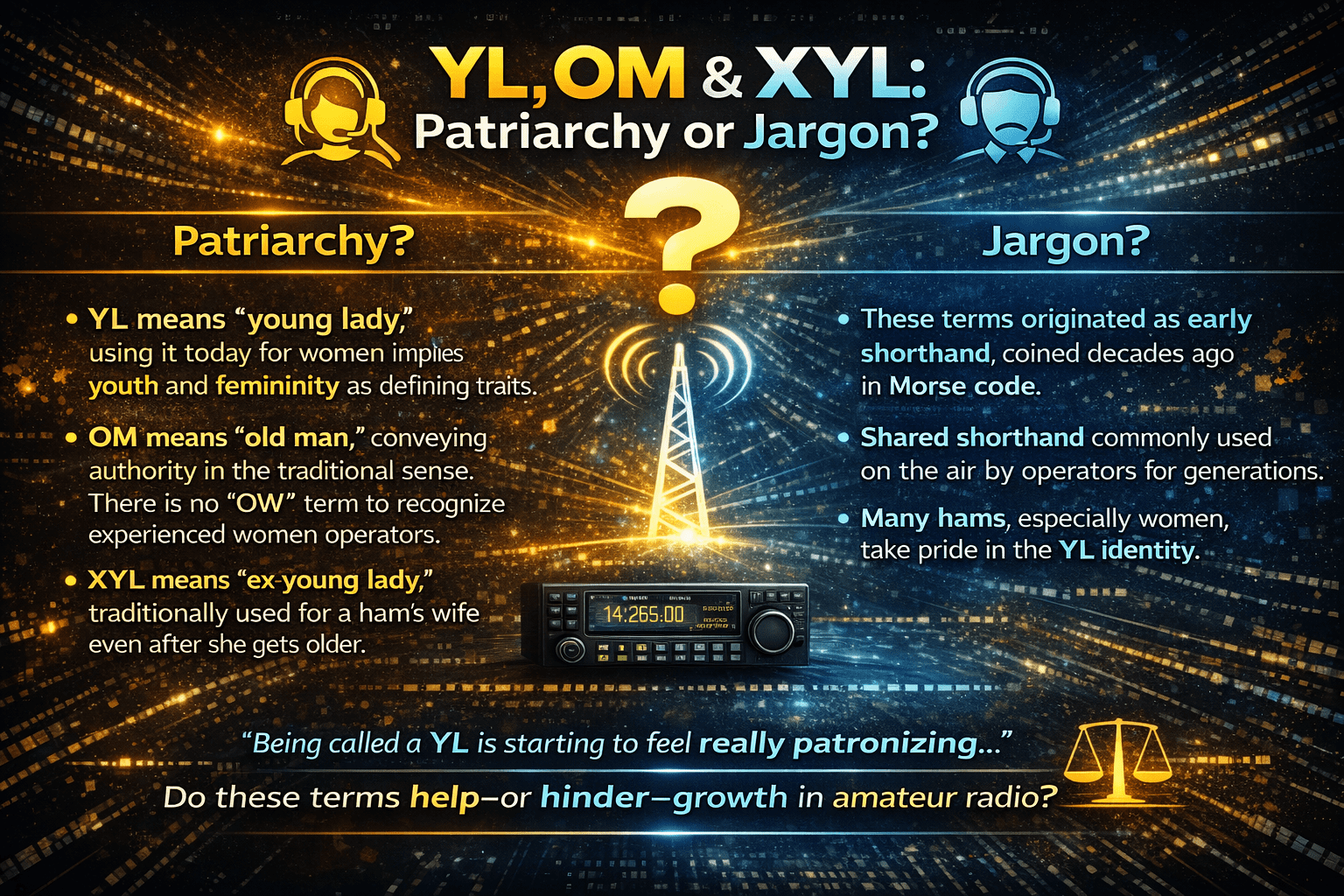
Is it time for our amateur radio community to reconsider the use of gendered terms in our hobby? I think the answer is yes.
The terminology
What are the terms I’m talking about?
YL (”Young Lady”) — used to refer to any female amateur radio operator, regardless of age
OM (”Old Man”) — used to refer to any male amateur radio operator, regardless of age
XYL (”Ex-Young Lady”) — traditionally used to refer to a ham’s wife (originally meaning a woman who was a licensed ham before marriage, later used more loosely)
Do these terms reflect patriarchal norms?
It’s hard not to recognize the asymmetry in these terms. “OM” suggests experience and respect, in that “old man” is, in many cultures, a term of wisdom and seniority.
“YL” seems to emphasize youth and femininity, suggesting that women in the hobby are defined by their gender and age instead of their standing in amateur radio. There is no equivalent “OW” (Old Woman) term for experienced female operators.
The term “XYL” is particularly telling as it frames a woman’s identity relative to her marital relationship with a male ham. There is no male equivalent to XYL.
Or is this situation more nuanced?
These terms originated as early Morse Code telegraphy culture became established. This was a time when brevity was everything. The terms were likely not coined with malicious intent. “OM” wasn’t really meant to convey wisdom — it was just shorthand.
Many female hams today use and embrace YL as a badge of community identity. There are active YL-focused clubs and nets around the world. Within the amateur radio community, the term often functions as neutral, affectionate jargon rather than as a means of exclusion.
Or are they both patriarchal and friendly jargon?
The shorthand terms do reflect the patriarchal norms of the era when they were first coined. That is, I think, historically accurate. The asymmetry in how men and women are labeled — and the XYL framing in particular — reflect a time when women’s roles were defined largely in relation to men.
Do those terms perpetuate those norms today? That seems more debatable. Language can outlive the attitudes that shaped it, and communities can reclaim or redefine terms. There are two audiences to consider: those inside the amateur radio community, and those outside the community. I’m concerned that those outside the community may leap to the conclusion that YL and XYL are demeaning to women.
I don’t have any suggestions that would serve as gender-neutral replacements for these gendered terms.
I also did not find much published on this point.
Previously published content
Amateur Radio the gender imbalances in Ham radio, and why I will no longer use the term YL
This 2016 blog post by a female operator directly addresses the gender dynamics of the term YL and states plainly that it contributes to women feeling like they don’t fully belong in the hobby. She argues the terms originated nearly a century ago and reflect social norms that are no longer acceptable, and notes that amateur radio is roughly 15% women in the USA.
But thinking about it, one obvious example of this to me is the fact that in Ham radio we still commonly use YL, ie "young lady," to refer to all women regardless of age. I will freely admit that this didn't annoy me much when I was a young woman, but by now I am 30 years old and am going to have a doctorate in astrophysics by the end of the year (hopefully). And being called a YL is starting to feel really patronizing and condescending to me, in a way related to calling a grown man "boy." It definitely has been said to me many times in a way that does not make me feel like just another Ham radio operator.
YL coined by ARRL in 1920
Historical context: The term YL was coined in 1920 by the ARRL. The reasoning for the term is telling — it reveals the creators were aware of the asymmetry but chose youth over experience in labeling female radio amateurs:
The term YL was coined in 1920 by the American Radio Relay League for young ladies of all ages, as “OM will not fit and OL would certainly be most inapplicable.”
ARRL documented that XYL is for unlicensed women
An ARRL publication on women’s participation in amateur radio notes that XYL is the term for unlicensed women, usually wives of male operators. No critical analysis of the term is included in that publication.
Published academic studies?
No formal academic or peer-reviewed analyses of the use of these terms seem to exist. Specifically, I was looking for publications through the lens of gender studies and linguistics.
Conclusion
It seems to me that we are at a point where a cultural realignment might benefit the hobby. We don’t need to classify women in the frame of their relationship to men. Continuing to do so may contribute to limited interest and participation by women in our community of licensed radio amateurs.
This is akin to the renaming of blackboards and whiteboards, where for some of us, this just didn’t matter, but for others, it mattered a great deal.
I’m sure some folks will read this and think I’m being too politically correct. My response is: I have daughters and I want them to have as many opportunities for growth, self-fulfillment, and success as I have enjoyed. That’s not possible when we embed terms that subtly — and sometimes not so subtly — cast women in terms of their relationship with men.
I do think we have arrived here innocently. These are terms that have been part of amateur radio culture since the telegraphy days. However, just because we use such terms without harmful intent does not mean they are not harmful.
As I continue to explore the art, science, and community of amateur radio, I have come to know men who are great operators…and some who are not. I know women who are great operators…and some who are not. The level of proficiency and helpfulness of fellow hams are the important points for me, not their gender. If using gendered terms effectively reduces engagement of potential amateurs, we should consider finding other labels.
Short Stack
And now for the part you’ve been waiting for: the short stack of interesting internet finds. Quoted content in the Short Stack is shown in italics.
ARRL
It seems the ARRL has entered the modern era! ARRL Introduces New LIVE Online Course for Ham Radio Licensing was publicized in November of last year and I missed it. It’s nice to see the League move forward.
Radio
Click-to-Tune for POTA. This is pretty cool. HamDash now has CAT control associated with the POTA map. Visit the site and click the POTA selection.
Elevate Your POTA Experience with the Icom IC-7300 MK2. “This article delves into an activation featuring the Icom IC-7300 MK2 transceiver, evaluating its performance in various aspects essential for portable operations.”
HRWB 259 - Making CW Keys with Aaron from Modern Morse. I’m only about halfway through this episode but I can tell it’s a great one. “Modern Morse keys are popular for POTA, SOTA, travel and anytime you want a portable high quality CW key. Aaron shares his journey through the design and manufacturing process for making his keys.”
See Which Shortwave Stations Are Broadcasting Right Now. “World Radio Map is a free web application that answers that question with an interactive Google Map, showing you real-time shortwave broadcasting activity around the globe.” Source: The SWLing Post
N7YG Digital Engine. “This program was specifically designed to function as a companion to the suite of N3FJP software and provide the users with a simple digital modem with a floating waterfall that can reside on the same screen as the logging software…Now includes support for PSK Reporter, EXTFSK, TinyFSK and K1EL Winkey FSK.”
Guess I need to use this – N1MM Logger. “If you go back enough years perhaps N1MM was a bit more of a learning curve than I wanted to take on. With time I’d like to think N1MM and I both got better suited to working with each other.”
Building A $50 SDR With 20 MHz Bandwidth. “Although the RTL-SDR is cheap, accessible, and capable enough for many projects, it does have some important limitations. In particular, its bandwidth is limited to about 3.2 MHz, and the price of SDRs tends to scale rapidly with bandwidth. [Anders Nielsen], however, is building a modular SDR with a target price of $50 USD, and has already reached a bandwidth of almost 20 MHz.”
SDR vs. HDR — Are analog hams Troglodytes, stuck in a rut, resistant to change, and all that? Since I touched on software-defined radio several times in this issue of the Random Wire, this Solder Smoke post is on point. It rounds out the context around SDR. I’m not sure what is really meant by HDR in the Solder Smoke post, but the content is informative.
Amateur Radio Weekly – Issue 413. Always a good read.
Advice on Being the Best Elmer You Can Be. “I implore you to lay down the daggers of self-righteousness and insult and take up the mantle of encouragement. Your life and our hobby will be better for it.”
Meshtastic
Bridging Meshtastic to SMS/RCS. “We’ve built a Meshtastic ↔ Android SMS/RCS gateway, and it’s already proving to be both useful—and honestly, pretty fun.”
Antennas
The REZ Antennas XForm Transformer proves its worth. Michael KB9VBR writes: “REZ Antennas raises the bar on small delta loops with the introduction of their XForm 4:1 transformer. Part of the Scout XF modular antenna system, this transformer adds a variety of nonresonant antenna options to the already versatile system.”
Lumped-Constant Loaded Dipole Antenna. Catchy name for the antenna? Perhaps. Looks like a trapped dipole to me. “This electrically shortened dipole is similar in appearance to a trap dipole except the ‘traps’ consist of coils only, causing the antenna to operate not unlike two mobile inductively loaded whips, mounted horizontally base-to-base.”
Computing
DietPi just made it easy to host your own Google Photos on a Raspberry Pi. “DietPi v10.2 introduces Immich, the open-source and self-hosted Google Photos alternative, as a new package in the software library.”
HAM-Toolbox version 1.8.0 released. “HAM-Toolbox provides a variety of useful Tools to help you operating your HAM-Radio…ranging from activity monitoring Tools like DX-Cluster and PSK-Reporter, to Tools helping you with resource information like Bandplan, Glossar, AWG and many more Tools.” For Mac/iOS
systems.
7 settings I change after installing Ubuntu. “Every time I install Ubuntu, whether it's a fresh setup or an upgrade—I follow a checklist of tweaks I immediately apply. It's a set of changes I always make to ensure the system feels comfortable, familiar, and efficient for me.”
The Best Laptops for Older Adults. Despite the clickbait title, reliable, easy laptops are good for all ages.
Geekery
I don’t know what else to call some of these edge case items that most hams won’t be interested in…but some of us will!
Ampisu is a compact pocket-sized USB lab power supply with SCPI and web control (Crowdfunding). “…Ampisu [is] a compact, pocket-friendly, and isolated three-output lab power supply designed to fit in a pocket and include features of a typical full-sized power supply.”
Networking
What The FCC’s Router Ban Could Mean for You. “The U.S. government is banning the importation of new routers made overseas, meaning consumers will no longer be able to purchase devices from many popular manufacturers.”
EtherHam Store
The sweatshirt arrived from the EtherHam Store and I see I placed the logo too low on the chest. I suppose I could add a callsign above the logo. That might work.
The logo actually looks a bit better in person than the image suggests.
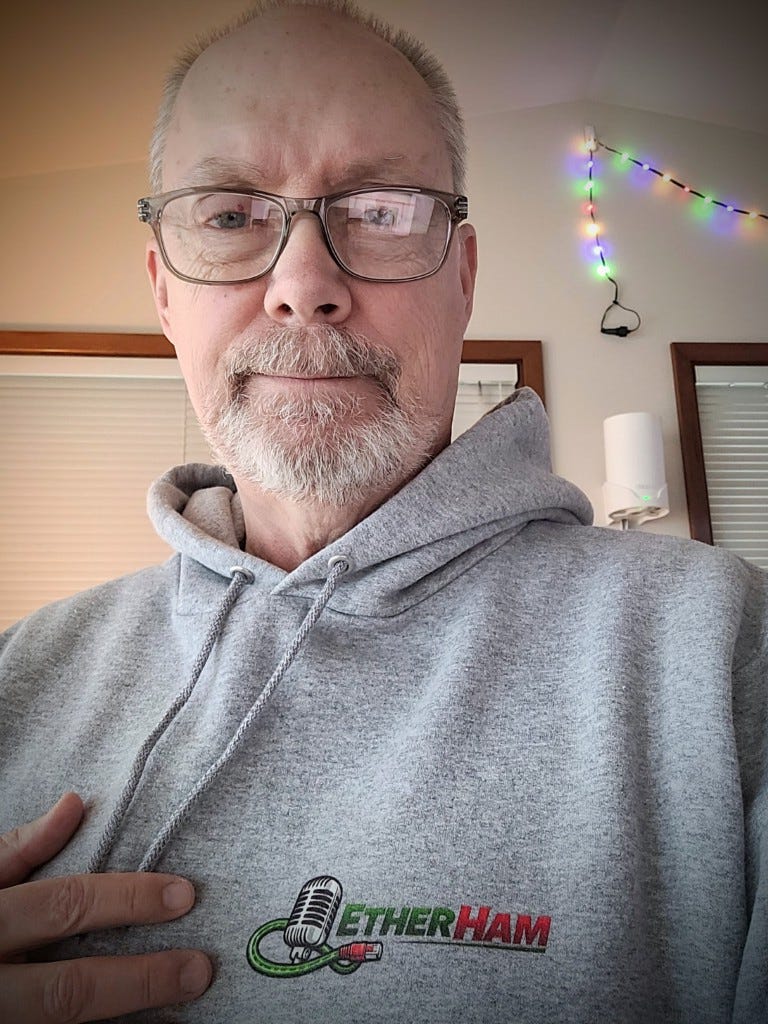
I normally wear a men’s medium size. In this case, I ordered a large and it is comfortably loose. I think the sizing is accurate. This is a Champion-brand sweatshirt with a smooth, double-thick hood. The body and sleeves are fleeced inside.
Signing Off
Why do I close with the same phrase every week?
Remember to touch a radio every day!
I believe that seeing and touching a radio brings it into the now, imprinting it in your consciousness. If your radio is stuck in a box or a closet, it’s likely to stay there, unused. If your radio is where you see it every day, you are much more likely to fire it up and get on the air. I like to keep a radio nearby because it reminds me — even in my most frustrated moments — that I can always connect to a community of supportive, helpful people. Radio has been, and continues to be, a great way to take a break from things that may not be going as well as I might wish. Radio grounds me (yes, pun intended)!
Radio is about science, but there is also art involved. A beautiful PCB layout, a vintage device restored or upcycled with modern features, an elegant homebrew system…all have an artistic element. Where there is art, there is also community. This surfaces when we share our appreciation for particular builds and creations.
I’m all for STEM (science, technology, engineering, math) but somewhere, somehow, we lost sight of the inspiration and energy art provides. I’m a fan of STEM, but I’m a bigger fan of STEAM: science, technology, engineering, arts, and math. Artistic endeavors connect the other elements to us as humans and to our shared membership in a wider community.
With that, it’s time to tie a ribbon around this issue. 73, and remember to touch a radio every day!

Great issue as always Tom! HDR is Hardware Defined Radio. Agree about not using YL, etc. not just for the reasons you outlined but because it’s cliquey, insidery terminology that makes Amateur Radio less approachable. My prime example is Elmer which is a beloved term for us older Hams, but it’s inscrutable. The word Mentor is fully equivalent and much better known, so I use that in my writing.