

00 QRV: Are You Ready?
Welcome to Random Wire 185.
On the amateur radio side, I’m very pleased to share a positive outcome after a month of trying to get APRS beaconing working reliably on my TIDRADIO TD-H9 handheld transceiver. As is often the case with stubborn problems, the solution ended up being a simple on-off setting, but finding that took extensive trial-and-error testing. It's a small thing that felt like a very big thing when I finally cracked it
On the technology side, I’m also happy to share my new network-attached storage (NAS) solution using a Beelink ME Mini PC. It’s affordable, quick, and should be reliable. This project is well within reach of anyone who runs Linux on a computer, and it’s a great learning opportunity if you’re just getting started.
Find links to these below in the New on EtherHam section.

01 Thank You…America’s Kansas City Wide Network
This week’s thank-you goes to the team behind America’s Kansas City Wide Network — one of the most reliably busy watering holes on the digital amateur radio scene. Dedicated volunteers keep the lights on, and a very active group of regulars keeps it from ever getting too quiet.
I tune in when I travel. There’s a Portland repeater on the network, which means I can monitor and participate whenever I’m in range — a small thing that makes a long drive considerably more interesting. What I especially appreciate is that KCWide hasn’t stood pat. They’ve linked an M17 instance, extending a warm welcome to the new kid on the block. That kind of openness matters.
If you haven’t found your way to KCWide yet, consider this your invitation. Thank you to everyone who keeps it going.
02 New on EtherHam
It was a very satisfying week with several big wins.
The TIDRADIO TD-H9: A $70 APRS Radio Worth the Effort
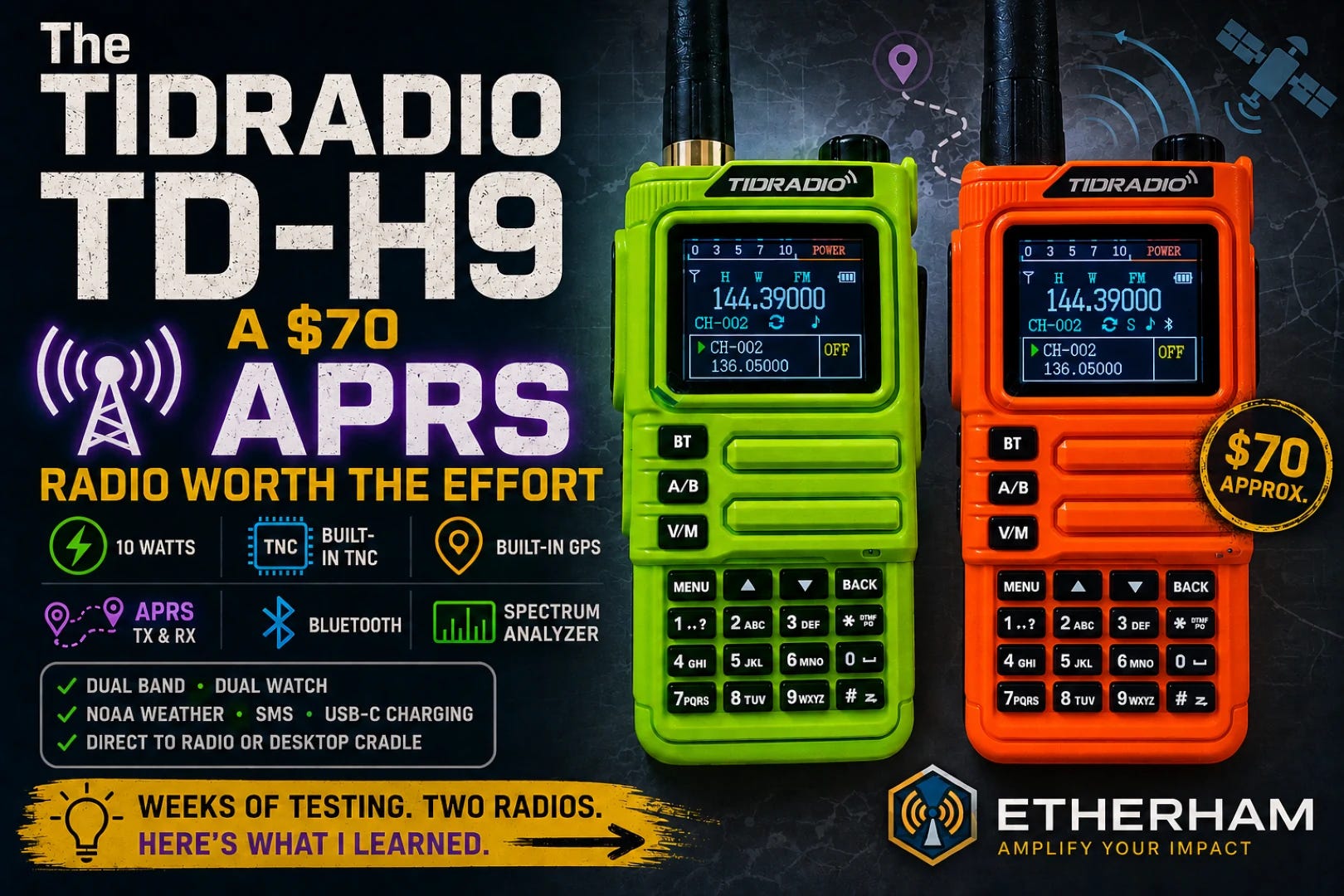
The TIDRADIO TD-H9 offers 10 watts, VHF/UHF, AM airband, a built-in TNC, GPS, APRS, Bluetooth, and a spectrum analyzer for around $70. The hardware delivers on that promise. Getting APRS automatic beaconing to work reliably, however, took two radios, weeks of testing, packet log analysis, and a lot of time on aprs.fi. The culprit turned out to be an undocumented interaction between two settings — and once identified, it was a one-sentence fix. This is what I learned, so you don’t have to learn it the hard way.
The full writeup is on EtherHam: settings, firmware notes, real-world packet data, and more. Make the jump to Getting APRS Working on the TIDRADIO TD-H9 for the details.
An AllStar Node on the Seeed reRouter CM4
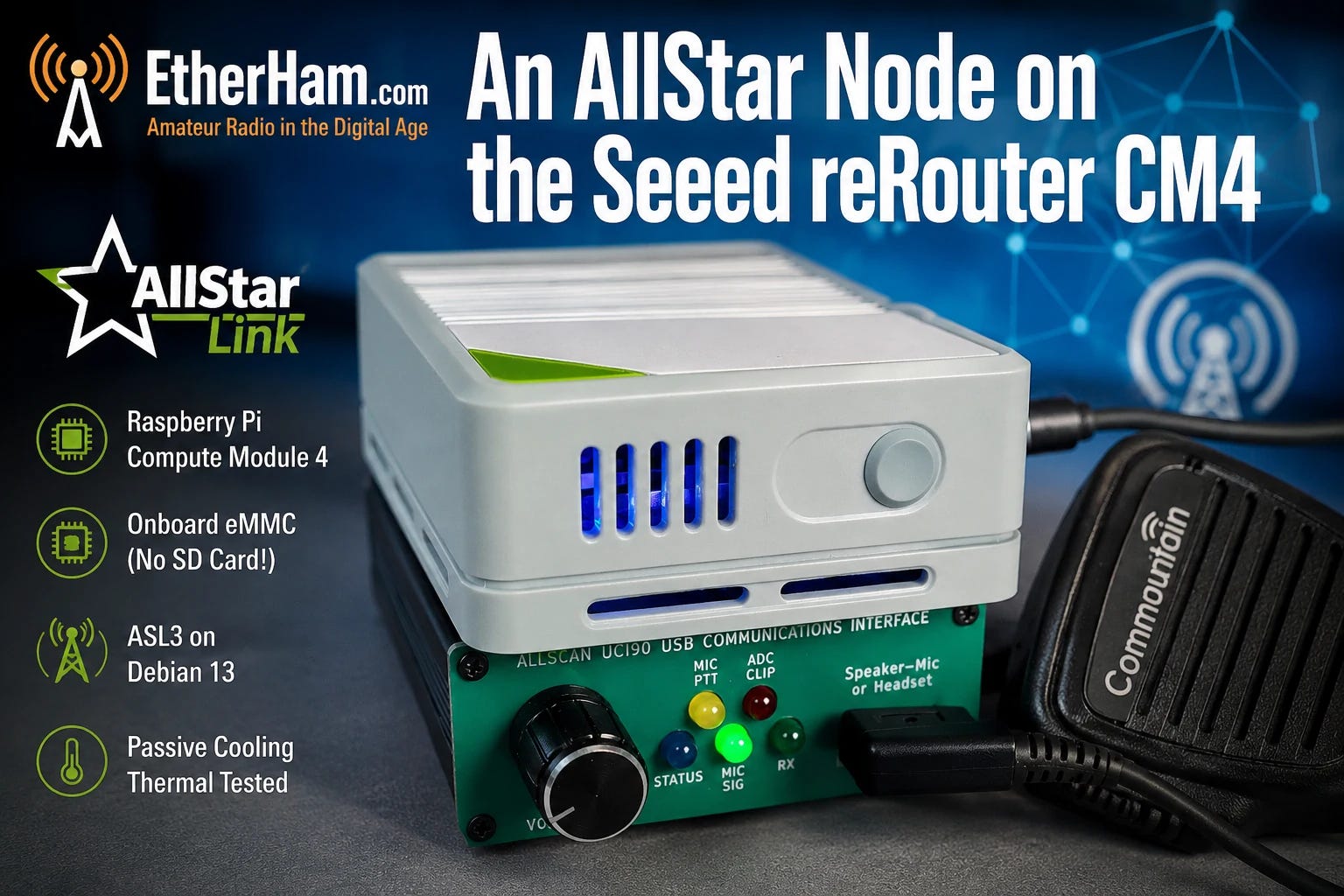
The Seeed Studio reRouter CM4 1432 is a compact mini-router built around the Raspberry Pi Compute Module 4 — and unlike standard Pi builds, it stores its operating system on onboard eMMC flash rather than a microSD card. For AllStar node builders who’ve lost a node to card corruption, that’s a compelling detail. This article walks through converting the reRouter from its factory OpenWRT installation to Raspberry Pi OS, installing ASL3 on Debian 13, and building a fully functional AllStar node — including UCI radio interface setup and thermal testing of the passive cooling system.
Read the complete article: An AllStar Node on the Seeed reRouter CM4.
Retiring the Pi 4: Building a Better Home NAS with the Beelink ME Mini
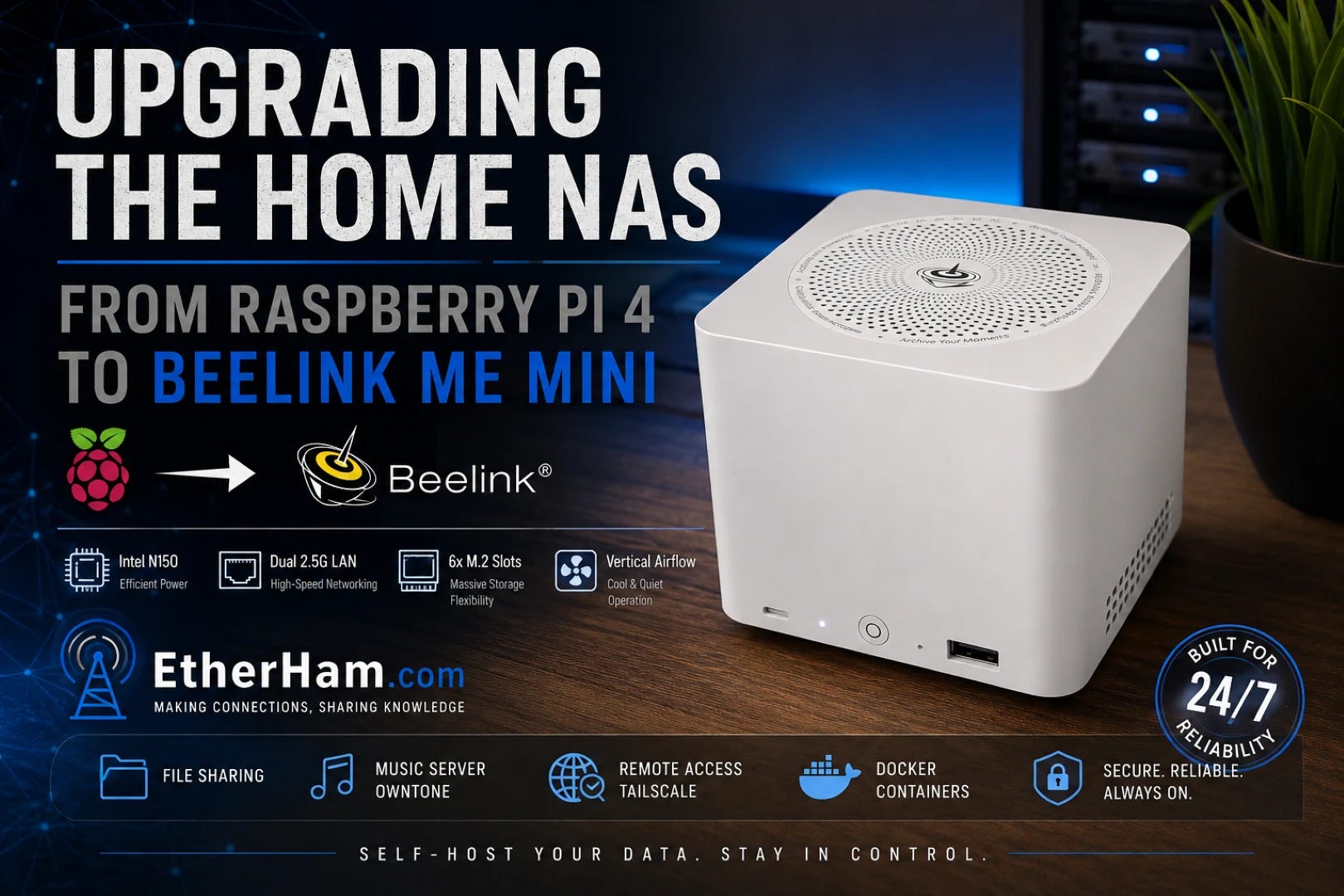
The Beelink ME Mini is a purpose-built NAS mini PC that competes directly with a Raspberry Pi 5 kit on price but wins decisively on performance, thermal design, and expandability. It ships with an Intel N150 processor, 16GB LPDDR5, a 1TB NVMe, dual 2.5GbE ports, and six M.2 slots — all in a compact enclosure with a substantial internal metal heatsink and a built-in power supply. If your Pi-based NAS is running out of steam, this is worth a serious look. Here’s my experience migrating a home NAS and OwnTone music server to this platform, running Debian 13 and OMV 8, including the gotchas worth knowing before you start.
Visit Upgrading the Home NAS: From Raspberry Pi 4 to Beelink ME Mini for more.
DroidStar IAX Still Broken — But the Fix Exists
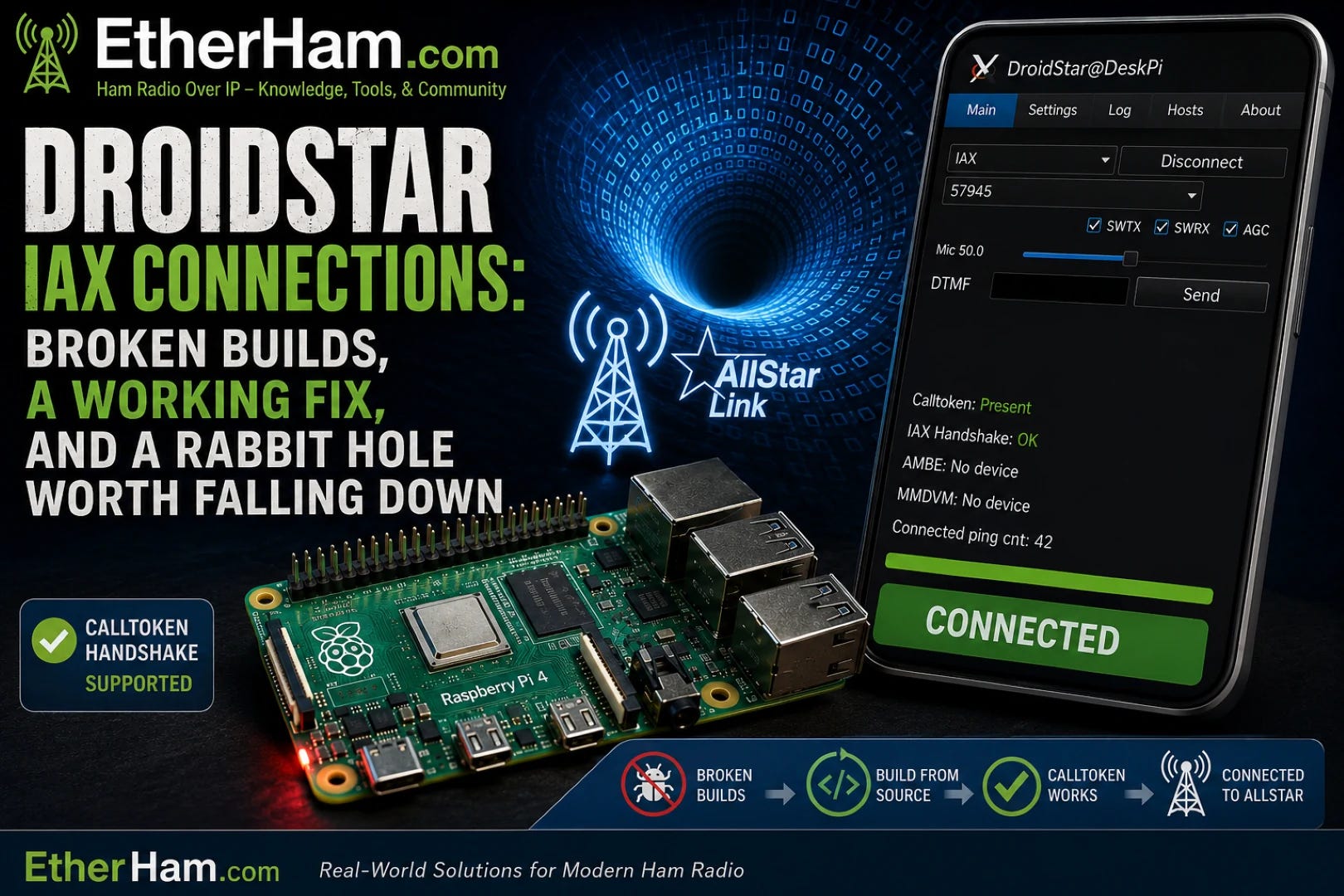
DroidStar's IAX/AllStar connection mode stopped working for many users in early 2026 — the Connect button simply does nothing. This article traces the bug to its root cause, tests available prebuilt Android APKs, and then builds DroidStar from source on a Raspberry Pi 4 utility machine to confirm that the fix is real, the IAX handshake works, and the problem is that nobody has shipped a working Android build yet.
Learn more at DroidStar IAX Connections: Broken Builds, a Working Fix, and a Rabbit Hole Worth Falling Down.
03 Gadgets
USB Cable Tester
I got a little frustrated last week trying to find a USB-C cable that carried data. It seemed like every cable I pulled out of the box was a charge-only cable.
Time for a cable tester. I ordered this one, even though it requires the user to interpret the LED lights displayed when testing:
Treedix USB Cable Tester USB Cable Checker Data Wire Fast Detection for Type-C, USB-A 3.0, Micro-B 3.0, Micro-B 2.0, Mini-B 2.0, and for Lightning Cables by Checking the LEDs (this is an affiliate link)
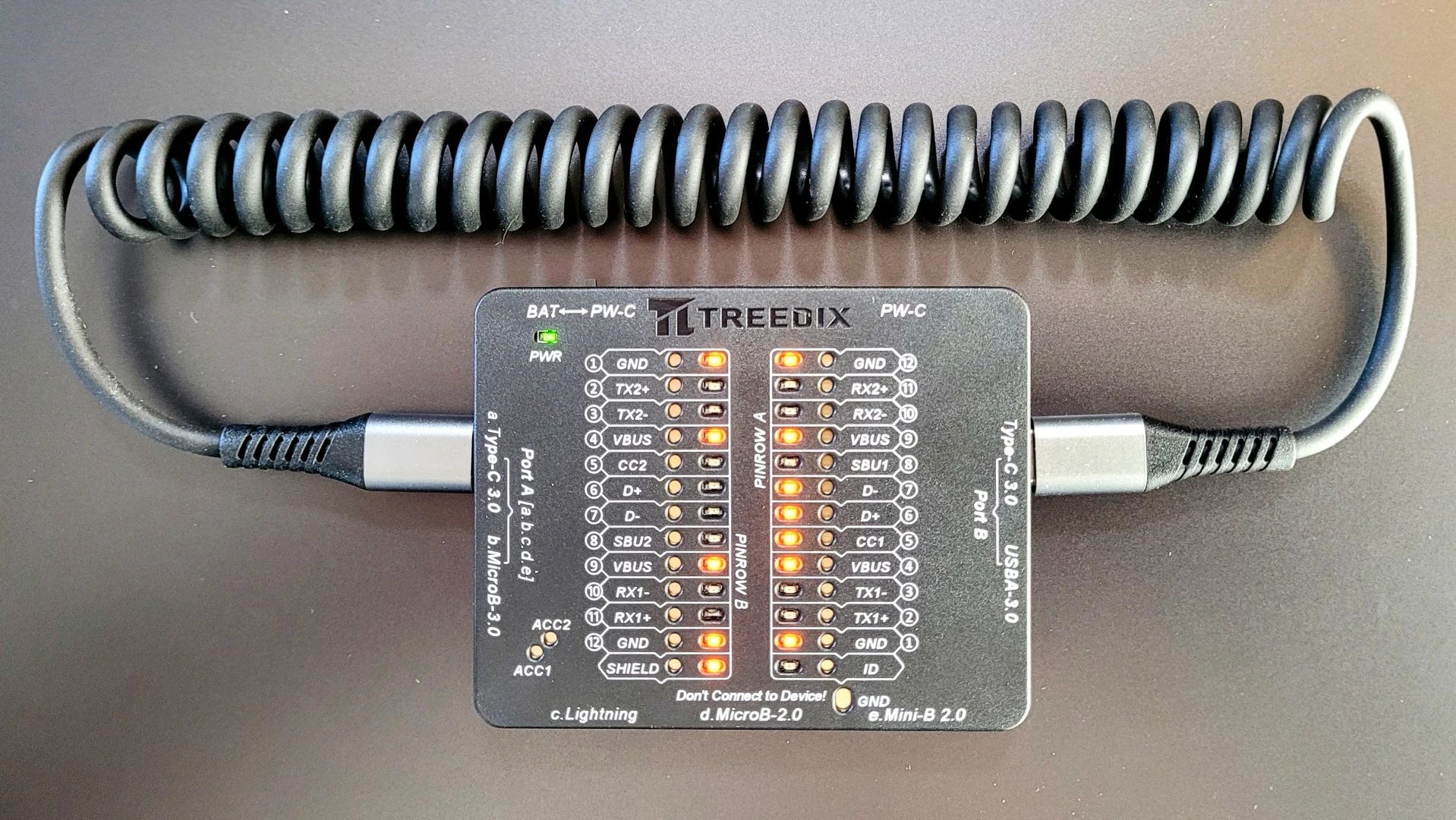
It is rated 4.5 stars by more than 100 users. For $19, I think this will save me a whole bunch of frustration. There is a less expensive version with clear acrylic panels and open sides, but since this will get tossed in the radio bag, I was more comfortable with an enclosed case.
Marking tested cables was the next problem — I didn't want to test the same cable twice. I thought about heat shrink, but that seemed like overkill. Colored electrical tape would work, but cables hit the floor and tape ends lift, collecting lint and dirt. The solution I landed on: red and green gel nail polish. Charge-only cables get red. Data-capable cables get green. I cure the dots with the UV flashlight I carry when I travel.
365nm Black Light Flashlight, UV Flashlight Rechargeable with LCD Display, Powerful Ultraviolet Lights for Pet Urine Detection, Resin Curing, Rockhounding, Scorpion, Uranium Glass, A/CLeak (this is an affiliate link)
That seemed to work. It took about a minute of exposure to cure the nail polish dots to the point they were firm and no longer tacky.
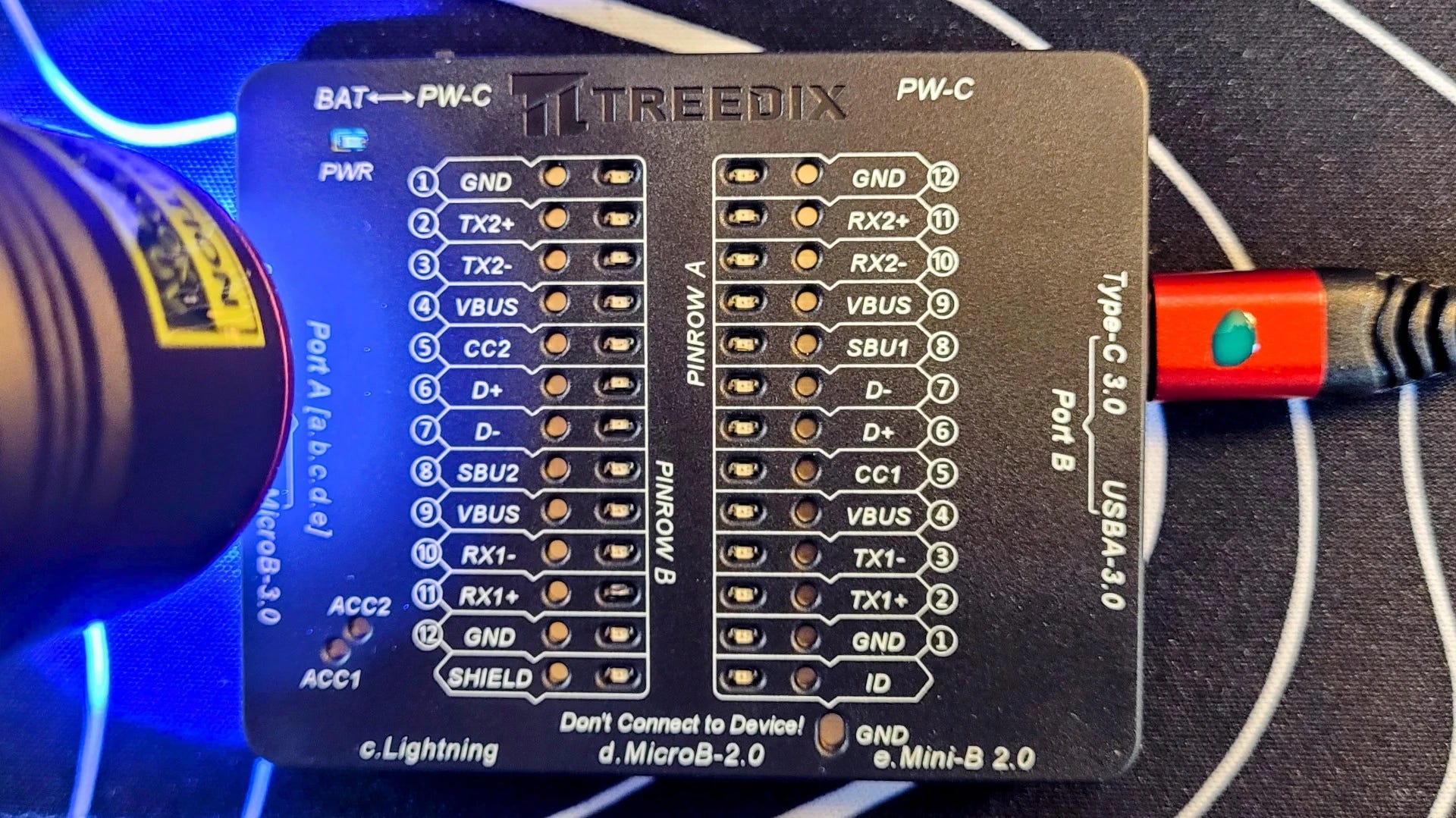
And I have another use planned for the red polish. Mom used to love going trolling for trout. Her favorite lure was a Dick Nite spoon. She always used a spot of red polish to put an eye on her lure. She called it her "Tricky Dicky" lucky lure. Good memory.
Earbud for AllScan UCI80M
I went looking for a way to monitor conversations on AllStar using one of my nodes configured with an AllScan UCI80M USB Communications Interface. The UCI80M uses a Motorola M1 speaker-mic connector. I found an earbud with an M1 connector and gave it a try. These are common in K1 (Kenwood) configurations but harder to find in M1.
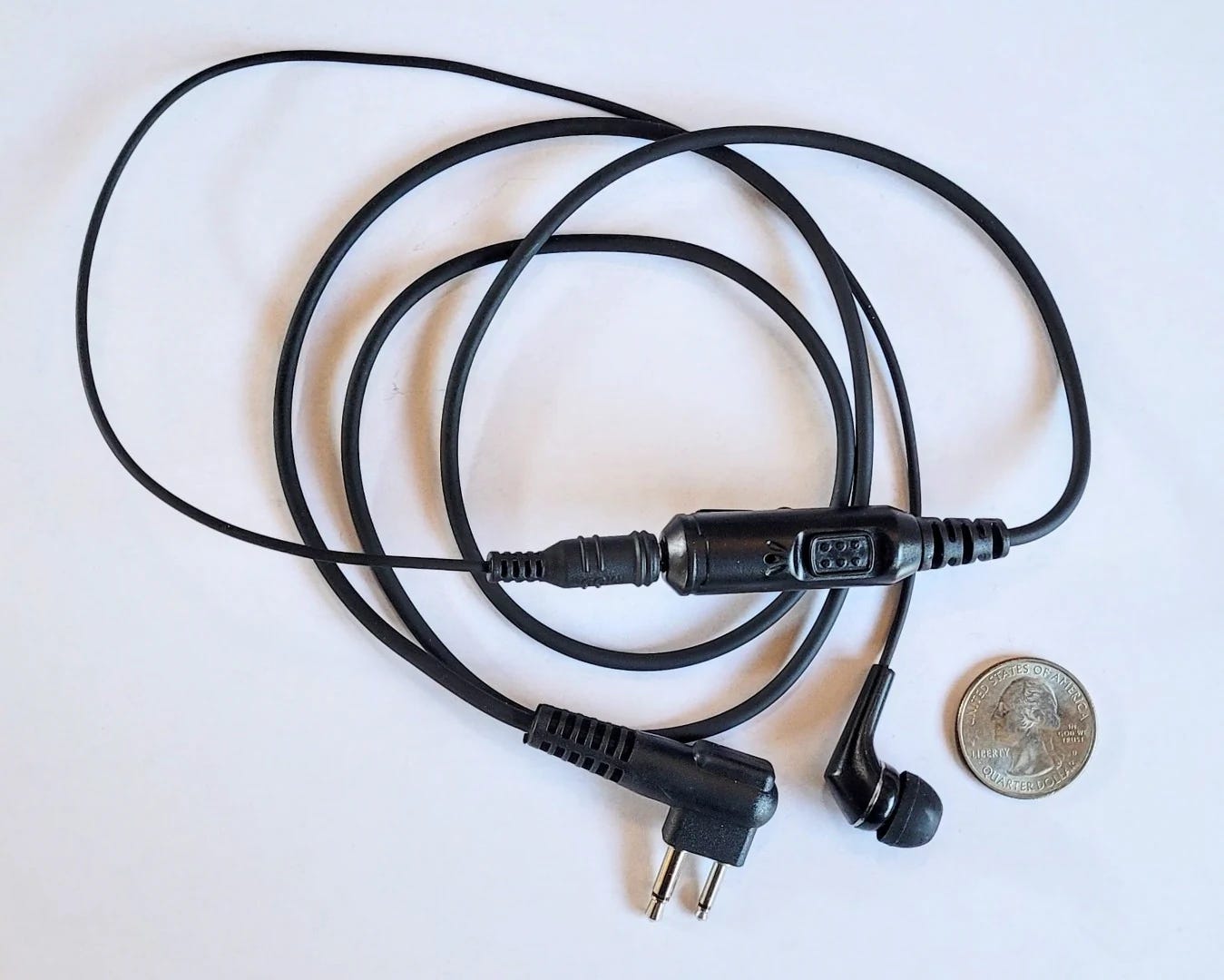
It works. The push-to-talk mic tested as "good audio" with the Enhanced Parrot on node 55553. Transmitted audio isn't studio quality, but it's understandable.
More interesting is the earbud itself. It's a single unit with a rubbery tip that fits comfortably in the ear canal. When I first plugged it in, the audio level was painfully high and distorted.
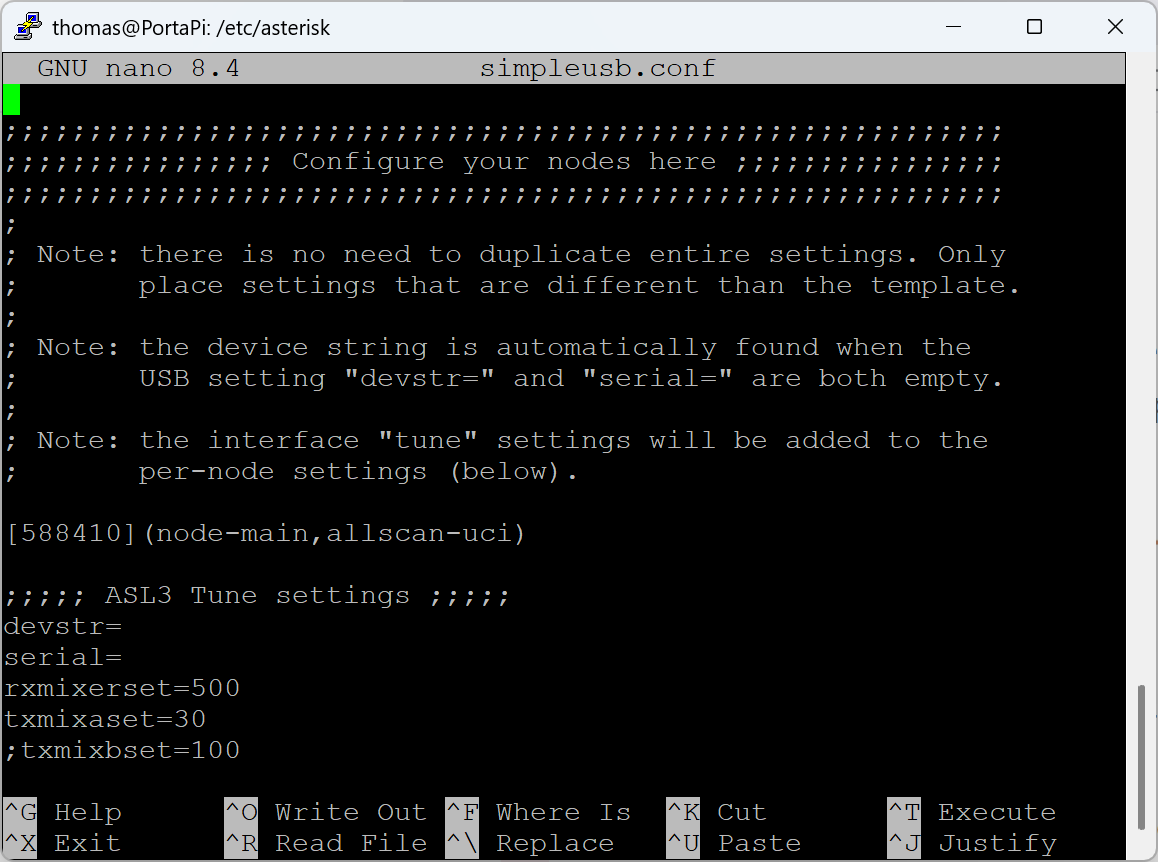
In AllStar, TX and RX audio levels are set in /etc/asterisk/simpleusb.conf. It's somewhat counterintuitive: the audio you hear is set on the TXMIXASET line, and the audio you transmit is set on RXMIXASET. I worked my way down from the default of 500 — tried 400, 300, 100, 50. Still too loud. At 40, still too loud. At 30, clear and comfortable. Below 30, no output at all. So 30 it is.
The package also included an acoustic tube earbud. I normally skip those — never liked how they feel — but tested it anyway. Surprise: barely any audio at 30. Cranked TXMIXASET back to 500 and got excellent, clear audio at a comfortable level. Pro tip: if the standard earbud is too loud, try the acoustic tube before fiddling with the config. Also, if you're getting static, try rotating the plug slightly in the PTT housing.
2 Pin Earpiece M1 Ear Piece Headset Ptt Mic to 3.5mm Aux Audio Earphone for Motorola cp100 cls1410 gp300 cp200d bpr40 CLS 1110 1410 cp185 dlr1060 rdm2070d dlr1020 rmu2040 rdu4100 dtr700 (this is an affiliate link)
This device has only 3.1 stars on Amazon, but from a sample of seven reviews. I thought it was worth the gamble at around $20. I’d give it 3.5 stars myself — maybe 4 if it proves durable. It does exactly what I needed: a way to monitor and participate in AllStar conversations through the UCI80M.
Fair warning: overmodulated stations really punch through when the speaker is millimeters from your eardrum. Great in a noisy environment. In a quiet room, bring TXMIXASET down.
04 Run Your Own NotebookLM — Locally
If you’ve used Google’s NotebookLM, you already know the appeal: drop in a document, ask questions, get answers grounded in your actual source material rather than whatever the model feels like inventing.
Open Notebook is the self-hosted version of that idea. Same workflow — upload PDFs, web pages, or documents, chat with an AI about the content, generate notes and summaries — but running entirely on your own hardware, with your choice of AI provider. It supports Ollama, so if you’re already running local models, you’re most of the way there.
I spun it up in a morning in an LXC container on my Proxmox server, pointed it at my existing Ollama instance, and had it ingesting a budget document within the hour. The install is Docker Compose — two containers, a config file, and you’re done.
The Open Notebook project is at github.com/lfnovo/open-notebook. If you’ve got a home lab and you’ve been curious about NotebookLM but prefer keeping your documents off Google’s servers, this is worth your time.
05 Digital Radio News Digest
Digital radio news is a bit light this week.
Recent developments in amateur radio digital voice and VoIP linking modes include updates to AllStarLink, with improvements to QSO One stability and the introduction of YAAMon, a new AllStarLink monitor. The MMDVMHost repository has also seen an update, and the app_rpt repository has received several commits, including fixes for call failures and additions to non-blocking PTT kick pipes. The Amp-ASL amp-server repository has been working on a custom Pi image to streamline installation.
06 Band Conditions This Week
With a solar flux of 144 and a sunspot number well into the triple digits, the higher HF bands are in fine shape right now — 10 through 20 meters should reward anyone willing to spin the dial, and DX contacts are well within reach. Today’s K-index of 1 points to quiet, stable conditions, but don’t let that lull you into thinking it’s been a smooth week; a max K of 4.3 tells us the geomagnetic field threw a minor tantrum at some point, likely giving the polar paths a rough go and knocking the low bands around for a stretch. If propagation felt frustrating earlier in the week, today’s the day to get back on and make up for lost time.
Solar Flux Index (SFI): 144.0 — Good — solid conditions on 10m through 20m
K-Index (current): 1.0 — Quiet — excellent conditions
K-Index (7-day max): 4.3 — Minor storm — HF disruption likely
A-Index: 42 — Minor storm (predicted)
Sunspot Number (NOAA/USAF daily): 211
Sunspot Number (SIDC daily EISN): 149
Active Solar Regions: 14
Source: NOAA Space Weather Prediction Center (swpc.noaa.gov) + SIDC (sidc.be)
Generated: 2026-06-04 21:03 UTC
07 Radio History
Sixty-three years ago this week, radio amateurs put their second satellite into orbit.
OSCAR 2 lifted off from Vandenberg Air Force Base on June 2, 1962, riding piggyback as ballast on a Thor-Agena B rocket carrying a classified military reconnaissance satellite. The irony is hard to miss — while the Air Force was running a spy mission, a group of volunteer hams had quietly hitched their homebuilt spacecraft along for the ride.
OSCAR 2 was nearly identical to OSCAR 1, which had launched just five and a half months earlier in December 1961. The team had learned from the first flight. They adjusted the thermal coatings to keep temperatures lower inside the spacecraft, tweaked the temperature-sensing system to get better data as the batteries aged, and dropped the transmitter power from 140 mW to 100 mW to stretch battery life. The satellite operated for 18 days before going silent, re-entering the atmosphere on June 21.
What’s remarkable isn’t the hardware — it was a simple battery-powered beacon in a metal box — it’s what it represented. By June 1962, amateur radio operators had already placed two satellites into orbit, making them among the earliest civilian participants in the Space Age, arriving only four years after Sputnik. That Project OSCAR lineage runs in a direct line to today’s AMSAT satellites, CubeSats, and the ARISS station aboard the ISS.
Not bad for a bunch of volunteers working on weekends.
08 Short Stack
Digital Radio
The Iconic aprs.fi App Finally Lands on Android! — “If you are an APRS enthusiast, a portable HF operator, or an automation geek, this is arguably the biggest software drop of the year.”
Empower Your Emergency Communications with ACK Off Grid Server — “The ACK Off Grid Server presents a transformative solution for emergency communications, catering specifically to amateur radio operators and emergency response teams.”
Discover Graywolf: The Ultimate APRS Station Software — “Graywolf emerges as a revolutionary all-in-one APRS station software, combining multiple functionalities into a single, user-friendly interface.”
What Is FT8 and How Does It Work? — “FT8 is a digital ham radio mode designed for making reliable contacts using extremely weak radio signals.”
APRStac: A Modern APRS Suite in a Single Binary — “APRStac is an APRS web client, digipeater, I-Gate, BBS, fileshare host, email gateway, and multi-protocol bridge developed by KN4MKB under the ModernHam project.”
SDR
How to Listen to Aircraft with an SDR — “This guide will walk you through everything you need to know to start listening to aircraft using an SDR.”
LoRa
When Amateur Radio Meets Search and Rescue: LoRa APRS in the Search for Missing Hiker Jaslinda — “As search and rescue teams worked tirelessly to locate missing hiker Jaslinda Saludin, technology from the amateur radio community became part of the operation. Members of the Cameron Highlands Amateur Radio Club supported the effort by providing LoRa APRS tracking devices…”
Antennas
Should You Disconnect Your Antennas During Thunderstorms? — I do. “If a thunderstorm is close enough that I can hear thunder, I disconnect my antennas. That practice is common among experienced ham radio operators and shortwave listeners alike.”
Ham Radio Tech: Do Nearby Metal & Trees Significantly Affect Antennas? — “Radio waves don’t exist in isolation. Every antenna interacts with its environment. Houses, gutters, vehicles, power lines, aluminum siding, steel towers, wet leaves, and even your neighbor’s rusty trampoline all become part of the antenna’s ‘neighborhood.’”
Gadgets
HRWB 264 - Gadgets For The Shack With Randy Hall K7AGE — There are plenty of gadgets listed in the show notes, and as always, the Ham Radio Workbench podcast is a great time.
AI
NotebookLM finally has an open-source rival, and I’m hooked — “Open Notebook is a project by developer Luis Novo, available freely on GitHub. It does what NotebookLM does. You upload sources, chat with them, ask questions, generate summaries, and even make podcasts.”
Engineer builds AI laser defense system that wiped out every mosquito in his home — My first thought was: what could go wrong? “A computer vision specialist has built a system that uses deep learning and a laser-based targeting setup to hunt down mosquitoes. Steven Cheng, who works in computer vision and robotics, documented the project as he developed what he calls "the ultimate mosquito killer," turning a simple household annoyance into an engineering challenge.”
Security
Your Android phone is already a security key and most people never turn it on — I just don’t know about this. We are so dependent upon our phones that they are becoming single points of failure in our lives. Making my phone my security key? I just don’t know.
09 Privacy-Focused Document Software
Do you need an alternative to Microsoft 365 or Google Workspace? If so, you’ve probably looked at LibreOffice and OnlyOffice, or maybe Nextcloud. These are document creation and editing packages, sometimes self-described as content collaboration systems.
Something new is on the near horizon: Euro-Office. This software is based on OnlyOffice but comes with a consortium of vendors backing it. It is being updated for the European market with an initial release date of June 9.
Euro-Office doesn’t have the email offering that draws people to M365 or GW. However, it appears that Office.EU will combine Euro-Office and email into a Europe-focused suite, compliant with GDPR and avoiding the U.S. Cloud Act (but I’m not a lawyer, so don’t bank on this conclusion). If all that sounds attractive to you — and it kind of does to me! — head over to https://office.eu/.
If privacy-centered software is your cup of tea, you may also want to think about where your website is hosted. Hetzner, based in Germany, is an affordable option with a solid reputation.
10 If I Win the Lottery: Coffee, Curiosity, and Radio
I’ve often thought: if I win the lottery, I’ll build a clubhouse for my local amateur radio club. It would be great to have a space with different operating stations, maybe some workspaces for making and repairing gear, and since we’re hams: coffee — lots of coffee.
This is purely a thought experiment. As I’ve pondered this, I’ve started to wonder if this might be a way to attract new people into the hobby: a coffee shop with amateur radio operating stations. Certainly the local hams would visit, so we’d often have licensed, experienced people available. But would younger people visit? Maybe — if it was positioned as a coffeehouse where makers and radio operators were doing things with hardware and software and radio waves.
Is that enough of a draw? I don’t know. I do know it’s different than what I hear in conversations about attracting people to the hobby. Clearly, what brought licensed hams into the community over the years has varied. Service in the military is one group of people. Silicon Valley folks another. I’m a Sputnik/Apollo kid, so NASA and hearing radio coming to Earth live from space was a big deal for me. Later, we’ve seen preppers getting licensed.
People in each of these groups saw amateur radio as something they could use to do something with. And for most of them, worldwide communication was not something they carried around in their pocket. That has changed. Getting connected is no longer the draw — the smartphone solved that problem decades ago, and younger generations have never known a world without it.
But maybe, just maybe, connecting locally over a cup of coffee in a tech-oriented space would pull the curtain back on this mysterious thing called amateur radio, at least for some people.
Will I ever do this? I would have to buy lottery tickets, and that’s something I almost never do. But if I did, and if I won, I think creating a radio maker space with coffee would be a grand thing to do. The best part: I’d never run out of coffee.
11 QRT: End Transmission
New Mini PC by HP
HP announces new OmniDesk Mini PC: World’s first “AI Mini PC” with Intel Core Ultra and Thunderbolt Share — I do love me a good PC by HP. No idea how much this is going to cost (undoubtedly too much) but might be worth watching for on eBay in a few years!
The Knack
I overheard some conversation on the W6EK repeater in California about “the knack.” This brought back memories of how I would disassemble many things in my childhood…and only occasionally getting them put back together again in working order. I share this Dilbert YouTube in case you find the humor entertaining. I do.
I’m guessing that “The Knack” is a real thing. The disassembly-to-reassembly success ratio in childhood is probably a reasonable predictor of career trajectory in this great hobby of hobbies: amateur radio.
73, and remember to touch a radio every day!

Well, there goes my weekend. This issue is a long list of must reads! Fantastic stuff as always! 🤪❤️
Fantastic issue as always, thank you!
2 comments
K1 earbuds: I didn't bother with them, there are numerous K1 to M1 adapters available (like on amazon), i had one already for my BTECH UV-Pro. The common K1 sets work perfectly with he adapter. Example
https://www.amazon.com/BTECH-GMRS-PRO-Enhanced-Accessory-Compatibility/dp/B0BKQY24RW/ref=sr_1_3_pp?crid=1VOYN90TBZVWS&dib=eyJ2IjoiMSJ9.KM_cefcGkdLUrFJo-XdpagkhIJ056QS1oZgBUgeqb2btbikTsCBMWceYppMX9GtgL2p3Du8Cogs4GKedwfi_B9EEqNjHbA12qovZnSuGvZjQa8clzmBl-iIEaZA8QfYYCfWciUUCmKa9hts1ZItqwQ.Xi4FKvmA-RnAOh4YhXLpciYBggmo_BnJr9h3ztZkvCA&dib_tag=se&keywords=m1+to+k1+adapter&qid=1780683141&sprefix=m1+to+k1%2Caps%2C168&sr=8-3
NotebookLM: depending on your privacy stance, you really have to be a glutton for punishment to run the local version, enough said ...... If you are loading up a bunch of user manuals or other public docs, i don't see what the big fuss is ....... i would hazard that this is the 80-20% use case
73 de ws1m
Bammi